SCM to Reflect North Korean Nuclear Situation in Operational Plans
Scheduled to Begin During Next Year's UFS Joint Exercises
As North Korea's nuclear threats directed toward the south become more overt, South Korea and the United States are set to begin full-scale efforts to incorporate scenarios of North Korea's nuclear use into their operational plans.
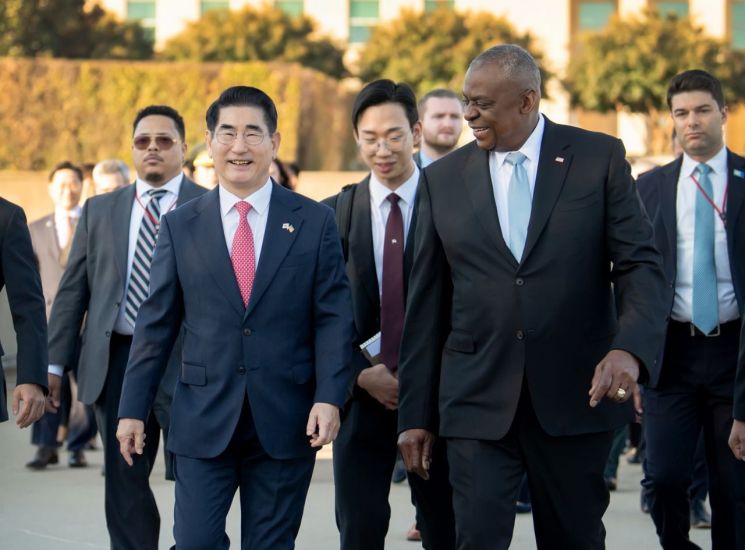 On the 30th (local time), at the U.S. Department of Defense (Washington D.C.), Defense Minister Kim Yong-hyun (left in the photo) and U.S. Secretary of Defense Austin (right in the photo) met for the 56th Security Consultative Meeting (SCM) between Korea and the U.S. Photo by Yang Nak-gyu
On the 30th (local time), South Korean Minister of National Defense Kim Yong-hyun and U.S. Secretary of Defense Lloyd Austin held the 56th Security Consultative Meeting (SCM) near the Pentagon in Washington, D.C., where they discussed these matters. In a joint statement, the two ministers announced, "Future joint exercises will include realistic scenarios that encompass responses to North Korea's nuclear use." Although not explicitly stated, this passage is interpreted as an intention to reflect North Korea's nuclear use situations in operational plans.
Joint exercises are conducted based on operational plans. Until now, North Korea's nuclear use scenarios were not incorporated into operational plans, so joint exercises could not simulate such situations. There is a reason why North Korea's nuclear use was not reflected in operational plans: the basic premise has been to respond based on the U.S. extended deterrence, even in the face of nuclear threats.
The detailed plan established by South Korea and the U.S. is called Operational Plan (OPLAN) 2022. OPLAN 2022 is subdivided into detecting signs of North Korean nuclear use, deterring and preventing nuclear use, and responding in case of a nuclear attack, but it only covers situations prior to a nuclear attack. This year's training practiced procedures to detect signs of nuclear weapon use through various intelligence means such as reconnaissance satellites, HUMINT (human intelligence), and SIGINT (signals intelligence), and to employ all measures including diplomatic means to prevent use.
Operational plans are top-secret military operation plans assuming wartime on the Korean Peninsula, and since South Korea's wartime operational control authority lies with the ROK-U.S. Combined Forces Command, the operational plans also fall within the authority of the Combined Forces Command. The authority to use U.S. nuclear weapons rests solely with the U.S. President and cannot be exercised by the Combined Forces Commander. Therefore, operational plans such as "responding to North Korea's nuclear attack with nuclear weapons" could not be established. Accordingly, extended deterrence based on the use of strategic weapons decided by the U.S. President has formed the foundation of the posture to prepare for the possibility of North Korea's nuclear use.
However, a government official stated that the situation has changed as North Korea has begun to make overt threats suggesting it could use nuclear weapons in a preemptive strike. Since the SCM joint statement did not specify a timeline but used the term "in the future," the incorporation of North Korea's nuclear use scenarios into operational plans is expected to proceed over the long term.
As the first step, a Ministry of National Defense official explained that at the 4th NCG (Nuclear Consultative Group) meeting scheduled for December, a draft concept of nuclear and conventional integration (CNI) will be prepared, followed by a CNI tabletop exercise (TTX) during the Ulchi Freedom Shield (UFS) joint exercise around August next year. CNI refers to integrating U.S. nuclear and South Korea's advanced conventional forces for operation, but there is currently no clear concept on how to implement this on the Korean Peninsula. Therefore, the plan is to clarify the concept of CNI on the Korean Peninsula, prepare military options that can be used for CNI, and conduct a tabletop exercise during UFS.
Since many personnel already participate in UFS, the idea is that conducting the CNI tabletop exercise as part of the larger exercise will allow for a more extensive implementation. Additionally, since UFS is conducted based on existing operational plans, it offers the advantage of being able to outline the next operational plan that reflects North Korea's nuclear use scenarios.
At the 2021 SCM, South Korea and the U.S. agreed in a joint statement to "modernize operational plans" in response to North Korea's nuclear and missile advancements. Considering North Korea's increased provocative capabilities now, a more significant change in operational plans than the concept three years ago is expected. The current SCM joint statement includes language about incorporating CNI into operational plans, stating, "We will continue to make rapid progress on NCG tasks such as South Korea's conventional support for U.S. nuclear operations through ROK-U.S. CNI."
South Korea and the U.S. also mentioned "realistic scenarios including responses to North Korea's nuclear use." This is interpreted as suggesting that operational plans may also reflect considerations for various forms of gray zone provocations, not just nuclear use by North Korea. As part of strengthening extended deterrence, the joint statement proposed "increasing the frequency and regularity of strategic asset deployments."
Secretary Austin noted in the statement that the regular deployment of strategic assets "is a visible demonstration of the U.S. commitment to the defense of the Republic of Korea." This is interpreted as a reaffirmation that the U.S. extended deterrence commitment will continue regardless of domestic political situations in the U.S.
Expressions traditionally included in SCMs, such as welcoming the conclusion of the Special Measures Agreement on defense cost-sharing and maintaining the current level of U.S. forces in South Korea, were also highlighted at this SCM held one week before the U.S. presidential election.
© The Asia Business Daily(www.asiae.co.kr). All rights reserved.
![Clutching a Stolen Dior Bag, Saying "I Hate Being Poor but Real"... The Grotesque Con of a "Human Knockoff" [Slate]](https://cwcontent.asiae.co.kr/asiaresize/183/2026021902243444107_1771435474.jpg)















