'2025 Hanguk Economy Outlook' Publication Commemorative Meeting
"Inflation Pressure Increases if Trump Wins US Presidential Election"
"The paradigm of semiconductor production is shifting from mass production of a few items like DRAM to customized production of various types such as artificial intelligence (AI) chips and high-bandwidth memory (HBM), but it seems Samsung Electronics has missed that trend. SK has caught that change. Due to such structural problems, significant difficulties are beginning for (Samsung Electronics)." (Lee Geun, Distinguished Professor, Department of Economics, Seoul National University)
"The global semiconductor market is quite good, but Samsung Electronics is not doing well. Currently, AI is leading the semiconductor market, and I think a major factor is that Samsung Electronics has not entered the ecosystem led by Nvidia. Since this is a problem that cannot be solved in the short term, the current situation is likely to persist next year as well." (Lee Dong-jin, Associate Professor, Department of Economics and Finance, Sangmyung University)
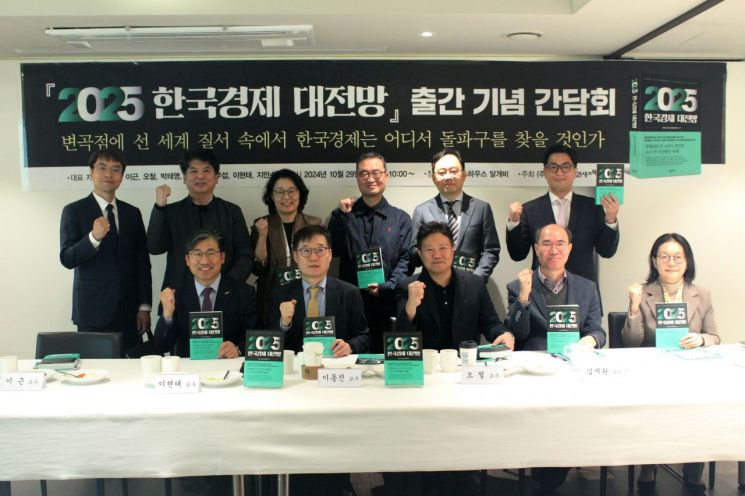
Recently, numerous diagnoses about the crisis at Samsung Electronics have emerged. This was at a press conference for the publication of '2025 Korean Economic Outlook (21st Century Books)' held on the 29th at a restaurant in Jongno-gu, Seoul. The 2025 Korean Economic Outlook is a book in which 33 domestic economic experts forecast the domestic and international economy for next year and explore ways to overcome crisis situations.
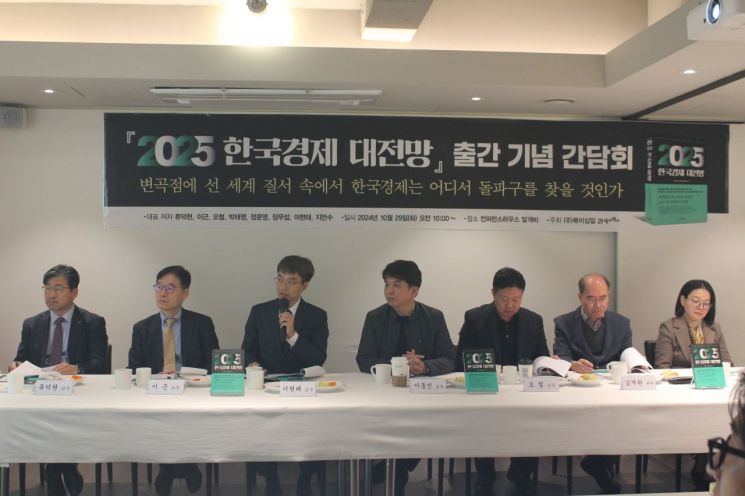
The authors presented the idiom "dong-sang-i-mong" (same bed, different dreams) as a key phrase related to the global economic outlook for next year. They emphasized that countries such as the United States, which seeks to protect its own industries, and China, which aims for technological self-reliance and control of global supply chains, will prioritize their own interests, and Korea must work tirelessly amid the rapid changes in the global economy. Furthermore, they identified three key issues to watch carefully in the Korean economy next year: recovery of the semiconductor market and continuation of automobile exports, recovery of consumption and escape from sluggish domestic demand, and political-economic changes in the U.S. and recovery in China.
Distinguished Professor Lee Geun diagnosed that although Korea had benefited from the U.S.-China conflict structure in the semiconductor industry, even that expectation is now fading.
"There was a side where Korea gained time and benefited as the U.S. restrained China's pursuit. Now, the U.S. has not been able to completely block China's chase. China continues to pursue DRAM and has specialized in HBM, which does not require extreme ultraviolet (EUV) processes. Samsung Electronics is not achieving results in the non-memory sector and is being chased in DRAM as well."
Regarding the U.S. presidential election, the authors focused on the possibility of Donald Trump returning to power. They predicted that if Trump is elected, inflationary pressures will increase, reducing the likelihood of the Bank of Korea lowering its base interest rate.
Distinguished Professor Lee Geun said, "If Trump is elected, various inflation factors will increase due to anti-immigration policies and tariffs, reducing the reasons for (the Bank of Korea) to lower the base interest rate. In a globally strengthened protectionist environment, both domestic demand and exports could face unfavorable situations."
Associate Professor Heo Jun-young of Sogang University’s Department of Economics also emphasized that "the moment Trump was elected in the 2016 presidential election, the yield on the U.S. 10-year Treasury bond jumped sharply for 30 minutes," highlighting that Trump's election means rising inflationary pressure.
"Trump keeps saying that low interest rates are good, but his fundamental policy stance inevitably leads to rising interest rates. This will certainly be a burden for the Bank of Korea, and I believe the Bank of Korea is fully considering that part."
Some in the economic community argue that the Bank of Korea should have already cut interest rates but missed the timing. In response, Professor Lee Dong-jin disagreed with the criticism of the Bank of Korea’s delay, citing household debt issues.
"Household debt is a situation that cannot be ignored. When the real estate market enters a downturn, it can place an enormous burden on our financial system. The Bank of Korea is carrying that burden and must consider when to raise interest rates. From the Bank of Korea’s perspective, it will try to delay it as much as possible for now."
The authors emphasized that in a challenging domestic and international environment, the government’s role is truly important and that there is a need to change policy direction and respond actively.
© The Asia Business Daily(www.asiae.co.kr). All rights reserved.
![Clutching a Stolen Dior Bag, Saying "I Hate Being Poor but Real"... The Grotesque Con of a "Human Knockoff" [Slate]](https://cwcontent.asiae.co.kr/asiaresize/183/2026021902243444107_1771435474.jpg)
















