Major Domestic Importers Chile's Top Brands
White No.1 Nara Sella 'Montes Chardonnay'
Red No.1 HiteJinro 'View Maren Cabernet Sauvignon'
In a blind tasting of representative Chilean wines conducted among major domestic wine importers, Nara Sella's 'Montes Alpha Chardonnay' and HiteJinro's 'Viu Manent Cabernet Sauvignon' showed the highest preference.
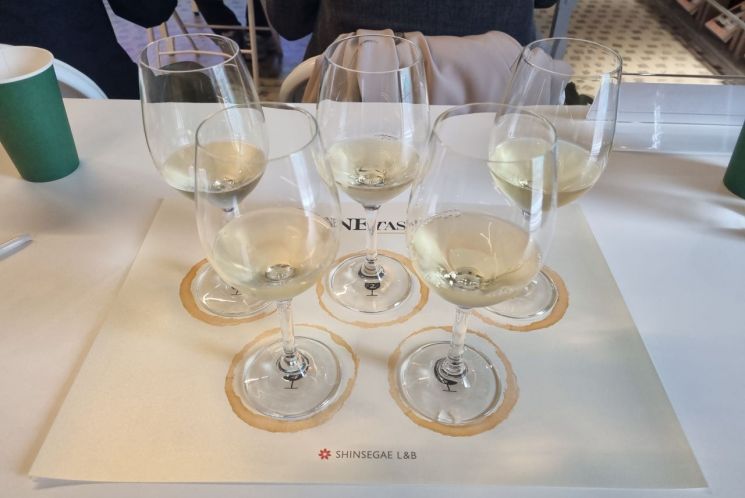
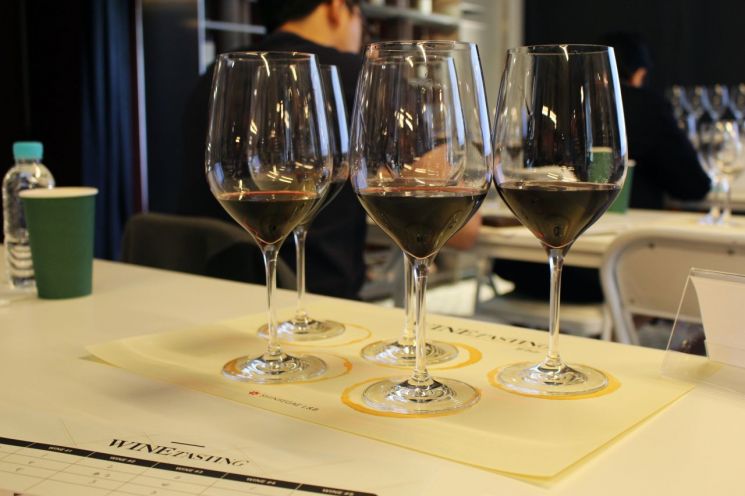
On the afternoon of the 29th, Shinsegae L&B held a 'Chilean Wine Blind Tasting' for the media at Down Space in Sinsa-dong, Gangnam-gu. This blind tasting featured a total of 10 wines, five white and five red, from major domestic importers' representative Chilean wine brands, including Shinsegae L&B's 'G7', Geumyang International's '1865', Ayoung FBC's 'Errazuriz', Nara Sella's 'Montes', and HiteJinro's 'Viu Manent'.
Who is the Best Value-for-Money Chilean Wine?
 Sommelier Jinsu Kim from the Product Planning Team at Shinsegae L&B is explaining about Chilean wine.
In the white wine blind tasting conducted with the Chardonnay variety, Nara Sella's 'Montes Chardonnay' received the highest score. It was followed by Ayoung FBC's Errazuriz Max and HiteJinro's Viu Manent. In the red wine session that followed, tasting was conducted with the Cabernet Sauvignon variety, where HiteJinro's Viu Manent ranked first, followed by Montes Alpha and Errazuriz Max.
Kim Jin-su, sommelier of Shinsegae L&B's product planning team, who led the event, said, "The Chilean wine region benefits from exceptional natural conditions and low production costs, allowing wines to be offered to consumers at good prices," adding, "When comparing wines at the same price point, there is virtually no other production region that can compete with Chilean wines in terms of quality." He added, "However, as a latecomer, Chilean wines have a relatively short history of winemaking and less prestige, which acts as a weakness."
The Chilean wine region has a mild Mediterranean climate, roughly intermediate between France's Bordeaux and the United States' Napa Valley. The abundant sunlight during the growing season is suitable for grapes to fully ripen, and the dry climate reduces the likelihood of fungal diseases, promoting active organic grape cultivation. Although summer temperatures in Chile can exceed 30 degrees Celsius, the premium wine regions experience significant diurnal temperature variation due to cold night air descending from the Andes Mountains. This results in wines characterized by rich concentration and acidity.
Like other New World wine regions, Chile mainly cultivates French grape varieties, with red grapes accounting for about three-quarters of total plantings. Among red grapes, Cabernet Sauvignon holds the largest share at about 30%, followed by Merlot and Carmenere. Among white grapes, Sauvignon Blanc is the most widely planted.
The wines presented in this blind tasting were of the Gran Reserva grade. In Chile, Gran Reserva generally refers to wines with at least 1% higher alcohol content than the minimum standard, distinctive flavors, and oak barrel aging. However, unlike Old World wine-producing countries such as France, which have strict and clear quality grading systems, New World countries like Chile have relatively loose grading regulations, making the meaning somewhat ambiguous. Therefore, it is advisable to understand these grades as indicators of the quality level of various wines produced by winemakers.
Love for Chilean Wine in Korea Will Continue
This blind tasting was held based on the judgment that expanding demand for Chilean wine could serve as a catalyst for the overall wine market rebound amid a recent slowdown in the domestic wine market. The domestic wine market, which has grown rapidly in recent years, is advancing premiumization alongside quantitative growth. However, even amid this trend, Chilean wines remain the best choice for consumers seeking value for money due to their reasonable price and quality.
In fact, most major wine importers consider Chilean wine brands as a core part of their portfolios. This is because there are few wines that can compete with Chilean wines as entry-level or daily wines. Looking at the country-specific portfolio of Nara Sella, the only listed domestic wine importer, Chilean wines accounted for about 16% of sales in the first half of this year. This ranks third after the United States (40%) and France (20%). Considering that Nara Sella is the largest importer of American wines, this is a considerably high figure, suggesting the proportion and importance of Chilean wines in wine importers' portfolios.
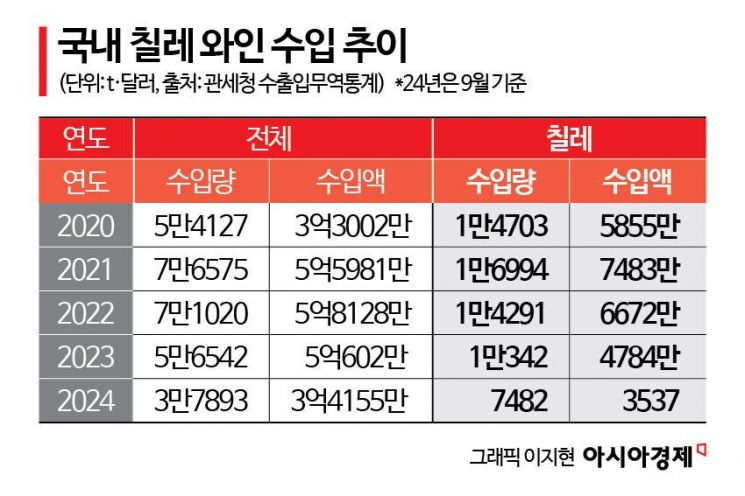
This trend is also reflected in actual import statistics. According to customs export-import trade statistics, as of September this year, domestic imports of Chilean wine totaled 7,482 tons. This accounts for 19.7% of the total import volume of 37,893 tons during the period, ranking first among countries by import volume. Although the import value showed a gap compared to France, the wine-producing country, with $130.27 million, Chile recorded $32.99 million (about 46 billion KRW), ranking behind the United States ($58.37 million) and Italy ($56.03 million), making it one of the most popular wine-producing countries among Koreans.
The industry expects Chilean wine to continue its growth as it maintains price competitiveness while steadily improving quality. A Nara Sella official said, "It is true that Chilean wine, once perceived as a value-for-money wine, experienced a slight slowdown as demand for premium wines increased recently," adding, "However, Chilean wine is steadily advancing in premiumization and securing competitiveness, so it is expected to firmly establish itself as one of the categories of premium wines in the rapidly changing market."
© The Asia Business Daily(www.asiae.co.kr). All rights reserved.
![Clutching a Stolen Dior Bag, Saying "I Hate Being Poor but Real"... The Grotesque Con of a "Human Knockoff" [Slate]](https://cwcontent.asiae.co.kr/asiaresize/183/2026021902243444107_1771435474.jpg)

















