Top Performer in Returns Over the Past Month
Further Increase 'Questionable'
"Need to Confirm Improved Economic Indicators"
The returns of China-related exchange-traded funds (ETFs) have been showing strong performance. This is interpreted as being influenced by the Chinese government's continued implementation of economic stimulus measures.
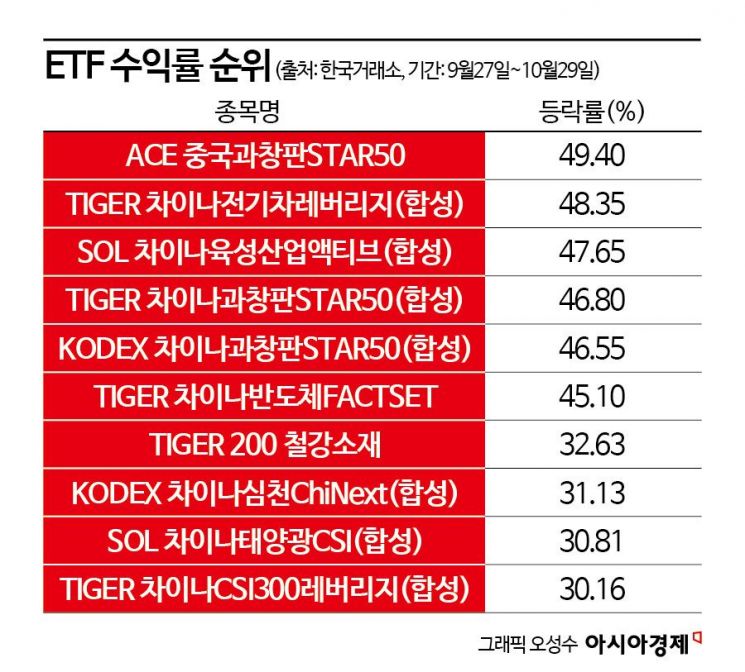
According to the Korea Exchange on the 30th, from the 27th of last month to the day before, the ACE China STAR Market STAR50 posted a return of 49.40%, ranking first among ETFs listed domestically. Following were TIGER China Electric Vehicle Leverage (48.35%), SOL China Growth Industry Active (47.65%), TIGER China STAR Market STAR50 (46.80%), KODEX China STAR Market STAR50 (46.55%), and TIGER China Semiconductor FACTSET (45.10%), all China-related ETFs occupying the top ranks in returns.
This upward trend is interpreted as being influenced by expectations for the Chinese government's economic stimulus measures. Since the end of last month, China has introduced various monetary and fiscal policies. The People's Bank of China announced various policies including lowering the reserve requirement ratio (RRR) and reducing the loan prime rate (LPR), which serves as the benchmark interest rate.
Additionally, the National Development and Reform Commission and the Ministry of Finance of China indicated proactive fiscal policies such as a 200 billion yuan (approximately 38 trillion KRW) investment plan and the issuance of special government bonds. Along with this, they announced various stimulus measures including expanding the 'whitelist' loans supporting real estate companies to 4 trillion yuan (approximately 766 trillion KRW) by the end of the year and renovating an additional one million old houses.
Due to these stimulus measures, the benchmark CSI300 index, composed of the top 300 stocks by market capitalization on the Shanghai and Shenzhen stock exchanges, rose from 3,171.010 on September 18 to 4,256.096 on the 8th of this month. Kim Seung-hyun, ETF Consulting Manager at Korea Investment Trust Management, explained, "This is interpreted as being influenced by the Chinese monetary policy and the government's strong commitment to proactive stimulus policies. In particular, the monetary policy showed a strong signal for the first time since 2015, and the fact that valuations have been at historically low levels over the past two to three years also played a role."
However, the CSI300 index recently slipped to around the 3,900 level. This reflected disappointment over the previously announced real estate stimulus measures. The financial investment industry advises that improved economic indicators are necessary for the upward trend to continue.
Manager Kim said, "In the short term, there is a possibility of further gains, but in the long term, it is still difficult to see a trend reversal to an upward trajectory. From a macro perspective, a rebound in China's manufacturing index is needed, and from an individual company perspective, a recovery in earnings through a rebound in consumer demand must be confirmed." He added, "Since major companies' earnings announcements are scheduled for mid-November, it will be important to confirm earnings rebounds at that time."
© The Asia Business Daily(www.asiae.co.kr). All rights reserved.
![Clutching a Stolen Dior Bag, Saying "I Hate Being Poor but Real"... The Grotesque Con of a "Human Knockoff" [Slate]](https://cwcontent.asiae.co.kr/asiaresize/183/2026021902243444107_1771435474.jpg)















