Expectations for University Autonomy and the Establishment of a New Higher Education System
Ruling and opposition party lawmakers have joined hands to propose an amendment to the Higher Education Act.
On the 29th, Kim Dae-sik of the People Power Party (Busan Sasang District) and Kim Jun-hyuk of the Democratic Party of Korea (Suwon City, Gyeonggi Province) jointly introduced a full revision bill of the Higher Education Act at the National Assembly Communication Hall, marking the first full amendment in 26 years since its enactment in 1998.
To promote bipartisan cooperation and cross-party collaboration, 30 lawmakers from both ruling and opposition parties also participated as co-sponsors.
The Higher Education Act had been partially amended about 50 times since its enactment, but it had limitations in fully reflecting the rapidly changing social demands and educational environment.
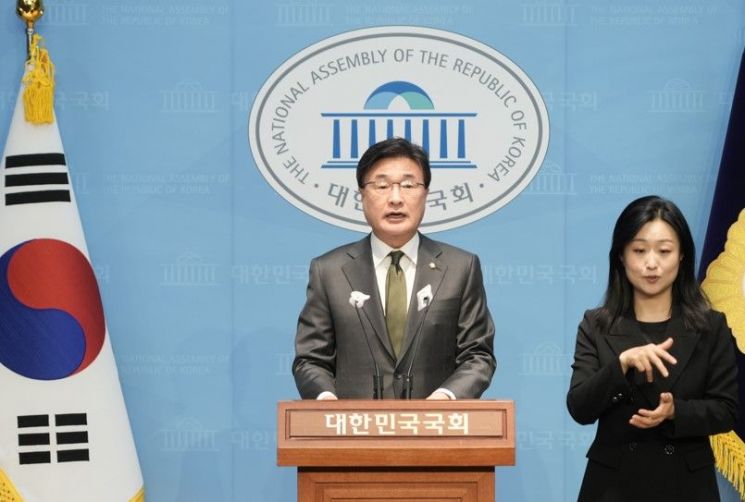 Representative Kim Dae-sik, who is the chief proposer of the comprehensive amendment to the Higher Education Act.
Kim Dae-sik of the People Power Party and Kim Jun-hyuk of the Democratic Party agreed that higher education reform, which transforms the paradigm of higher education, can begin through a full revision of the Higher Education Act.
Subsequently, by gathering various field opinions from universities and consultative bodies, they prepared a full revision bill of the Higher Education Act to guarantee university autonomy and enable universities to proactively respond to environmental changes and produce innovative outcomes.
The key points of the amendment to the Higher Education Act are fivefold: ▲ strengthening university autonomy ▲ expanding the scope of universities through a complete overhaul of the university system ▲ enhancing the role of universities and expanding support for students and others ▲ establishing a system for continuous regulation discovery ▲ creating a paradigm for co-growth between universities and local communities.
According to the amendment, first, the comprehensive supervisory authority of the Minister of Education, which had been raised as the top priority amendment task for guaranteeing university autonomy by university fields such as the Korean Council for University Education, was significantly revised.
To harmonize university autonomy and the public nature of higher education, the supervisory authority of the Minister of Education is allowed only in limited and exceptional cases involving urgent and significant public interest reasons, such as matters affecting public life and health.
In addition, matters related to academic operations, which are core to university autonomy, were completely shifted to a ‘Negative’ approach. Except for common legal provisions (academic year, duration of study, leave of absence, credit hours per course, off-campus classes, etc.), academic operations are autonomized, and common standards for academic operations are coordinated by university consultative bodies (Korean Council for University Education and Korean Council for College Education), allowing universities and consultative bodies to design and operate academic systems independently in response to social changes.
The amendment expands the eligibility for part-time enrollment to “those who wish to receive education,” enabling universities to provide excellent infrastructure and programs to adult learners or middle and high school students in the local community who wish to pursue higher education.
To enable junior colleges to actively respond to the demand for manpower in newly emerging industrial fields, the amendment abolishes the prior approval of the Minister of Education for establishing advanced major courses and professional technical master’s programs, while requiring annual disclosure of the status to ensure operational soundness.
To support the cultivation of highly skilled talents capable of solving various social problems, graduate schools with doctoral programs can establish integrated courses covering bachelor’s, master’s, and doctoral degrees. Additionally, new provisions regarding the duration of study, admission qualifications, and degree conferral for these integrated courses have been established.
Kim Dae-sik’s office pointed out that while cases of university integration are increasing as a strong innovation strategy to respond to major changes such as declining school-age populations and rapid industrial structure shifts (Big Wave), various university integration models that are difficult to support under existing laws are being autonomously proposed. The amendment provides a legal basis to support this.
To maintain competitive vocational education programs even after integration, universities merged with junior colleges can operate not only bachelor’s degree programs but also associate degree programs, advanced major courses, and professional technical master’s programs.
Furthermore, to create synergy effects based on the specialization of each campus, the amendment establishes grounds for designating and supporting integrated national universities. Previously, university integration was limited to absorption-type mergers centered on a main university, concentrating decision-making authority and resources in the main university.
Kim explained that to resolve this, when two or more national or public universities integrate and wish to be designated as an integrated national university, the amendment allows for balanced development among campuses to promote regional balanced development within the area.
Also, even if a national university and a teacher training university integrate, the teacher training university will not simply be absorbed as a college but can be designated and supported as a comprehensive teacher training university to build a superior teacher training system covering elementary and secondary education, creating synergy effects.
With the development of digital technology, acceleration of social changes, and increasing future uncertainties, society continuously demands individuals to have the ability to utilize advanced technologies and solve complex social challenges.
The amendment expands the role of universities beyond traditional education, research, and service to actively respond to these social demands by nurturing problem-solving talents who can cope with future changes and continuously supporting lifelong education. It also expands universities’ functions to act as hubs for regional development through networks such as industry.
Additionally, to strengthen support for various issues and demands students may face within the higher education system, such as welfare, career, and employment, and to support students’ successful education and social advancement, the amendment newly establishes grounds for student support.
Regions face the dual challenges of low birth rates and youth population outflow, and regional universities are also struggling due to declining school-age populations and financial difficulties. It is a critical time to secure competitiveness across all areas of education, jobs, and culture in the region through systems that improve the quality of regional higher education, reduce educational disparities between regions, and better respond to the educational needs of local communities, with cooperation between the state and local governments.
Accordingly, the amendment establishes grounds for co-growth between regions and universities by requiring the state and local governments to formulate policies to activate region-centered university support systems and by establishing regional innovation university support committees and university-region co-growth support committees to deliberate on regional higher education development.
Kim Dae-sik said, “In this era of great transformation, the existing standardized and uniform higher education system can no longer sustain growth as before. There is a consensus between ruling and opposition parties to strengthen university autonomy and build a new higher education system,” adding, “We expect universities to play an innovative role contributing to future society.”
© The Asia Business Daily(www.asiae.co.kr). All rights reserved.
![Clutching a Stolen Dior Bag, Saying "I Hate Being Poor but Real"... The Grotesque Con of a "Human Knockoff" [Slate]](https://cwcontent.asiae.co.kr/asiaresize/183/2026021902243444107_1771435474.jpg)
















