Accumulating Hundreds of Millions of Data Points per Flight
Conducting 'Predictive Maintenance' to Forecast Defects in Advance
Exterior Inspections with Unmanned Drones... Time Reduced by 60%
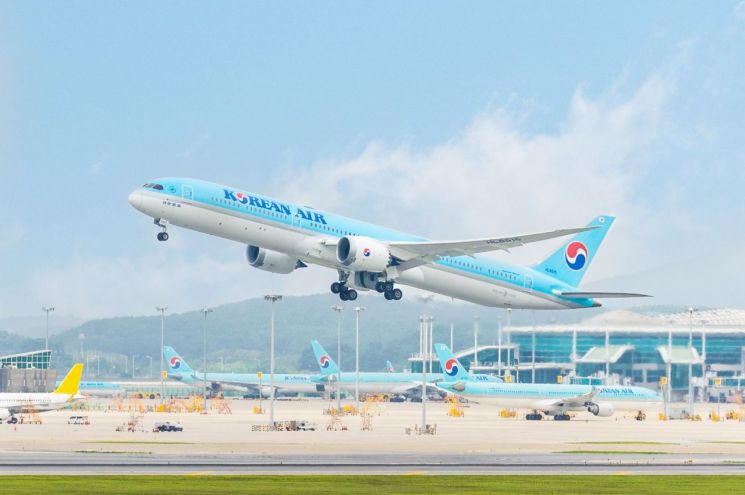
Korean Air is focusing on aircraft maintenance business utilizing artificial intelligence (AI)-based big data analysis and drones.
According to the industry on the 30th, Korean Air is promoting such a 'smart MRO (Maintenance, Repair, and Overhaul)' business. First, Korean Air is actively utilizing data collected from aircraft. Each aircraft is equipped with about 2,500 sensors. Assuming each sensor generates one data point per second, a flight on a transpacific route lasting 13 hours one way produces over 100 million data points per flight. In fact, the data produced by all aircraft operated by Korean Air amounts to an average of about 62 gigabytes (GB) per day.
The data collected by the aircraft includes everything from flight information to the operation and status information of aircraft parts. Based on this, Korean Air started 'predictive maintenance' for the first time among domestic airlines in August last year. Predictive maintenance is a maintenance method that predicts when defects will occur in aircraft parts or systems and responds proactively. It monitors the aircraft's condition in real time based on the vast amount of data collected by the aircraft to identify early signs of defects. This reduces the time and cost required for maintenance and decreases delays and cancellations caused by aircraft defects. It is considered more efficient than preventive maintenance, which replaces parts with remaining life at scheduled intervals, or corrective maintenance performed after defects have already occurred.
Korean Air introduced Airbus's predictive maintenance solution 'Skywise' in February last year. It was applied to all Airbus models owned by Korean Air, including the A220, A321neo, and A330. In July, Korean Air also signed a contract to use Boeing's digital solution 'AHM.' Additionally, solutions from manufacturers of engines and auxiliary power units (APU) have been introduced and utilized for predictive maintenance.
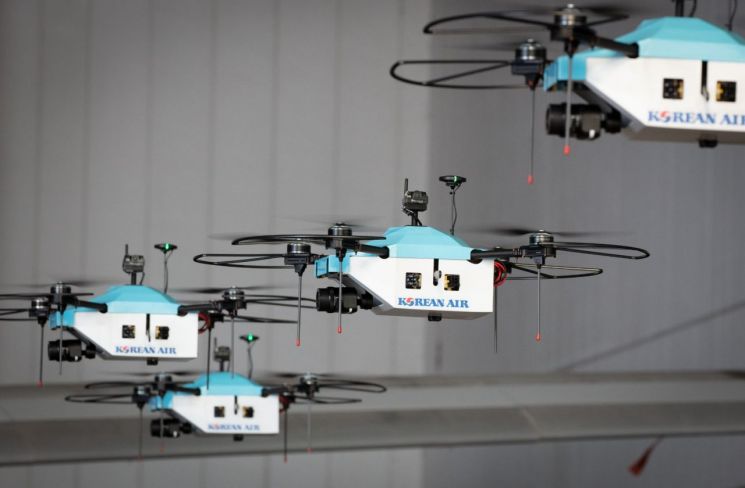
Drones are used for aircraft exterior maintenance. Previously, Korean Air Aerospace Division developed and introduced a prototype as part of the Ministry of Land, Infrastructure and Transport's inspection drone development project in 2021. Korean Air's inspection drone measures 1 meter in width and length, about 40 cm in height, and weighs 5.5 kg. Each drone is equipped with one high-performance optical 3x zoom 4K camera. This drone can continuously perform inspections for 20 minutes. Through this, the precision of fuselage exterior inspections has been improved, and the required time has been reduced by about 60%. This unmanned drone exterior inspection is the world's first. Although drones have been used to inspect aircraft fuselage exteriors before, it was done by manually controlling a single drone.
Currently, based on the experience accumulated with the inspection drones, Korean Air is developing an AI automatic defect analysis system. They are also working with the Ministry of Land, Infrastructure and Transport and other related departments and institutions to improve maintenance manuals and various systems. Korean Air plans to commercialize inspection drones in earnest starting in 2027 after completing related technology enhancements and system improvements.
© The Asia Business Daily(www.asiae.co.kr). All rights reserved.
![Clutching a Stolen Dior Bag, Saying "I Hate Being Poor but Real"... The Grotesque Con of a "Human Knockoff" [Slate]](https://cwcontent.asiae.co.kr/asiaresize/183/2026021902243444107_1771435474.jpg)

















