KCCI Analyzes Global Manufacturing Subsidies
$58.4B in 2015 → $506B This Year
"Korea Also Needs Direct Subsidy Payments"
Global manufacturing subsidies have increased nearly ninefold over the past decade, rising from 80 trillion won to 700 trillion won. There is a growing call for South Korea to maximize national interests by increasing direct subsidies for advanced industries such as semiconductors and bio.
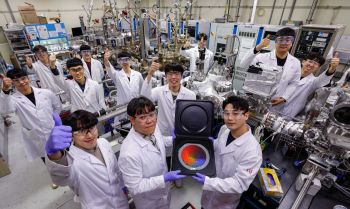 On December 20 last year, researchers from the Spin Convergence Research Group, which plays a driving role in the growth of the semiconductor industry, posed with an 8-inch semiconductor wafer produced through collaborative research with the Nano National Fusion Center (NNFC) at the Korea Institute of Science and Technology (KIST) in Seongbuk-gu, Seoul. Photo by Jinhyung Kang aymsdream@
The Korea Chamber of Commerce and Industry (KCCI) announced on the 29th that, using data from the Swiss private trade policy research institute GTA, it analyzed manufacturing subsidies worldwide and found that subsidies rose from $58.4 billion (about 80 trillion won) in 2015 to $550.2 billion (about 760 trillion won) last year, and $506 billion (about 700 trillion won) as of September this year. Based on last year’s figures, subsidies increased 9.4 times over eight years, and 8.7 times over nine years as of this year’s January to September period. The amount of subsidies could increase further by the end of the year. These figures include not only direct cash payments but also loans, guarantees, in-kind support, tax reductions, trade finance, and capital injections.
According to KCCI, subsidy payments surged after the COVID-19 pandemic. The amount increased 3.8 times from $514.2 billion (about 710 trillion won) in the five years before COVID (2015?2019) to $1.9728 trillion (about 2,700 trillion won) in the five years after (2020 to September this year).
While major countries increased fiscal (cash) subsidies, South Korea mainly implemented policies focused on financial support. By detailed type, over the past 10 years, 'government loans' accounted for the largest share at $636.5 billion (about 880 trillion won, 25.6%), followed by 'fiscal subsidies' at $586.2 billion (about 810 trillion won, 23.6%), 'trade finance' at $237.7 billion (about 330 trillion won, 9.6%), 'capital injections' at $191.2 billion (about 265 trillion won, 7.7%), and 'loan guarantees' at $107.4 billion (about 150 trillion won, 4.3%).
Fiscal subsidies increased sharply after the COVID-19 pandemic. In the five years after COVID (2020 to September this year), fiscal subsidies amounted to $499.5 billion (about 690 trillion won, 25.3%), about six times higher than the $86.7 billion (about 120 trillion won, 16.9%) in the five years before COVID (2015?2019), and accounted for the largest share among detailed types. Looking at the share by type, only fiscal subsidies increased from 16.9% to 25.3%, while government loans decreased from 38.7% to 22.2%, trade finance from 15.8% to 7.9%, capital injections from 10.9% to 6.8%, and loan guarantees from 4.6% to 4.2%.
U.S. fiscal subsidies increased 37 times from $2.8 billion (about 3.9 trillion won) in the five years before COVID to $104.8 billion (about 144.7 trillion won) in the five years after. This was largely influenced by the U.S. Inflation Reduction Act (IRA) and the CHIPS and Science Act announced in 2022. The European Union (EU) also increased subsidies 4.9 times during the same period, from $16.8 billion (about 23.2 trillion won) to $82.8 billion (about 114.3 trillion won). Countries that previously had low fiscal subsidies such as Japan ($0.4 billion to $66.5 billion), Germany ($0.5 billion to $58.4 billion), and France ($0 to $34.9 billion) also significantly increased support after COVID.
South Korea, on the other hand, showed the opposite trend. Over the past 10 years, subsidy types were led by 'trade finance' ($77.5 billion, about 107 trillion won), followed by government loans ($55.6 billion, about 76.8 trillion won), loan guarantees ($13.1 billion, about 18.1 trillion won), export support ($9.8 billion, about 13.5 trillion won), and in-kind support ($7.7 billion, about 10.6 trillion won).
Major countries increased fiscal subsidies for advanced industries such as semiconductors, bio, secondary batteries, and displays over the past 10 years. Compared to the five years before COVID, subsidies in the five years after increased 6.8 times for semiconductors ($19.7 billion to $133.2 billion), 12.9 times for bio ($7.3 billion to $94.4 billion), 3.1 times for secondary batteries ($16.8 billion to $52.3 billion), and 2.2 times for displays ($17.7 billion to $39.7 billion).
By country, semiconductor fiscal subsidies were led by the U.S. ($39.9 billion, about 55 trillion won), Japan ($30.8 billion, about 43 trillion won), China ($17.1 billion, about 24 trillion won), the EU ($13.3 billion, about 18 trillion won), and India ($10.6 billion, about 15 trillion won). The U.S. focused on attracting domestic companies through the CHIPS Act. China has been establishing investment funds since 2014 and recently announced its third fund plan. Japan, the EU, and India also implemented various subsidy policies to attract semiconductor manufacturing plants domestically.
For bio, countries such as China ($17.4 billion, about 24 trillion won), France ($14.2 billion, about 20 trillion won), and Germany ($12 billion, about 17 trillion won) increased subsidies to support vaccine development and other efforts after the COVID-19 pandemic. Secondary battery subsidies were led by the U.S. ($17.9 billion, about 25 trillion won) and the EU ($8.5 billion, about 12 trillion won). Display subsidies were led by China ($15.9 billion, about 22 trillion won), Japan ($7.4 billion, about 10 trillion won), and the EU ($6.8 billion, about 9.4 trillion won).
The Organisation for Economic Co-operation and Development (OECD) analyzed in its report "The Return of Industrial Policy" that "the recent global subsidy trend began as governments increased subsidies to respond to the economic shock caused by COVID-19," and "as geopolitical risks such as the U.S.-China conflict and the Ukraine war heightened concerns over supply chains and economic security, countries have actively engaged in subsidy competition."
Kim Hyun-soo, head of the Economic Policy Team at KCCI, said, "South Korea also needs to align with the global trend of providing direct subsidies to advanced industry companies to encourage bold investments," adding, "Since bills related to advanced industries like semiconductors have been raised as agenda items in the recently launched National Assembly Livelihood Council, we hope to derive support policies that maximize national interests from a 'national strategy' perspective."
© The Asia Business Daily(www.asiae.co.kr). All rights reserved.
![Clutching a Stolen Dior Bag, Saying "I Hate Being Poor but Real"... The Grotesque Con of a "Human Knockoff" [Slate]](https://cwcontent.asiae.co.kr/asiaresize/183/2026021902243444107_1771435474.jpg)















