People Power Party First-Term Lawmakers Study Group
Lecture on "AI and Semiconductors"
"Direct Subsidies Essential for Growth of Korean Fabless Industry"
Ko Dong-jin, a member of the People Power Party and former president of Samsung Electronics, stated on the 29th that “direct government subsidies are essential for the domestic fabless (semiconductor design specialized companies) industry to grow.”
Ko spoke as a lecturer at a study meeting for first-term members of the People Power Party held in the first conference room of the National Assembly Members’ Office Building in Seoul. He said, “It costs 10 billion won to create a single sample based on the 5nm (nanometer, one-billionth of a meter) process.” He added, “There are limits to relying solely on venture capital funding, so direct government subsidies are necessary.”
Ko mentioned, “Deputy Prime Minister and Minister of Economy and Finance Choi Sang-mok also said that he is considering direct subsidy support measures for small and medium-sized enterprises and startups,” and emphasized, “The issue of direct subsidy support must be included in the deliberation of the Industrial, Trade, Small and Medium Venture Business Committee bill.” Using the example of Taiwan’s MediaTek, he said, “Just like MediaTek, which achieved significant growth thanks to TSMC and national support, we must actively support fabless startups at the national level,” stressing, “Cooperation from the Ministry of Economy and Finance is urgently needed.”
Ko pointed out, “While China and Japan are investing huge amounts of money in the semiconductor industry, we are limited to tax support and low-interest loans.” He added, “The bill discussion related to semiconductor cluster investment was a major agenda item in consultations between the ruling and opposition policy chiefs, and there were requests for subsidy support in the livelihood consultation body.” He continued by saying that government and private sector cooperation is necessary for the growth of the semiconductor industry and asked, “I request continuous support from the members participating in the livelihood consultation body.”
Impact on Semiconductor Investment if Trump Returns to Power? “No Major Changes Expected”
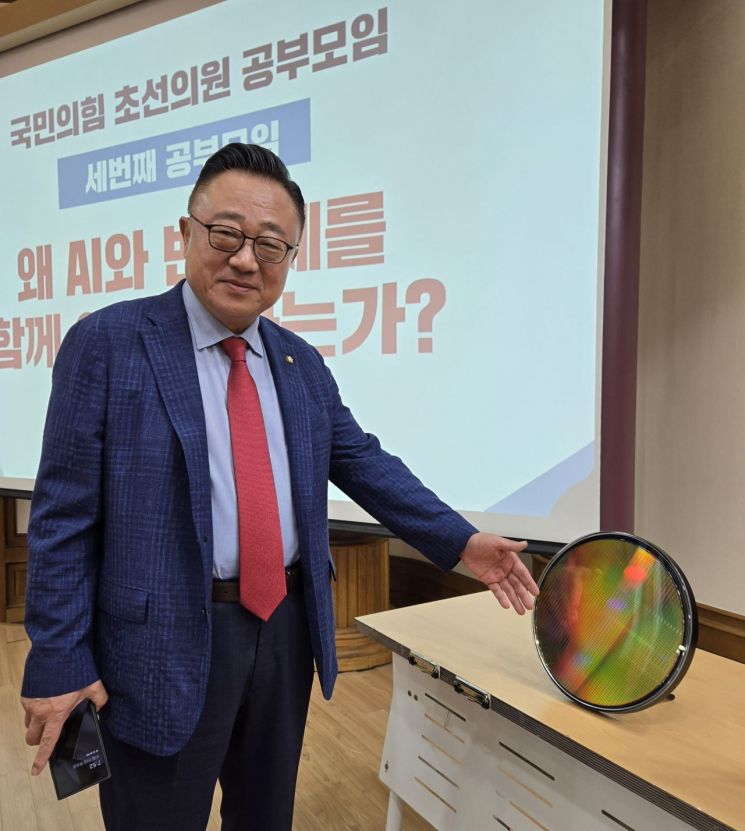 On the 29th, Go Dong-jin, a member of the People Power Party, introduced semiconductor wafers at the 1st Small Conference Room in the Yeouido Members' Office Building in Seoul. On the same day, he appeared as a lecturer for the study group of first-term members of the People Power Party and gave a presentation on AI and semiconductors. Photo by Choi Seo-yoon
Ko also commented on the possibility of changes in U.S. semiconductor investment policies if former President Donald Trump wins the U.S. presidential election.
Regarding concerns that benefits for Korean companies such as Samsung Electronics and SK Hynix’s semiconductor investments worth tens of trillions of won in the U.S. might be affected, he said, “Whether it’s the Democratic or Republican Party, the stance on sanctions against China is expected to remain consistent.” He added, “During the Trump administration, I was surprised to see cooperation with the Democrats on China sanctions while discussing 5G at the White House and State Department, even though it was a Republican government.”
Ko said, “Former President Trump has a somewhat unique style and pursues strategies based on his beliefs.” He noted, “There is an analysis that he is currently targeting the ‘shy conservative’ vote, but personally, I think that even if Trump returns to power, there will be no major changes in semiconductor investment policies such as SK Hynix and TSMC’s factory establishment or production in the U.S.” He explained, “This is because after the election, there is a high possibility of switching to a realistic policy direction.”
Samsung Foundry Market Share Gap “Will Be Overcome by Juniors”
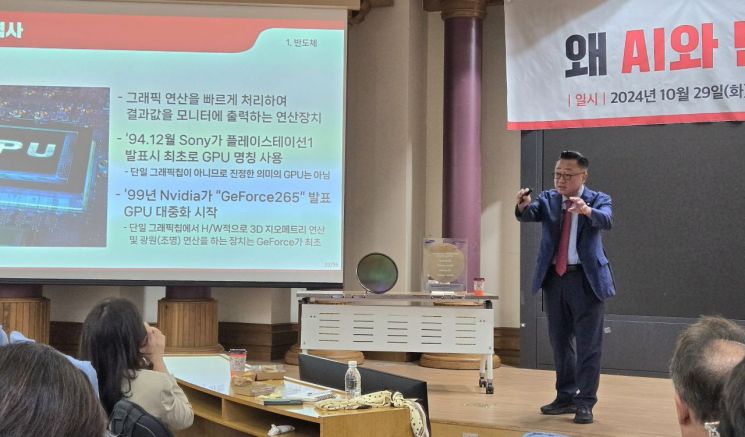
Ko also addressed the issue of Samsung Electronics’ declining foundry market share. He said, “Back in 2015, Samsung’s foundry market share was close to TSMC’s, but now the gap has widened significantly.” He added, “Samsung Electronics is paying a lot of attention to this, and I believe the juniors will overcome this field well.” He further stated, “When the U.S. restrained Japan through the Plaza Accord in 1985, Korea was able to find a new breakthrough by taking advantage of that gap. The current situation where the U.S. is restraining China can also be another opportunity for us.”
Before the lecture, Ko recalled his experience working at Samsung Electronics, saying, “Although I did not directly develop semiconductors, I personally felt the changes in the semiconductor market while being in charge of the mobile phone business for over 15 years.” He said, “Around 2013 to 2014, I witnessed the phenomenon where the proportion of central processing units (CPU) in mobile phone application processors gradually decreased while the proportion of graphics processing units (GPU) increased.” He added, “At that time, it was difficult to understand why this change was happening, and honestly, I did not expect the AI era to arrive so quickly.” Ko continued, “The potential of AI technology comes from vast amounts of data,” and emphasized, “Data is an asset, so it is important to manage it concretely.”
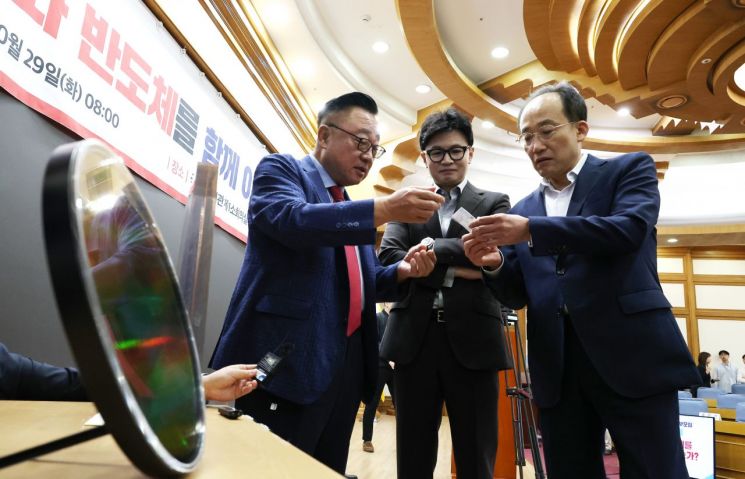 People Power Party leader Han Dong-hoon (center) and floor leader Choo Kyung-ho (right) are attending the People Power Party freshman lawmakers' study meeting titled "Why Talk About AI and Semiconductors Together?" held at the National Assembly Members' Office Building on the morning of the 29th. They are conversing with lawmaker Ko Dong-jin while examining semiconductor wafers and other items. [Image source=Yonhap News]
On this day, Ko gave a lecture titled “Why Talk About AI and Semiconductors Together” at the People Power Party’s first-term members’ study meeting. Han Dong-hoon, the party leader, Chu Kyung-ho, the floor leader, and 44 first-term members of the People Power Party attended. Ko personally prepared a 55-page PowerPoint (PPT) presentation for this lecture. One of Ko’s ideas to make semiconductors easier to explain to the members was to set up an actual semiconductor wafer model on one side of the lecture hall.
Ko joined Samsung Electronics in 1984 and served as head of the European Research Institute, head of the Wireless Business Division’s Technology Strategy Team, and head of the Wireless Business Division. From 2018 to February 2022, he served as president of Samsung Electronics’ IM Division (now MX Division). His quick response and transparent communication during the Galaxy Note7 fire incident are regarded as exemplary crisis management. Ko, who was elected in this year’s general election, is actively engaged in legislative activities related to the semiconductor industry, having introduced the “Special Act on Strengthening Semiconductor Industry Competitiveness,” which includes the establishment of the “Special Committee on Strengthening Semiconductor Industry Competitiveness” (Semiconductor Special Committee) in June as a key provision.
© The Asia Business Daily(www.asiae.co.kr). All rights reserved.



















