Conducting Baccarat with Viewer Bets
Random Exposure Driven by Algorithm
"Player Entry!"
At around 3 a.m. on the 29th, when entering a live broadcast on a YouTube channel, a casino dealer began shuffling cards. The streamer sitting across from the dealer reached out and took the cards, starting the game. The live chat was flooded with messages shouting 'All-in' nonstop. This is a YouTube channel broadcasting illegal online gambling 'Baccarat' live. After the streamer finished one round of the game, the betting amounts placed by participants, such as 5 million won and 10 million won, were displayed above the chat window.
Recently, on YouTube, so-called 'proxy gambling' content, where streamers participate in games using bets placed by viewers, has been rampant. These videos are presumed to be broadcast from casinos across Southeast Asia and have gained great popularity by providing an immersive experience as if actually participating in the game.
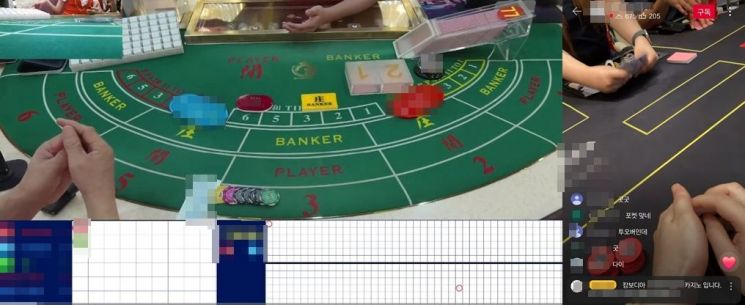 An illegal gambling proxy live broadcast, presumed to have been filmed at a casino in Southeast Asia on the 28th, is being streamed live. [Image source=YouTube screen capture]
Proxy gambling videos become even more active as it gets closer to late-night hours. In fact, at around 1 a.m. on the same day, a YouTube baccarat live broadcast attracted about 670 viewers. As the streamer broadcast baccarat live in real time and encouraged interaction, viewers responded with comments like "The game looks fun" and "I want to participate."
These videos are randomly exposed to viewers through the YouTube algorithm. Even without directly searching for or looking up illegal gambling, viewers can be exposed to these broadcasts unexpectedly and drawn in. Although the Korea Communications Standards Commission (KCSC), the regulatory and supervisory body, is making every effort to crack down, complete eradication remains difficult.
The KCSC recorded a total of 53,086 corrective action requests for illegal gambling information from early this year until last month. This number is comparable to the total corrective requests last year (55,610). The number of illegal gambling content cases requested for review by the Sports and Gambling Supervision Committee (SGSC) to the KCSC also sharply increased from 17,462 in 2021 to 37,390 last year.
Some point out that the nature of the KCSC’s review process makes it difficult to immediately block illegal content. Under current law, for gambling and other illegal content, the KCSC’s review process involves face-to-face meetings, which causes a long delay before blocking measures can be taken. This contrasts with digital sex crimes, which are reviewed electronically and take about a day on average to process corrective actions. During this delay, illegal content producers frequently change URL addresses to evade the crackdown.
The political sphere has also recognized this issue and proposed the so-called 'Illegal Site Expulsion Act,' which introduces an electronic review system for gambling content. The amendment, led by Kim Seung-su of the People Power Party, aims to immediately block illegal gambling sites and content producers from frequently circumventing addresses through continuous KCSC reviews.
A KCSC official explained, "We are making efforts to eradicate illegal gambling, including discussing cooperation measures with the SGSC on the 10th to respond to illegal gambling sites," adding, "If an electronic review system is introduced for all illegal content, the time required for corrective actions is expected to be significantly shortened compared to now."
© The Asia Business Daily(www.asiae.co.kr). All rights reserved.
![Clutching a Stolen Dior Bag, Saying "I Hate Being Poor but Real"... The Grotesque Con of a "Human Knockoff" [Slate]](https://cwcontent.asiae.co.kr/asiaresize/183/2026021902243444107_1771435474.jpg)















