Keynote Speech at 'AI Summit India'
"Will Become an AI Exporter in the Future"
Love Calls to Samsung and SK Expected to Intensify
Micron and TSMC Also Invest in India
India, a populous nation of 1.4 billion, has set an ambitious goal to become the 'hub' of the global semiconductor market and is attracting major players into its fold. Attention is also focused on the moves of domestic semiconductor companies such as Samsung Electronics and SK Hynix, which have long received 'love calls' from the Indian government.
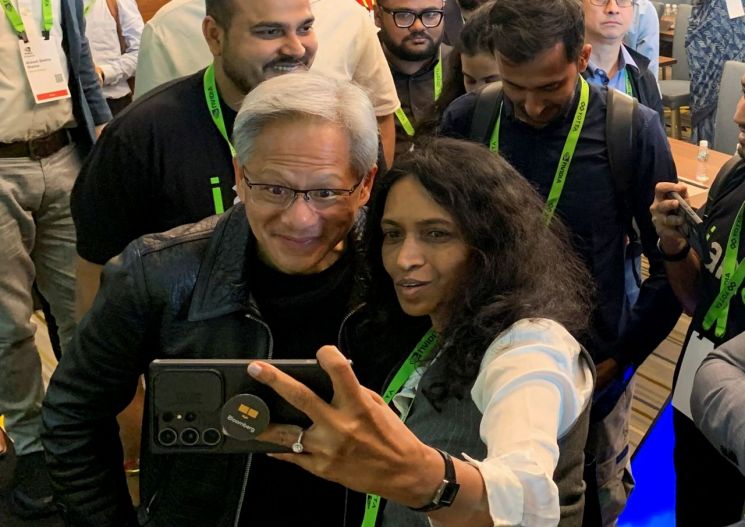 On the 24th, Jensen Huang, CEO of NVIDIA, who attended the 'AI Summit India' held in Mumbai, India, is taking a photo with local attendees.
 [Image source=Reuters Yonhap News]
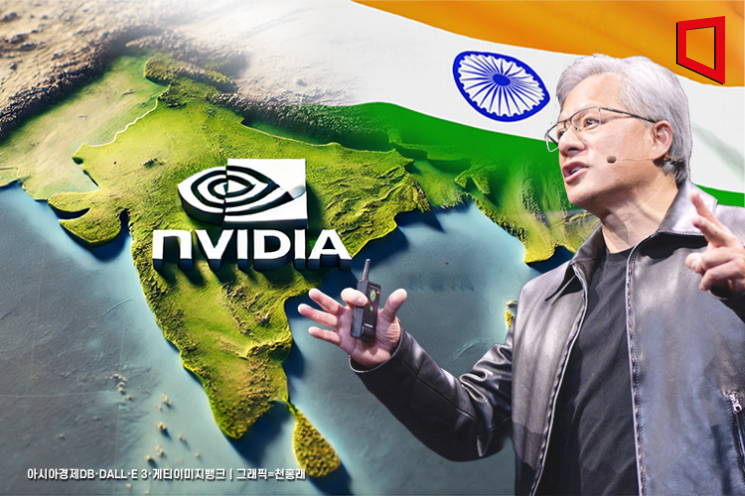
According to foreign media and industry sources on the 30th, Jensen Huang, CEO of Nvidia, a leader in the artificial intelligence (AI) chip market, recently visited Mumbai, India, to deliver a keynote speech at the 'AI Summit India.' CEO Huang stated, "It is important for India to build its own AI infrastructure," and predicted, "India has been producing and exporting software, but in the future, it will become a country that exports AI." He also emphasized, "India's tech talent is unparalleled."
Nvidia has invested heavily in the Indian market, operating six branches across the country with about 4,000 employees. In Gujarat, western India, it is constructing a 1GW-scale data center, which will be equipped with the next-generation AI chip 'Blackwell.' The company also announced plans to increase collaboration with Indian companies to build AI models.
Given CEO Huang's extraordinary interest in India expressed in official settings, analysis is gaining traction that semiconductor companies cannot avoid considering entry into the Indian market. This is especially true for companies that have Nvidia as a client or already count it among their customers. Some speculate that India, having put effort into CEO Huang's visit, will leverage the momentum to actively call on global companies to establish semiconductor factories.
Love Calls Toward Strengthening Samsung and SK
The industry is watching closely to see if the Indian government's requests for Samsung Electronics and SK Hynix to build semiconductor factories will intensify. Last month, Invest India, the national investment promotion agency, commissioned the Korea Semiconductor Industry Association to survey the intentions of Korean semiconductor companies regarding entry into India. At that time, Korean companies reportedly expressed the greatest concern about potential shortages of water and infrastructure if factories were built in India.
Samsung Electronics has continuously received proposals from India. The first request to build a factory came in 2014 through the Korean Embassy in India and was declined, but India has been persuading Samsung whenever opportunities arise. In April 2022, M.K. Stalin, Chief Minister of Tamil Nadu, reportedly made a request through a local subsidiary. However, Samsung declined India's proposals, citing ongoing construction of its 4th factory at the Pyeongtaek campus in Gyeonggi Province and two semiconductor factories plus an advanced packaging R&D center in Taylor, Texas, USA. Instead, Samsung operates two R&D centers in Bengaluru.
India is also said to have strongly inquired about production investment intentions from SK Hynix. Last July, news emerged that the Indian government and SK Hynix were considering building a semiconductor back-end (packaging) factory, but this turned out to be a one-sided wish from India. Recently, as SK Hynix has taken the lead in the high-bandwidth memory (HBM) market and strengthened its position in the memory industry, India's demands may become more concrete. The fact that Nvidia, TSMC, and others forming a 'tripartite alliance' are considering entry into India could also influence SK Hynix's decision.
Micron, TSMC, and Others Join the ‘India Rush’
Analysis that Samsung Electronics and SK Hynix cannot easily overlook India is supported by the fact that many competitors have already planted their flags there. American company Micron, which fiercely competes with these two companies in the HBM market, is highly likely to produce India’s first semiconductor product. Ashwini Vaishnaw, India’s Minister of Electronics and Information Technology, stated on local television, "India’s first semiconductor will hit the market by December," referring to Micron’s factory under construction in Gujarat. Micron is investing $2.75 billion (about 3.7 trillion KRW) to build a DRAM and NAND flash assembly plant in Gujarat. However, this plant is focused more on assembly than production. The first production plant is expected to be built in 2026.
TSMC, the world’s largest foundry (semiconductor contract manufacturer), is collaborating with India’s Tata Group to build a large-scale foundry plant in the same state, with an investment of $11 billion (about 14.75 trillion KRW). Alongside Samsung Electronics, Intel and Huawei have also entered India with R&D centers. AMD plans to invest $400 million (about 530 billion KRW) by 2028 to establish a semiconductor design center in Bengaluru. Dutch automotive semiconductor company NXP is aiming to expand its R&D facilities and workforce in India with a $1 billion (about 1.34 trillion KRW) investment. NXP CEO Kurt Sievers predicted, "The Indian semiconductor market will reach $63 billion (about 84.54 trillion KRW) by 2026."
© The Asia Business Daily(www.asiae.co.kr). All rights reserved.
![Clutching a Stolen Dior Bag, Saying "I Hate Being Poor but Real"... The Grotesque Con of a "Human Knockoff" [Slate]](https://cwcontent.asiae.co.kr/asiaresize/183/2026021902243444107_1771435474.jpg)

















