Late Report of the White Paper to the General Election White Paper Special Committee's Top Leadership
Criticism Over Ambiguous Handling of Responsibility
Incomplete System Nomination Cited as a Cause of Failure
The People Power Party's post-election report was released only six months after the general election. While it cited factors such as an 'unstable party-government relationship' and 'unfinished system nomination' as reasons for the election defeat, it could not avoid criticism for handling the issue of responsibility ambiguously.
On the 28th, the People Power Party's Special Committee on the General Election Report submitted the report titled "Last Chance" to the party's Supreme Council. Although the report had been completed some time ago, it had not gone through the reporting procedures. The Supreme Council announced the contents to the media immediately after the report. Although the report covered the entire election process, it was criticized for vaguely addressing the responsibilities of President Yoon Seok-yeol and People Power Party leader Han Dong-hoon.
The Primary Cause of Defeat: 'Unstable Party-Government Relationship'
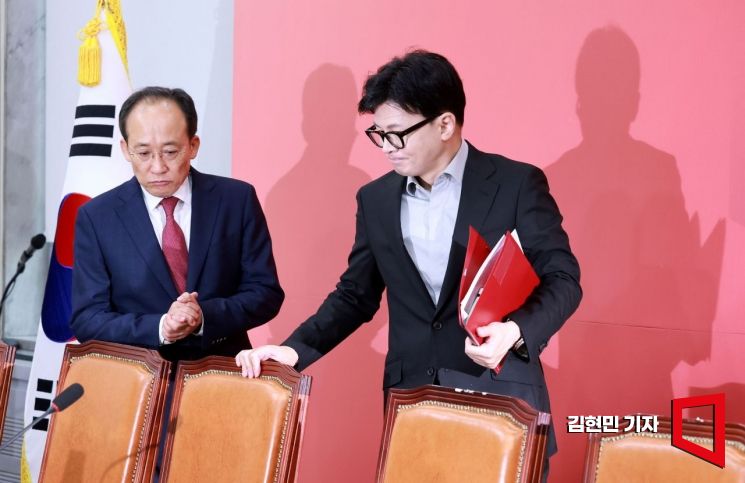 Handonghun, the leader of the People Power Party, and Chugyeongho, the floor leader, are attending the Supreme Council meeting held at the National Assembly on the 28th. Photo by Kim Hyunmin
In the general election report, the People Power Party identified the 'unstable party-government relationship' as the foremost reason for the April 10 general election defeat. Since the election was held in the second year of the administration, it was heavily influenced by the public's evaluation of the government's governance, which is politically intertwined with the ruling party. Additionally, although the opposition fueled the argument for regime judgment, the party appeared to be led by the presidential office and government, failing to respond adequately.
In particular, the special committee presented results from its own survey, evaluating failures in actively responding to major issues in the following order: the Lee Jong-seop and Hwang Sang-moo issues (8.90 points), the Daepa controversy (8.75 points), the Kim Geon-hee issue (8.51 points), the Marine Corps Chae Sang-byeong issue (8.24 points), and the expansion of medical school quotas (8.09 points). The committee pointed out that "instead of confronting, the party seemed to follow the government's stance, failing to create a healthy and productive tension between the party and government." It also took a critical stance on the regime judgment argument that emerged in April, just before the election.
However, for Leader Han, who served as the overall election campaign committee chairman and emergency committee chairman, it seems difficult to accept the committee's analysis, which effectively points the finger at him. During each crisis originating from the presidential office and government during the election, he voiced criticism and tried to restrain the situation. For example, when the controversy over Kim Geon-hee's luxury handbag arose in January, Leader Han stated, "There are clearly regrettable parts in the process and concerns among the public," distancing himself from issues that could cause public alienation. Later, when former Defense Minister Lee Jong-seop was appointed as ambassador to Australia and departed, Han urged the Public Officials Corruption Investigation Unit to summon him and called for his return. He also drew a line by calling former Civic Society Secretary Hwang Sang-moo's knife attack remarks "inappropriate." After President Yoon's statement on increasing medical school quotas in April, Han urged resolution, saying, "This is not a matter to be obsessed with numbers."
Unfinished System Nomination
The report pointed out issues such as system nomination for regional candidates and the opacity of the People Power Party's proportional representation party, People’s Future. It introduced that "the secretary-general in charge of the general election work himself evaluated it as a 'half-baked system nomination,'" and criticized that "there were many opinions that the system should be rationally reorganized with consideration for 'winning nominations.'"
First, it criticized that "the party failed to prepare for talent recruitment early, limiting the pool of candidates, and the criteria established just before the election were difficult for many to accept." With leadership changes before the election, systematic talent acquisition was not achieved, and the suddenly introduced system nomination failed to gain consensus.
In fact, the People Power Party's leadership system changed frequently. After the emergency committee chairman Jeong Jin-seok's regime, Kim Ki-hyun's leadership led the election, but it collapsed after defeats such as the Seoul Gangseo District Mayor race. Subsequently, the acting leader Yoon Jae-ok took over, followed by emergency committee chairman Han Dong-hoon. Due to frequent leadership changes, there was no time to organize the election structurally or institutionally.
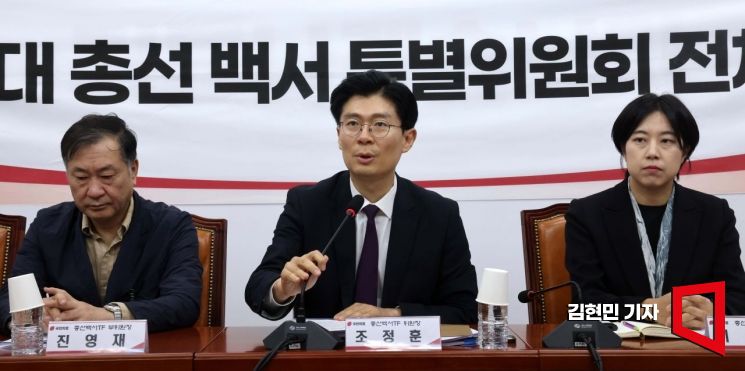 Cho Jung-hoon, Chairman of the People Power Party's 22nd General Election White Paper Task Force, is speaking at the plenary meeting of the 22nd General Election White Paper Special Committee held at the National Assembly on the 8th. Photo by Kim Hyun-min kimhyun81@
The report particularly criticized the issue of incumbent lawmaker reassignment. Instead of the election planning team, the nomination committee reassigned incumbents, but the results were poor. Except for Representative Kim Tae-ho, who moved from the combined district of Sancheong-gun, Hamyang-gun, Geochang-gun, and Hapcheon-gun in South Gyeongsang Province to Yangsan-si Eul district in South Gyeongsang, Representatives Seo Byung-soo, Park Jin, Cho Hae-jin, Park Sung-joon, and Yoo Kyung-joon suffered defeats. Additionally, it was pointed out that prolonged primary races due to multi-candidate contests and runoffs led to intensified internal conflicts and difficulties.
Proportional Representation Nomination Also Full of Doubts
Regarding proportional representation, there were criticisms not only about procedural issues but also about a lack of scalability. The report stated, "The final interview evaluation results of proportional representation candidates by the nomination committee were not shared with the leadership and working-level staff of People’s Future and are currently unavailable," raising doubts about whether the 'system nomination' was properly conducted due to serious procedural flaws.
In fact, the People’s Future proportional representation nomination was chaotic. On March 20, Representative Lee Cheol-gyu, who served as the People Power Party's talent recruitment committee chairman, raised concerns that "the process of proportional representation nomination was not transparently disclosed." As controversies continued, the party reshuffled the order, citing insufficient consideration for Honam politicians and party officials, causing further turmoil.
In this regard, the report criticized, "Despite various concerns about proportional representation nominations, the leadership pushed forward with the nominations." It also criticized the content of the nominations. Regarding nominations made to balance vulnerable regions, it stated, "Candidates were nominated as Honam natives simply because of their Honam ties, not because they actually lived and worked in the Honam region." Regarding nominations from professional organizations, it noted, "Complaints arose that proportional representation candidates lacked diversity and representation by profession, failing to gain collective support from related professional organizations or being ignored, which affected voter sentiment," and criticized, "The party failed to secure central party-level support from organizations that were friendly to or had considerable organizational power within the People Power Party."
Simple Statements Rather Than In-Depth Analysis or Accountability
The general election report was announced 200 days after the election due to delays in the Supreme Council's final report. Although the report work began immediately after the election defeat, the delay was influenced by factors such as Leader Han, who led the People Power Party during the election as emergency committee chairman, running again in the July 23 party convention. The so-called 'text message controversy,' in which President Yoon's spouse Kim Geon-hee expressed an apology during the election period, also contributed, as it heightened sensitivity to debates over responsibility for the election defeat. Ultimately, the announcement was postponed until after the party convention and further delayed due to political schedules such as the October by-elections.
There are also criticisms that the report contains fewer 'harsh criticisms' than initially expected. It seems difficult to avoid criticism that the content was somewhat reduced compared to the promises made by Representative Cho Jeong-hoon, who chaired the special committee. Representative Cho had pledged to include unreserved content without taboos or sacred cows regarding the general election report. Therefore, many expected an in-depth analysis of the party's strategy and the presidential office's faults, but these were largely omitted. Regarding the controversy over Leader Han ignoring Kim Geon-hee's text messages during the July 23 party convention, Representative Cho said at the special committee meeting in August that "an appropriate amount of space was sufficiently allocated," but the report only stated, "The so-called 'First Lady text message controversy,' which surfaced two months after the election defeat, confirmed once again that both the emergency committee chairman and the presidential office failed to respond appropriately, and that the unstable party-government relationship during the election was a major cause of defeat."
An attendee of the Supreme Council meeting reportedly said regarding the explicit mention of the regime judgment argument as one of the causes of defeat, "The party brought up the 'regime judgment argument' when the ruling party's approval ratings had already fallen, making it difficult to secure even 100 seats," adding, "A dynamic analytical method should have been used, but this trend was not reflected."
© The Asia Business Daily(www.asiae.co.kr). All rights reserved.
![Clutching a Stolen Dior Bag, Saying "I Hate Being Poor but Real"... The Grotesque Con of a "Human Knockoff" [Slate]](https://cwcontent.asiae.co.kr/asiaresize/183/2026021902243444107_1771435474.jpg)

















