Foreign Investors Net Buy Samsung Electronics for Entire Day at 9.2 Billion KRW... Buy Turnaround After 34 Days
Samsung Electronics Rises Nearly 4% on Rare Foreign and Institutional Joint Buying
Uncertainty Remains Over Continuation of Foreign Buying Momentum
Focus on Samsung Electronics' Confirmed Q3 Earnings Announcement at Month-End
The foreign selling spree of Samsung Electronics has come to a halt. It is the first time in 34 trading days. Whether the foreigners, who recorded an unprecedented level of selling, have turned to buying remains to be seen, and attention is expected to focus on Samsung Electronics' confirmed third-quarter earnings announcement scheduled for the end of this month.
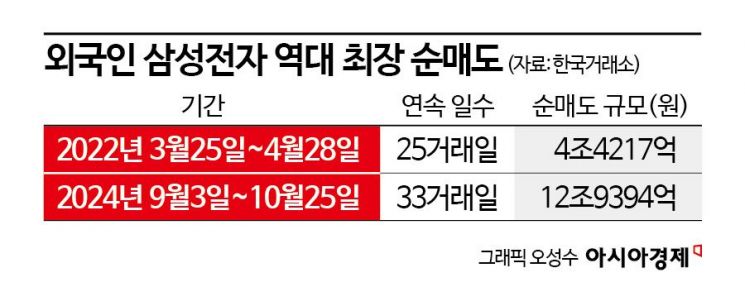
According to the Korea Exchange on the 29th, foreigners net purchased about 9.2 billion KRW worth of Samsung Electronics shares the previous day. It was the first time in 34 trading days since September 2 that foreigners bought Samsung Electronics. Foreigners, who maintained a selling trend until the morning, switched to buying in the afternoon, putting an end to the 34-day selling streak.
Previously, foreigners launched an unprecedented selling offensive against Samsung Electronics. From August 3 to September 25, foreigners consecutively net sold Samsung Electronics for 33 trading days, setting a new record for the longest consecutive net selling period. The previous record was 25 trading days from March 25 to April 28, 2022. This time, they surpassed 25 trading days and continued to break the longest record, with net selling continuing for 33 days. The scale of selling was also record-breaking. During this period, foreigners' net selling amounted to 12.9394 trillion KRW.
On this day, foreigners and institutions jointly engaged in buying, driving Samsung Electronics' stock price up. In particular, institutions were the largest net buyers of Samsung Electronics, purchasing 153.9 billion KRW. Samsung Electronics, which fell to 55,700 KRW early in the session, hitting a new 52-week low, rebounded thanks to the joint buying by foreigners and institutions and closed at 58,100 KRW, up 3.94% from the previous session.
With the blue-chip stock rising sharply for the first time in a while, the KOSPI also recovered the 2,600 level. On this day, the KOSPI closed at 2,612.43, up 1.13% from the previous session. Ji-won Kim, a researcher at KB Securities, explained, "The index was driven by Samsung Electronics' nearly 4% gain following foreign media reports that Nvidia conditionally approved Samsung Electronics as an HBM supplier."
Although the continuous net selling by foreigners on Samsung Electronics has ended, it is still uncertain whether foreigners will maintain their buying momentum. Previously, foreigners net sold for six consecutive trading days from August 23, turned to buying on September 2, but switched back to selling the next day, starting the 33-day selling streak.
Moreover, the stock price rise on this day was influenced by a Taiwanese media report that Samsung Electronics had conditionally agreed to supply high-bandwidth memory (HBM) to Nvidia. A similar report in July had caused the stock price to rise but then fall after it was confirmed to be untrue.
Therefore, the market is expected to focus on Samsung Electronics' confirmed third-quarter earnings scheduled for the end of this month. Ji-young Han, a researcher at Kiwoom Securities, said, "Due to its high market capitalization weight, Samsung Electronics' stock price slump, which was the core of the KOSPI's neglect phenomenon, experienced over a month of foreign net selling since September 3, during which the stock price plummeted 23%. We need to find clues for a turnaround in the business segment earnings scheduled for later this week." Kyung-min Lee, a researcher at Daishin Securities, said, "It will be important to see whether the upcoming earnings guidance and Q&A session can serve as a turning point to alleviate and resolve uncertainties about the pre-reflected industry conditions and earnings, as well as investors' anxiety."
© The Asia Business Daily(www.asiae.co.kr). All rights reserved.
![Clutching a Stolen Dior Bag, Saying "I Hate Being Poor but Real"... The Grotesque Con of a "Human Knockoff" [Slate]](https://cwcontent.asiae.co.kr/asiaresize/183/2026021902243444107_1771435474.jpg)
















