Japanese Prime Minister Shigeru Ishiba, who suffered a crushing defeat in the House of Representatives election (general election) held about a month after taking office, stated that he had "received a very severe judgment" and announced plans to pursue political reform going forward. Amid speculation both inside and outside the party about an early replacement of Prime Minister Ishiba, he effectively indicated that he has no intention of stepping down prematurely. He also said that at this point, he is not considering a coalition government other than the existing coalition with the Komeito Party.
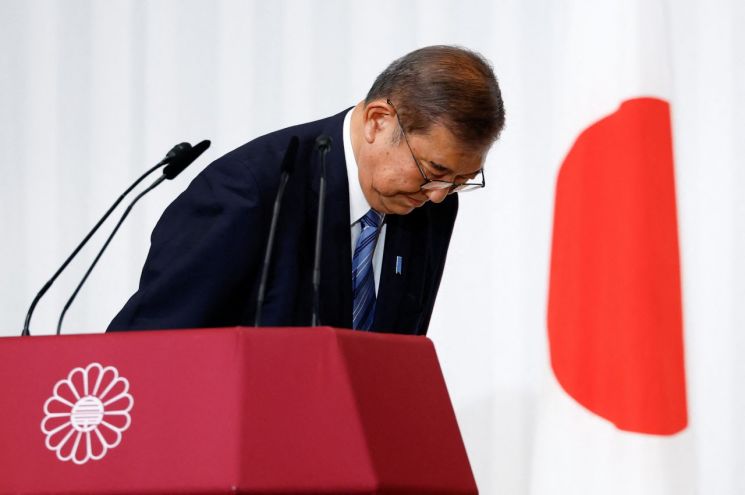
At a press conference held at the ruling Liberal Democratic Party (LDP) headquarters on the afternoon of the 28th, Ishiba said, "I will fulfill my duties." In the House of Representatives election held the previous day, the ruling LDP secured 191 seats, and the Komeito Party won 24 seats, failing to achieve a majority of 233 seats either alone or as a coalition. As a result, Prime Minister Ishiba, who had gambled on an early general election, is also facing calls for accountability. This is the first time in 15 years since 2009, when the LDP handed over power to the former Democratic Party, that the LDP has failed to secure a majority.
Ishiba said he accepts the election results as a public call to hasten political reform. He emphasized, "In response to the voice of the people, we will avoid political stagnation and prioritize tasks such as political reform and economic reform." Specifically, he explained that efforts will be made to address issues such as economic reform, constitutional revision, security, and the formulation of supplementary budgets.
With a weak base within the party, Ishiba had initially planned to endorse lawmakers involved in a 'slush fund scandal' as part of an effort to embrace opposition factions, but excluded them from candidacy after public opinion worsened. However, the already deteriorated public sentiment did not recover, and controversies such as the payment of party activity expenses poured in, ultimately hampering both the LDP and Prime Minister Ishiba. Before the election, the LDP and Komeito held 247 and 32 seats respectively, totaling 279 seats.
Ishiba stressed that "more fundamental reforms will be undertaken regarding politics and money," and said he would engage in cross-party discussions on issues such as abolishing policy activity expenses, disclosing the use of research and publicity funds, and the early establishment of third-party institutions. Regarding Shinjiro Koizumi, the LDP election campaign chairman who submitted his resignation taking responsibility for the election, Ishiba said, "A successor will be decided promptly."
Failing to secure a parliamentary majority, Prime Minister Ishiba is expected to either expand the coalition by courting other opposition parties or maintain a system of cooperation with some opposition parties on a case-by-case basis. However, this path is also expected to be thorny. The largest opposition party, the Constitutional Democratic Party, which significantly increased its seats from 98 to 148 in this election, has clearly stated that it will not form an alliance with the ruling party. There are concerns that initiatives such as constitutional revision, which the LDP has been pushing, and the establishment of an Asia version of NATO, advocated by Ishiba, will lose momentum. Calls for Ishiba’s resignation within the party may also intensify.
Ishiba said, "There is a party that has greatly increased its seats, and we must fully recognize what claims that party made in the election and what the public sympathized with. We will actively introduce policies where we are lacking or need improvement." However, regarding the future framework for government administration, he was reserved, saying, "At this point, I am not considering a coalition other than the existing one with the Komeito Party."
Regarding U.S.-Japan relations ahead of the U.S. presidential election next month, he responded, "Regardless of which candidate wins, we will maintain the currently very favorable U.S.-Japan relationship and work together to strengthen a free and open international order."
© The Asia Business Daily(www.asiae.co.kr). All rights reserved.
![Clutching a Stolen Dior Bag, Saying "I Hate Being Poor but Real"... The Grotesque Con of a "Human Knockoff" [Slate]](https://cwcontent.asiae.co.kr/asiaresize/183/2026021902243444107_1771435474.jpg)















