"Support for Contributions to Medical Innovation Including Photoacoustic Diagnostic Technology"
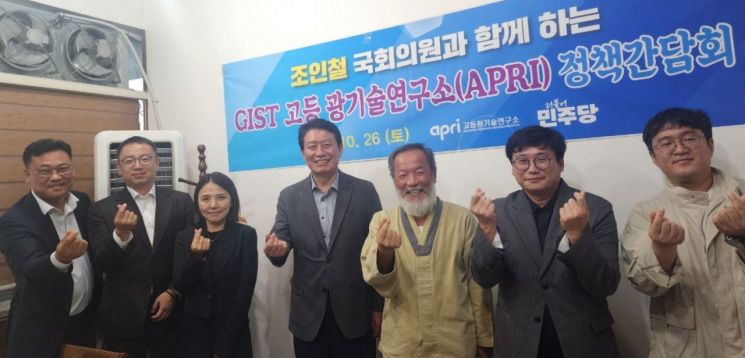 Democratic Party of Korea lawmaker Jo In-cheol held a policy meeting on the 26th with the Gwangju Institute of Science and Technology (GIST) High-Intensity Light Technology Research Center to discuss innovation in optical technology and the advancement of medical diagnostic technology.
 [Photo by Jo In-cheol’s office]
Jo In-cheol, a member of the Democratic Party of Korea representing Gwangju Seo-gu Gap, announced on the 28th that he held a policy meeting on optical technology innovation and the advancement of medical diagnostic technology together with the Gwangju Institute of Science and Technology (GIST) Advanced Optical Technology Research Center on the 26th.
The meeting was organized to discuss the future potential of optical technology in the Gwangju region and the need for government support. Attendees included Kim Hyung-taek, head of the GIST Ultra-High Power Laser Plasma Application Research Center; Kim Hye-min, Park Hyun-sang, and Yoon Hyuk, principal researchers at the GIST Advanced Optical Technology Research Center; and Kim Sang-jip, a researcher at the Department of Veterinary Pathology, Chonnam National University.
Center Director Kim Hyung-taek explained, “The current medical system has an inefficient structure where end-stage patient treatment costs exceed most of their lifetime medical expenses. By utilizing photoacoustic diagnostic technology, we can significantly reduce medical costs as well as the time required for diagnosis and confirmation.” He added, “Unlike existing MRI and CT, photoacoustic imaging technology can visualize the inside of the human body without radiation exposure, which will contribute to improving public health.”
Researcher Kim Hye-min said, “We are developing diagnostic equipment that combines photoacoustics and lasers. Once developed, it will minimize the side effects of existing X-ray equipment and enable fast and convenient diagnosis.” She expressed hope that “the new equipment will reduce patients’ radiation exposure and provide opportunities for rapid diagnosis.”
Researcher Kim Sang-jip emphasized, “Semiconductors and lasers share common characteristics of becoming cheaper and more compact as technology advances, which can bring changes to the medical industry.” He stressed the need for policy support so that Gwangju can become a global hub for optical technology.
Assemblyman Jo stated, “Although Gwangju’s optical technology had a rocky start, it has now reached a level that is competitive worldwide.” He added, “Since the laser equipment possessed by GIST boasts world-class standards, we must ensure that budget shortages do not prevent its utilization.”
Jo further expressed his determination, saying, “Lawmakers from Gwangju and the Honam region must join forces to secure budgets for the development of Gwangju’s optical technology.” He pledged, “We will continue to provide ongoing support and attention so that the advancement of science and technology in Gwangju can contribute to public health and medical innovation.”
© The Asia Business Daily(www.asiae.co.kr). All rights reserved.
![Clutching a Stolen Dior Bag, Saying "I Hate Being Poor but Real"... The Grotesque Con of a "Human Knockoff" [Slate]](https://cwcontent.asiae.co.kr/asiaresize/183/2026021902243444107_1771435474.jpg)















