Dependence on Car Sales, No Promise for AI Product Launch
Concerns Over Stock Overvaluation Relative to Performance
Next M7 Candidate Netflix, Focus on Cash Flow
Despite Tesla's recent strong earnings and record-breaking stock price surge, Wall Street remains skeptical about whether it deserves to be a member of the 'Magnificent 7' (M7). Factors cited include its business model's reliance on automobiles and an overvalued stock price. Netflix was identified as the strongest competitor threatening Tesla's M7 spot.
On the 27th (local time), Yahoo Finance reported, "Tesla's stock price recorded its largest single-day gain in over 11 years following an impressive Q3 earnings announcement, but Wall Street is reevaluating whether the company should be included in the M7," adding, "Tesla has a lot to do if it wants to remain an elite tech company." The M7 refers to the seven major tech stocks driving the U.S. stock market rally: Nvidia, Apple, Alphabet, Amazon, Meta Platforms, Microsoft, and Tesla.
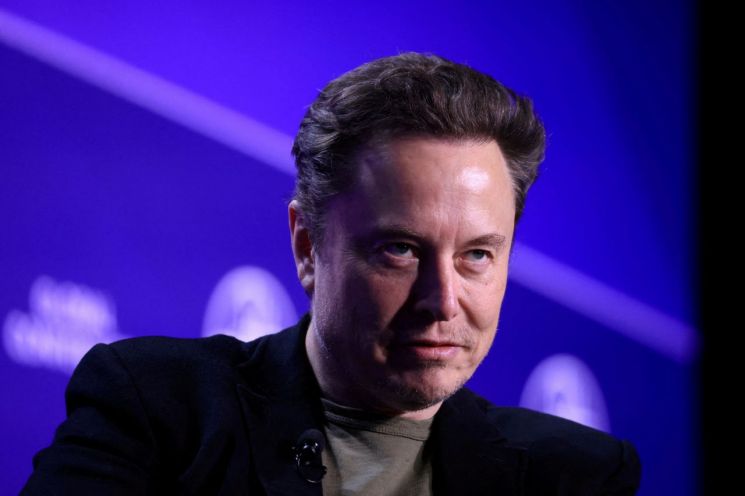
The first basis for the 'Tesla skepticism' emerging from Wall Street is the stock price being overvalued relative to earnings. Tesla's Q3 net income increased by about 17% year-over-year, and its earnings per share (EPS) exceeded market expectations. However, considering that Tesla's EPS in Q1 and Q2 both fell short of market forecasts due to price wars with China, experts argue that a more significant earnings improvement is needed. Additionally, Tesla's current 12-month forward price-to-earnings ratio (PER) is about 73 times, roughly three times higher than the average forward PER of about 26 times for the other M7 companies excluding Tesla.
Experts also point out that Tesla's business model's dependence on electric vehicle sales threatens its M7 status. Unlike other M7 companies advancing in artificial intelligence (AI) development, Tesla's humanoid or AI product launches remain uncertain. Daniel Morgan, Senior Portfolio Manager at Synovus Trust, said, "I remember Cisco, Intel, Dell, and Microsoft (MS), the key players of the 1990s dot-com bubble," emphasizing, "Even then, no automobile company was part of the 'Four Horsemen' members."
Last week, Tesla CEO Elon Musk gave a rosy forecast during a conference call, projecting Tesla's vehicle sales growth rate to increase by 20-30% next year, but Wall Street's reactions were mixed. Morgan Stanley and Wedbush set Tesla's target price at $310 and $300, respectively, while JP Morgan set a lower target of $135. The basis for this is that the carbon emission credit sales, which drove Tesla's Q3 earnings, are not sustainable. According to Bloomberg, as of last Friday, only 40% of Tesla analysts on Wall Street recommended 'buy'?the lowest preference among M7 companies.
Netflix is being mentioned on Wall Street as a strong candidate to replace Tesla's M7 spot. Last week, Netflix's Q3 subscriber count, revenue, and earnings per share all exceeded market expectations, pushing its stock price to an all-time high. Netflix's year-to-date stock price increase is 55%, ranking third among the M7 after Nvidia and Meta. Nearly 87% of Wall Street analysts covering Netflix have issued a 'buy' recommendation.
Jes?s Alvarado-Mart?nez, an analyst at Portfolio Wealth Advisors, stated, "To be a member of the M7, you need to be a 'cash-generating machine,'" adding, "Netflix's excellent cash flow and subscriber growth meet that requirement." Netflix's free cash flow (FCF) in Q3 was approximately $2.19 billion, up about 15% year-over-year. Additionally, Netflix reported that its Q3 subscriber count increased by 5.07 million year-over-year to 282.7 million. For next year's annual revenue, Netflix projected $43 billion to $44 billion, which would represent an 11-13% growth compared to this year's forecast of $38.9 billion.
© The Asia Business Daily(www.asiae.co.kr). All rights reserved.
![Clutching a Stolen Dior Bag, Saying "I Hate Being Poor but Real"... The Grotesque Con of a "Human Knockoff" [Slate]](https://cwcontent.asiae.co.kr/asiaresize/183/2026021902243444107_1771435474.jpg)

















