Holding the 12th General Meeting of the Teacher Diligence Committee
Dividing into 9 Sections Based on Teacher Characteristics
Following public officials, teachers have also finalized discussions on working hours exemption (time off). From now on, kindergarten, elementary, middle, and high school teachers, as well as university professors, can appoint full-time union representatives and engage in paid union activities during working hours.
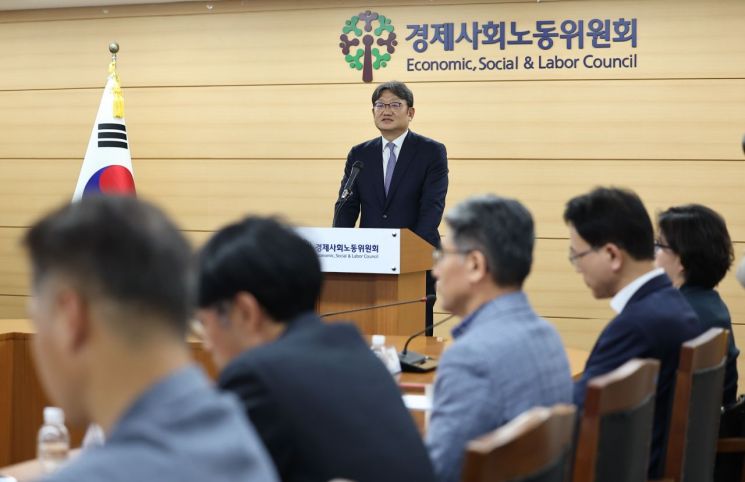 Chairman Kwon Ki-seop of the Economic, Social and Labor Council speaking at the Civil Servant Working Hours Exemption Review Committee held on the 22nd [Image source=Yonhap News]
The Teachers' Working Hours Exemption Deliberation Committee under the Presidential Economic and Social Labor Council held its 12th plenary meeting on the 28th at the Gyeongsanowi main conference room in Jongno-gu, Seoul, and finalized the working hours exemption limits for teachers with unanimous approval from all members, including labor and government representatives. Of the 15 committee members, 14 attended the meeting, including 5 teacher representatives, 5 appointing authority representatives, and 4 public interest members, to reach this agreement.
Time off is a system that allows full-time union representatives to conduct union activities during working hours while setting limits on such time. This enables paid union activities. For teachers, the foundation was laid when the Teachers' Union Act amendment passed in the National Assembly in 2022, but progress was slow due to disagreements between the government and unions. Full-scale discussions began after the Teachers' Working Hours Exemption Committee was launched in June.
Over about four months, the committee held 11 plenary meetings, 13 secretariat meetings, and 2 public interest meetings to coordinate opinions. As a result, they decided to categorize the exemption limits into nine segments based on the characteristics of kindergarten, elementary, middle, and high school teachers and the size of union membership, setting annual exemption hour limits accordingly.
Specifically, the limits are divided as follows: up to 800 hours for 99 or fewer members; up to 1,500 hours for 100?299 members; up to 2,000 hours for 300?999 members; up to 4,000 hours for 1,000?2,999 members; up to 9,000 hours for 3,000?4,999 members; up to 12,000 hours for 5,000?9,999 members; up to 14,000 hours for 10,000?14,999 members; up to 20,000 hours for 15,000?29,999 members; and up to 25,000 hours for 30,000 or more members.
For kindergarten, elementary, and middle school teachers, since union membership is concentrated in the 3,000?9,999 member range at the city/province level, the exemption limits were set considering equity with public officials' unions. For high school teachers, most are distributed in the 299 or fewer members range at the individual school level. The limits were determined by comprehensively considering equity between private and national/public universities, the financial status of small and medium private universities, and the characteristics and activity status of high school teachers.
The annual number of personnel who can use the exemption cannot exceed twice the number of full-time available personnel. However, the number of users for unions with 99 or fewer members is capped at 2, and for those with 100?999 members, it is capped at 3. Additionally, for kindergarten, elementary, and middle school teachers, considering academic schedules and students' right to learn, it is recommended to use exemption hours in units of 1,000 hours.
As an ancillary opinion, it was proposed that two years after the announcement of the teachers' working hours exemption limits, Gyeongsanowi conduct a survey and prepare for a re-deliberation in the future. The teachers' time off will be officially implemented once the Gyeongsanowi chairman immediately notifies the Minister of Employment and Labor of the resolution, and the minister completes legal review and administrative notice procedures before issuing the announcement.
Gwon Ki-seop, chairman of Gyeongsanowi, said, "I consider the resolution on teachers' working hours exemption limits meaningful as it represents complete agreement among labor, government, and public interest members," adding, "I will strive to ensure that this precedent, achieved through understanding of the field, patience, and mutual trust-based dialogue, positively influences social dialogue for job creation for future generations."
© The Asia Business Daily(www.asiae.co.kr). All rights reserved.
![Clutching a Stolen Dior Bag, Saying "I Hate Being Poor but Real"... The Grotesque Con of a "Human Knockoff" [Slate]](https://cwcontent.asiae.co.kr/asiaresize/183/2026021902243444107_1771435474.jpg)















