Interview with Mercedes-Benz Battery Head and Purchasing & Quality Chief
Reserved Comments on Fire Incident Under Investigation
"Strict Supplier Selection Criteria... No Exceptions for Zhong Parasis"
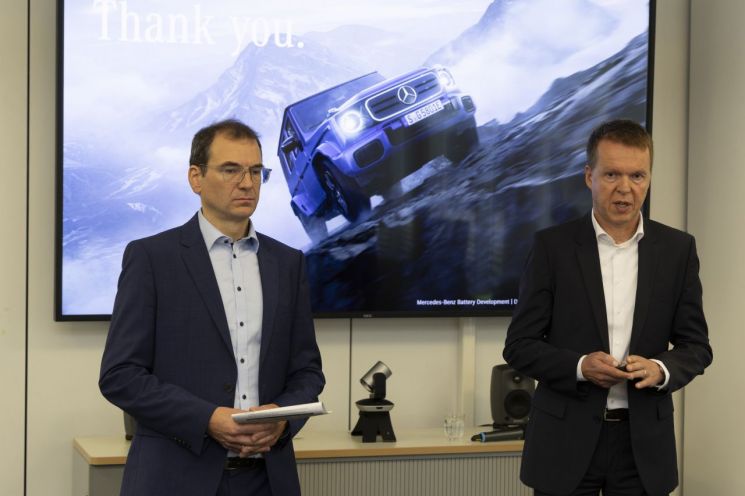 On the 21st (local time), Uwe Keller, Head of Battery Development (right), and Carsten Breckner, Head of Powertrain Purchasing and Supplier Quality, are interviewing with a Korean press group at the Mercedes-Benz headquarters in Untert?rkheim, Stuttgart, Germany. (Photo by Mercedes-Benz)
Uwe Keller, Head of Battery Development
Carsten Breckner, Head of Powertrain Purchasing and Supplier Quality
The executives in charge of battery development and procurement at the Mercedes-Benz headquarters in Stuttgart, Germany, appeared somber. They expressed deep regret over the fire incident involving a Mercedes-Benz electric vehicle in Korea but refrained from discussing detailed information. However, they clarified that the selection process for Mercedes-Benz's battery cell suppliers is strict and undergoes continuous verification. They also expressed their intention to actively support and participate in the battery certification system being introduced in Korea.
On the 21st (local time), at the Mercedes-Benz headquarters in Untert?rkheim, Stuttgart, Germany, Uwe Keller, head of battery development, and Karsten Breckner, head of powertrain procurement and supplier quality, met with Korean journalists and made these remarks. Keller stated, "We deeply regret the victims of the electric vehicle fire in Cheongna, Incheon, Korea, and Mercedes-Benz is taking this matter very seriously. We are cooperating as much as possible to utilize all knowledge gained from various inspections and checks on the affected model in the actual investigation, but since the investigation is not yet complete, we must wait for the final results."
He emphasized that they are making the utmost efforts to ensure the safety of the electric vehicle battery system. Keller said, "We collaborate with battery suppliers under a strict quality management process. We do not believe this incident is due to an issue with the battery design itself, and measures to prevent thermal runaway and similar problems have been implemented just like with other battery systems."
They also expressed confidence in the battery certification system, which the Korean government plans to introduce as the world's first. The battery certification system is a program where the government directly tests and certifies the safety of batteries installed in vehicles in advance. After a one-year grace period, it will be mandatory starting February next year. In Korea, Hyundai Motor Group was the first to express its intention to participate. Keller said, "We especially support Korea's new battery certification system because it ultimately realizes higher standards for electric vehicle safety. Mercedes-Benz applies the highest safety standards independently, regardless of any country's or market's regulations or standards."
Regarding criticism that the Mercedes-Benz EQE vehicle involved in the fire in Cheongna, Incheon, used relatively small battery cells from the Chinese company Farasis, they responded that the supplier selection is conducted under strict criteria, so it is not an issue. Breckner explained, "We follow not only the German Association of the Automotive Industry (VDA) standards but also international standards such as TS16949, conducting the same quality inspections and analyses for all battery suppliers. There are no exceptions in the supplier selection process, including product inspections and regular factory visits, and this applied to Farasis as well."
Therefore, since the investigation by Korean authorities is not yet complete, they intend to maintain Farasis as the battery supplier for the EQE vehicles. However, they announced that the upcoming EQS facelift model, scheduled for release within the year, will use products from the Chinese company CATL as before.
They also spoke about future battery strategies. While still prioritizing safety, they envision eventually internalizing battery production. Keller said, "Mercedes-Benz itself and its suppliers are investing significant effort in developing technologies to stop thermal propagation in batteries, regardless of existing regulations. Technologies that can stop or block thermal propagation will be introduced not only in solid-state batteries, which contain electrolyte and have low flammability, but also in lithium-ion batteries."
He continued, "Our goal is to create a unique, proprietary cell DNA with Mercedes-Benz's DNA and to mass-produce and industrialize it with partners. We may transfer our knowledge and technology to battery cell suppliers for production, and options such as joint ventures or equity investments in existing companies are also open. Although development is done at headquarters, production is carried out in Europe, the United States, and Asia, so cooperation with other companies in these regions is very important," he emphasized.
© The Asia Business Daily(www.asiae.co.kr). All rights reserved.
![Clutching a Stolen Dior Bag, Saying "I Hate Being Poor but Real"... The Grotesque Con of a "Human Knockoff" [Slate]](https://cwcontent.asiae.co.kr/asiaresize/183/2026021902243444107_1771435474.jpg)
















