During the Financial Crisis, Nationwide Unsold Units Over 85㎡ Accounted for 61%
Since 2023, 60~85㎡ Units Make Up 72.3% (As of August)
Changes in Unsold Unit Ratios Reflect Housing Supply Trends
"Serious Unsold Units in Provinces... Expansion of Public Purchase Rental Needed"
Although the trend of increasing unsold housing units has somewhat eased, changes in housing supply patterns over the past decade have led to a decrease in unsold large units exceeding 85㎡ and an increase in the proportion of units sized 60~85㎡. Regionally, the Seoul metropolitan area has a relatively higher proportion of small unsold units, while provinces have a higher proportion of large units. Given that the unsold housing issue is more severe in the provinces, there are calls to use this as an opportunity to expand residential welfare.
On the 27th, the Korea Research Institute for Construction Industry released a trend briefing report titled "Analysis of the Easing Trend in Unsold Housing Increase and Changes in Housing Supply Patterns." The nationwide unsold housing stock peaked at 75,438 units in February 2023, decreased to 57,925 units in November, then increased again to 74,037 units in June this year, before declining to 67,550 units in August.
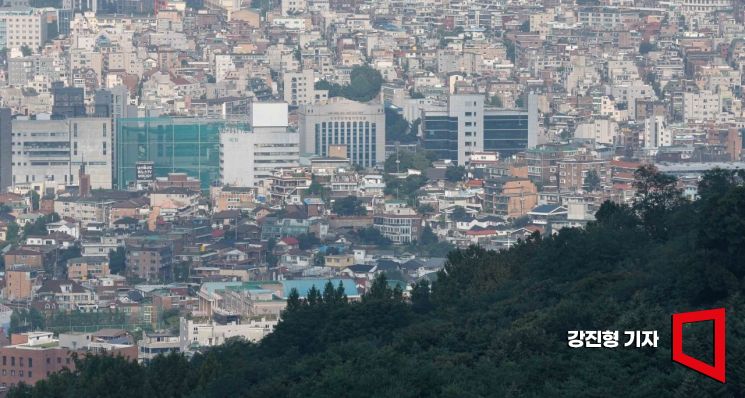 The government announced plans to expand housing supply to ensure residential stability for the public, with a new housing site of 50,000 units to be announced this November. The photo shows a densely packed villa area in Huam-dong, viewed from Namsan, Jung-gu, Seoul on the 9th. Photo by Kang Jin-hyung aymsdream@
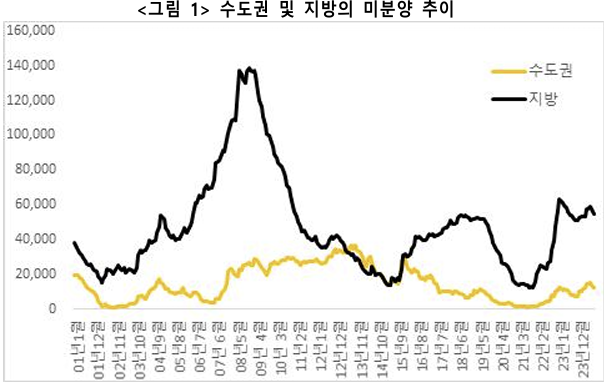 Unsold Housing Inventory Trends in the Capital Region and Provinces (Image Source: Korea Construction Industry Research Institute, Data Source: Ministry of Land, Infrastructure and Transport Statistics Nuri)
The risk indicator for unsold housing is divided into four stages: △Normal △Attention △Risk Entry △Risk Occurrence. Nationwide, the stage was at 'Risk Entry' from April to July this year but dropped to 'Attention' from August. The metropolitan cities in the provinces, where unsold housing is most severe, have been at the 'Risk Occurrence' stage from April to August this year. The Seoul metropolitan area has been at 'Risk Entry' from January to August this year, while other provinces have been at the 'Attention' stage since December 2022.
By size, as of August, units sized 60~85㎡ account for 72.3% of unsold housing nationwide. Units 60㎡ or smaller make up 14.5% (9,771 units), and those exceeding 85㎡ account for 13.2% (8,939 units). In the Seoul metropolitan area, 60~85㎡ units represent 71.5% (9,022 units), 60㎡ or smaller units have a relatively high share of 21.3% (2,689 units), and units exceeding 85㎡ are lower than the national average at 7.2% (905 units). Conversely, in the provinces, 60~85㎡ units account for 72.5% (39,818 units), units exceeding 85㎡ make up 14.6% (8,034 units), and units 60㎡ or smaller are 12.9% (7,082 units).
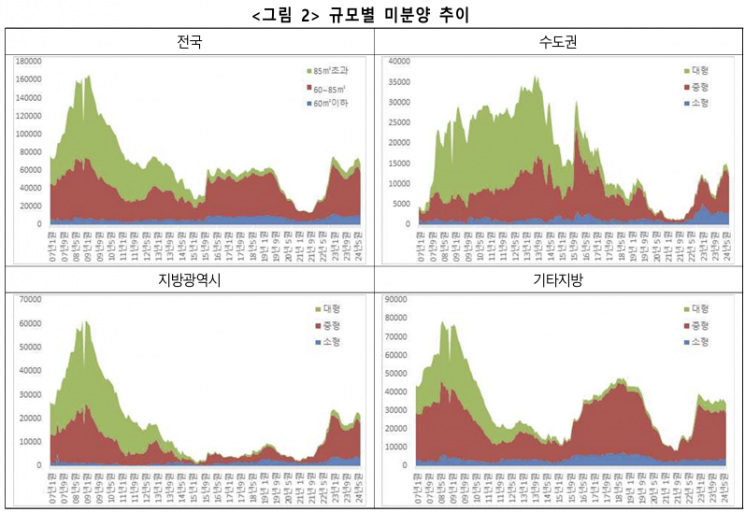 Unsold Housing Units by Type Trend (Image Source=Geonsanyeon, Data Source=Ministry of Land, Infrastructure and Transport Statistics Nuri)
Compared to the global financial crisis period, when units exceeding 85㎡ had the highest proportion, recently the 60~85㎡ segment has the largest share. As of December 2010, 61% of unsold units nationwide were over 85㎡, while 33.7% were 60~85㎡, and 5.3% were 60㎡ or smaller. The increasing trend of unsold units in the 60~85㎡ range reflects changes in housing supply patterns by size.
Looking at changes in housing supply distribution, in 2010, the supply proportions by size were evenly distributed in the 30% range. In 2010, the Seoul metropolitan area's supply proportions by size were 32.7% for 60㎡ or smaller, 30.5% for 60~85㎡, and 36.8% for over 85㎡. By 2023, these changed to 10.4% for 60㎡ or smaller, 48.0% for 60~85㎡, and 41.6% for over 85㎡. During the same period, in metropolitan cities in the provinces, the share of 60㎡ or smaller units decreased from 36.1% to 13.1%, while the 60~85㎡ segment increased from 30.2% to 63.3%, and units over 85㎡ rose from 36.8% to 41.6%.
Unsold housing occurs due to oversupply caused by changes in interest rates and government policies. As unsold units increase, construction companies face significant management challenges due to increased debt and financing difficulties, as sales and cash inflows do not materialize. When unsold units occur in housing supply projects financed through project financing, disruptions in cash flow can lead to insolvency risks for financial institutions such as securities firms, insurance companies, savings banks, and mutual finance institutions.
In particular, the unsold housing problem in the provinces is prolonged and more severe than in the Seoul metropolitan area, leading to calls for resolution through purchase and rental schemes.
Researcher Bin Jae-ik of the Korea Research Institute for Construction Industry explained, "With the possibility of housing demand activation due to policy interest rate cuts, the unsold housing issue is expected to gradually ease, but caution is still needed regarding unsold units in metropolitan cities in the provinces. Especially, using the severe unsold housing problem in the provinces as an opportunity to expand local residential welfare can enhance weakened urban competitiveness compared to the Seoul metropolitan area and positively impact revitalization."
Researcher Bin Jae-ik added, "It is necessary to strengthen measures to reduce unsold units by actively utilizing the stock held by public housing providers for unsold units sized 60~85㎡ and 60㎡ or smaller, and by expanding public purchase rental projects through collaboration with Korea Land and Housing Corporation (LH) rental housing. Purchased public rental housing should be supplied in various ways according to location, such as permanent rental, national rental, happy housing, and long-term lease, differentiated by size and tenant type."
© The Asia Business Daily(www.asiae.co.kr). All rights reserved.
![Clutching a Stolen Dior Bag, Saying "I Hate Being Poor but Real"... The Grotesque Con of a "Human Knockoff" [Slate]](https://cwcontent.asiae.co.kr/asiaresize/183/2026021902243444107_1771435474.jpg)

















