Deloitte Report 'Trends and Outlook of Generative AI'
The Asia-Pacific (APAC) region is expected to see intensified competition between the two semiconductor giants, Samsung Electronics and TSMC, as the adoption of generative AI accelerates, driven by population growth and economic expansion.
Deloitte Korea Group released a report titled "Generative AI Trends and Outlook in the Asia-Pacific Technology, Media, and Telecommunications (TMT) Sector" on the 25th, analyzing that the market for specially designed semiconductors and server hardware for generative AI will grow rapidly.
The report forecasts that the global market size for generative AI specialized chips and server hardware will exceed $50 billion (approximately 69 trillion KRW) this year.
The report stated, "Projections for the AI chip market in 2027 range from $110 billion (about 153 trillion KRW) to $400 billion (about 556 trillion KRW), but it is certain that the market is growing rapidly."
Increasing Demand for Generative AI Chips... Samsung Electronics and TSMC's Presence Soars
 Visitors are admiring wafers displayed on the screen at the TSMC Innovation Museum within the Hsinchu Science Park in Taiwan. [Image source=AFP·Yonhap News]
Along with the growth of generative AI, demand for AI chips specialized for this purpose and data center construction is also rapidly increasing. The report noted, "With the spread of generative AI, the hardware (manufacturing) and update markets are expected to develop together after 2025," adding, "The APAC region, already a leader in hardware production, is expected to generate strong growth momentum through this."
In the global semiconductor market, Samsung Electronics and TSMC are focusing all efforts on securing market share through semiconductor manufacturing optimized for generative AI. The report stated, "Leading global semiconductor companies spent about $300 million (approximately 420 billion KRW) on chip design using AI tools last year, and this is expected to exceed $500 million (about 700 billion KRW) by 2026."
Regarding this, Deloitte said, "Naturally, as demand for generative AI chips increases, the presence of foundry companies in the APAC region, such as Samsung Electronics and TSMC, is growing even stronger."
The report added, "While demand for specialized generative AI chips is increasing worldwide, production is mainly concentrated in Asia," and "this trend is expected to strengthen further."
It continued, "The semiconductor market for image processing chips (GPUs) is led by major US fabless companies, but they cooperate with semiconductor manufacturers in the APAC region for production," adding, "As a result, semiconductor manufacturing and inspection process technologies in the APAC region are rapidly growing, and their market share is expanding quickly."
Rapid Changes in IT, Content, and Telecommunications Industries
The adoption of generative AI is driving fundamental changes not only in semiconductors but also across various industries in the APAC region, including IT, media, and telecommunications.
In Japan, generative AI is being used in manga and novel production, providing consumers with new opportunities to become creators. This is driving growth in the content industry across the APAC region.
In the telecommunications industry, AI adoption for personalized experiences and network optimization is actively underway. This has led to business success through the development of large language models (LLMs) that reflect the diverse languages and cultures of the APAC region.
The report stated, "Generative AI is expected to bring changes to the traditional sports industry through integration with virtual reality and metaverse technologies."
The report also noted, "The generative AI hardware market requires significant upfront investment," adding, "While rapid growth in the software market is expected after 2025, the new and update markets for generative AI hardware?including PCs, smartphones, head-mounted displays, servers, and storage?are also expected to continue growing."
Challenges such as Data Security and Governance Remain
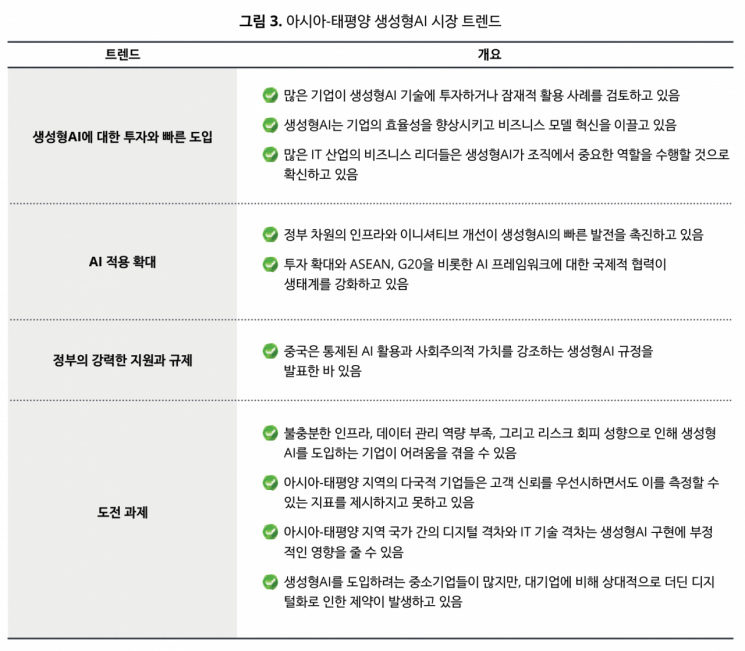
With the spread of generative AI, issues such as data security, personal information protection, and copyright concerns have emerged as important challenges.
The report stated, "In the APAC region, AI adoption is being strengthened based on active government support," adding, "Companies also face significant needs to address intellectual property issues, limitations of training data, and misinformation."
Choi Ho-gye, Partner of Advanced Technology, Media, and Telecommunications at Deloitte Korea Group, said, "Although strong regulations and other challenges are expected due to the adoption of generative AI in the APAC region, it will fundamentally innovate various TMT industries ranging from IT to telecommunications and sports."
© The Asia Business Daily(www.asiae.co.kr). All rights reserved.
![Clutching a Stolen Dior Bag, Saying "I Hate Being Poor but Real"... The Grotesque Con of a "Human Knockoff" [Slate]](https://cwcontent.asiae.co.kr/asiaresize/183/2026021902243444107_1771435474.jpg)
















