Kumho Petrochemical Expected to Announce New Year-End Shareholder Return Policy
Former Executive Park Cheol-wan Loses Civil Cases in 1st and 2nd Trials Against Kumho Petrochemical
Kumho Petrochemical (Kumho Seokhwa) has consecutively won the management rights dispute against Park Cheol-wan, former executive director and the largest individual shareholder, who is the nephew of Park Sam-gu, chairman of the Kumho Seokhwa Group. Amid these victories, the company is expected to further strengthen support from minority shareholders through expanded shareholder returns.
According to the investment banking (IB) industry on the 28th, Kumho Seokhwa is expected to announce a "new three-year shareholder return policy" by the end of this year. As Kumho Seokhwa has been regarded as a representative undervalued stock with an expected price-to-book ratio (PBR) of about 0.7 times this year, enhancing shareholder value has been a goal emphasized not only by former executive director Park but also by Kumho Seokhwa, which has been in dispute with him.
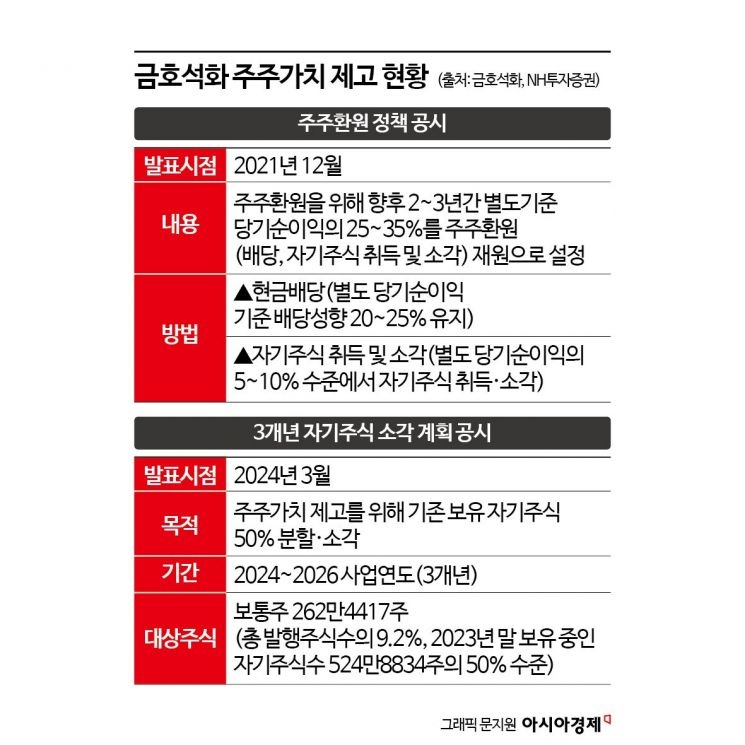
In the securities industry, the prevailing view is that Kumho Seokhwa will announce a "new three-year shareholder return policy" this December. Hyun-ryeol Jo, a researcher at Samsung Securities, said, "After announcing the three-year shareholder return policy in December 2021, an additional update will be made this December. Considering the strong demands for shareholder return policies ahead of the shareholders' meetings (held every March) over the past two to three years, the momentum for shareholder returns will be further strengthened over the next six months."
Young-kwang Choi, a researcher at NH Investment & Securities, also noted, "Kumho Seokhwa is implementing an active shareholder return policy based on solid profitability and financial structure. It allocates 25-35% of net income as resources for shareholder returns and pays dividends annually (20-25% of separate net income)." He added, "Kumho Seokhwa, which has been continuously purchasing and retiring treasury shares, announced in March that it plans to retire 50% of its treasury shares over the next three years and purchase an additional 50 billion KRW worth of treasury shares. Accordingly, it is expected to announce a new three-year shareholder return policy by the end of this year."
Recently, Kumho Seokhwa has further solidified its position in the civil lawsuit filed by former executive director Park. On the afternoon of the 25th, the Civil Division 12-1 of the Seoul High Court ruled in the appeal trial of the lawsuit filed by Park and three others against Kumho Seokhwa for invalidation of treasury share disposal, stating, "The appeals of the plaintiffs (including Park) are all dismissed. The litigation costs shall be borne by Park's side."
Previously, Kumho P&B Chemical of the Kumho Seokhwa Group and OCIMSB, a Malaysian subsidiary of the OCI Group, agreed in 2021 to establish a joint venture, OCI Kumho, and exchanged treasury shares worth 31.5 billion KRW to strengthen their strategic partnership. Kumho Seokhwa increased shareholder value by additionally retiring 171,847 shares equal to the number of exchanged shares. Park's side filed a civil lawsuit, claiming, "The management rights dispute continues. The management's disposal of treasury shares to the OCI Group was intended to secure friendly shares." At that time, Park had initiated a management rights dispute against Chairman Park but was dismissed from his executive position after losing the shareholders' meeting vote.
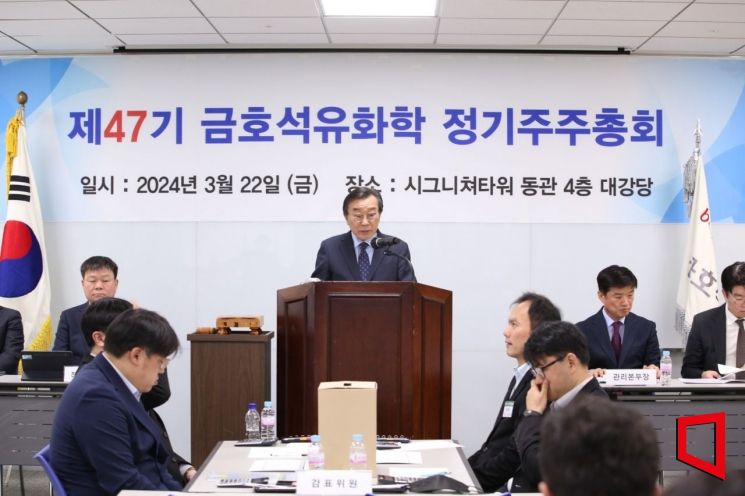 Baek Jong-hoon, CEO of Kumho Petrochemical, is presiding over the 47th regular shareholders' meeting held on March 22 at Signature Towers in Jung-gu, Seoul.
 [Photo by Kumho Petrochemical]
So far, Kumho Seokhwa has argued, "This lawsuit is inappropriate because there is no 'interest to confirm' or the plaintiff lacks standing," and the first trial last year ruled in favor of Kumho Seokhwa. The court explained, "When treasury shares are disposed of to a third party, the proportional interests (such as voting rights) of existing shareholders in the company decrease, and the stock value is diluted, which is the opposite of when the company acquires treasury shares, increasing existing shareholders' proportional interests." It further stated, "It is not permissible for Park and others to directly intervene in the transaction with the third party OCI and claim invalidity of the treasury share disposal, which is a legal act involving Kumho Seokhwa as a party." The appellate court also ruled that Park cannot interfere with the treasury share exchange between the two companies.
Having failed in the third "nephew's rebellion" initiated in 2021, 2022, and this year, Park faces increased pressure on his next moves. Ahead of the shareholders' meeting in March, Park joined forces with the activist fund Chapartners Asset Management to propose an agenda to amend the articles of incorporation for treasury share retirement, but was defeated in the vote. At that time, the amendment proposed by Kumho Seokhwa received 74.6% approval, while Park's shareholder proposal garnered only 25.6% support.
© The Asia Business Daily(www.asiae.co.kr). All rights reserved.
![Clutching a Stolen Dior Bag, Saying "I Hate Being Poor but Real"... The Grotesque Con of a "Human Knockoff" [Slate]](https://cwcontent.asiae.co.kr/asiaresize/183/2026021902243444107_1771435474.jpg)
















