Efforts to Create a Sustainable Ecological Environment
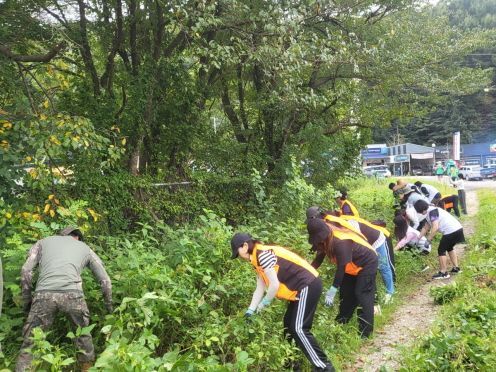 Paju City is conducting a project to remove invasive wild plants through cooperation between the public, private, and military sectors.
 Gyeonggi Paju City announced on the 25th the achievements of the invasive wild plant removal project carried out through cooperation between the public, private, and military sectors, and stated that it will continue activities to create a sustainable ecological environment.
Since April, the city has been engaged in removing invasive wild plants such as Ambrosia artemisiifolia (common ragweed). Given the widespread distribution of invasive wild plants, the city set a goal to remove 20% of the total distribution area. Gongneungcheon, a region closely connected to citizens' daily lives, was selected as a pilot area, and activity zones were designated by town and township to carry out intensive removal efforts.
So far, 581 people participated in five Gongneungcheon 'Pigweed Plogging' events, and a total of 2,776 people attended 67 'Invasive Wild Plant Removal Days' held in various towns and townships. Through collaboration among the public, private, and military sectors, a consensus on the importance of ecological conservation was formed, resulting in the removal of invasive plants over an area of 85,000㎡.
In particular, in September, during the peak removal period for invasive wild plants, towns, townships, and major facility departments collaborated with related organizations to carry out removal work for about two weeks. The work covered 59 locations including villages, sports facilities, and parks, with a removal area reaching 410,000㎡.
Additionally, by conducting contracted work simultaneously, invasive plants were removed from an area of 710,000㎡ including village roads (zones 1 and 2), Pyeonghwa Nuri-gil, Gongneungcheon, and Soricheon, maximizing the effectiveness.
Paju City achieved the initially planned 20% removal of invasive wild plants and will continue removal activities next year with the same budget as this year. Especially, to maximize efficiency, concentrated removal work using equipment will be conducted from early August to mid-September, the optimal removal period.
Kim Kyung-il, Mayor of Paju City, said, “The invasive wild plant removal project is essential to protect the ecosystem of native plants and to prevent health damage such as allergies among residents. The efforts made through the united hard work of the public, private, and military sectors are expected to greatly contribute to creating a pleasant environment.”
© The Asia Business Daily(www.asiae.co.kr). All rights reserved.
![Clutching a Stolen Dior Bag, Saying "I Hate Being Poor but Real"... The Grotesque Con of a "Human Knockoff" [Slate]](https://cwcontent.asiae.co.kr/asiaresize/183/2026021902243444107_1771435474.jpg)















