Criticism of Land in Forced Expropriation Zones and Imposition of Capital Gains Tax
"Land Seized Under the Guise of Public Interest, High Capital Gains Tax Imposed"
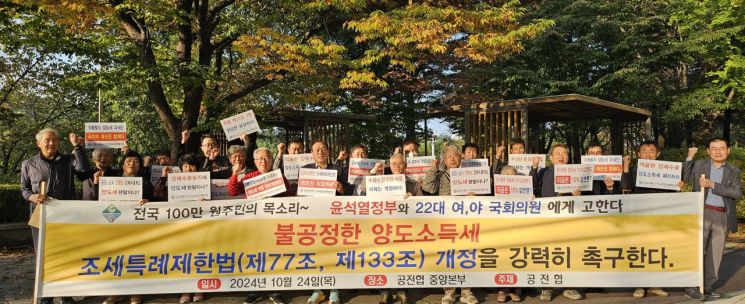 The National Solidarity Council for Public Housing Districts urged on the 24th for the amendment of the 'Restriction of Special Taxation Act' to expand capital gains tax reductions. Provided by Gongjeonhyeop.
The National Solidarity Council for Public Housing Districts (Gongjeonhyeop, Chairperson Lim Chaegwan) criticized the imposition of capital gains tax on forcibly expropriated land at a meeting held on the 24th at the Gongjeonhyeop headquarters conference room in Sunae-dong, Seongnam-si, Gyeonggi-do, and urged the revision of the 'Restriction of Special Taxation Act' to expand capital gains tax exemptions.
The meeting was attended by over 50 people, including representatives from residents' countermeasure committees in the metropolitan area such as Gyeonggi and Incheon, as well as from expropriation district residents' committees scattered nationwide in Busan, Daegu, Gwangju, and lawyers from the law firm How.
Chairperson Lim Chaegwan stated, “The original residents who were forcibly expropriated without receiving just compensation guaranteed by the Constitution during the development projects of public housing districts nationwide, including new towns, have lost their cherished homes and suffer the pain of having their houses and farmland, which they built with lifelong hard work and sweat, forcibly taken at low prices,” and criticized, “The government's unprincipled policy of imposing excessive capital gains tax on the expropriated persons, who are forcibly deprived of their houses and farmland under the pretext of public interest, is deplorable.”
Chairperson Lim emphasized, “I hope the government and lawmakers from both ruling and opposition parties will take steps to amend the Restriction of Special Taxation Act to expand capital gains tax exemptions and pay attention to protecting the rights and property of the one million expropriated persons who have suffered infringements on property rights and disadvantages.”
In cases where the state, local governments, and public institutions forcibly expropriate land to secure development project sites, most of the targeted land is farmland, and there is a large price gap before and after the development project. The problem, according to Gongjeonhyeop, is that there is an equity issue due to the large difference between the actual transaction prices of adjacent lands excluded from expropriation and the prices of expropriated land, and it is impossible to purchase replacement adjacent land at the expropriation price.
Meanwhile, in its statement released that day, Gongjeonhyeop urged the 'revision of the Restriction of Special Taxation Act' and simultaneously demanded measures such as the complete suspension of development plans using land expropriation methods or changes in development methods, avoidance of one-way, non-communicative, and unfair expropriation and development methods, establishment of communication channels for each project district, and guaranteeing residents' participation in public housing project proposals, urban planning reviews, and district planning processes.
© The Asia Business Daily(www.asiae.co.kr). All rights reserved.
![Clutching a Stolen Dior Bag, Saying "I Hate Being Poor but Real"... The Grotesque Con of a "Human Knockoff" [Slate]](https://cwcontent.asiae.co.kr/asiaresize/183/2026021902243444107_1771435474.jpg)















