Fed Releases Beige Book
Closer to Soft Landing than No Landing
"Easing Concerns Over Rate Freeze"
Last month, the Federal Reserve (Fed) reported that economic activity growth was barely detectable in most parts of the United States. Despite stronger-than-expected employment and consumption leading some to advocate for a 'rate hold,' the Beige Book suggests that the U.S. economy is on a soft landing trajectory rather than a no landing, providing grounds for the Fed to continue cutting interest rates.
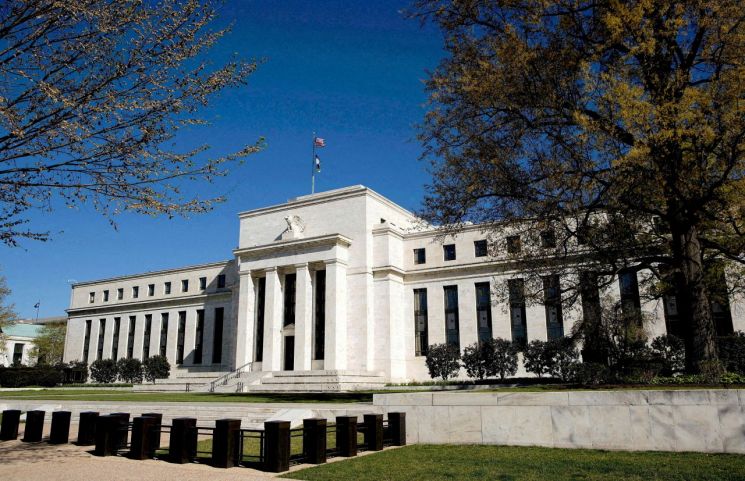
On the 23rd (local time), the Fed released its Beige Book, a report on economic conditions, stating that out of 12 districts, 10 showed almost no change in economic activity during September. The remaining two districts experienced modest growth.
Manufacturing activity declined in most regions. Employment generally increased slightly. The Fed noted that more than half of the districts reported slight or modest employment growth. Inflation trends generally continued to ease, while consumer spending varied by region. The Fed analyzed that in some areas, consumers were shifting toward cheaper alternatives.
Wall Street analysts interpret the Beige Book released that day as indicating that the U.S. economy is on a soft landing path, maintaining steady growth despite the tightening monetary cycle, rather than a no landing scenario. Although strong employment and consumption data last month raised expectations for no landing and a rate hold, the Beige Book’s assessment signals a gradual economic slowdown. A soft landing refers to a scenario where the economy declines moderately without a sharp recession or rising unemployment.
According to the September employment report released earlier by the U.S. Department of Labor, nonfarm payrolls increased by 254,000 last month, marking the largest gain in six months. Additionally, September retail sales rose 0.4% from the previous month, exceeding the forecast of 0.3%.
Nationwide’s Chief Economist, Kathy Bostjancic, said, "Contrary to the strong employment and consumption figures in September, the Beige Book shows that most regions nationwide experienced almost no economic growth," adding, "This is why the Fed needs to continue easing monetary policy." Bloomberg economist Eliza Winger also commented, "The Beige Book once again presents a soft landing picture," and analyzed, "The recent modest growth assessment will ease market concerns that the Fed might have to stop cutting rates."
According to the Chicago Mercantile Exchange (CME) FedWatch, the federal funds futures market on that day priced in over a 90% chance that the Fed will cut rates by 0.25 percentage points in November. The probability of a rate hold was 9.6%.
Additionally, the Beige Book mentioned about 15 times that the upcoming U.S. presidential election in November is a source of economic uncertainty, affecting consumption and corporate investment. The Fed stated, "Business contacts remain optimistic about the economic outlook but are cautious about employment and investment decisions." Earlier, the strike by port workers in the southeastern U.S. was assessed to have only temporary effects.
The Beige Book is a report evaluating economic conditions across the 12 Federal Reserve Bank districts. It serves as foundational material for the Federal Open Market Committee (FOMC) regular meeting scheduled for November 6-7.
© The Asia Business Daily(www.asiae.co.kr). All rights reserved.