SDV Experts Symposium in Daegu
The Korea Automobile Journalists Association and the Intelligent Automotive Parts Promotion Institute held a symposium on the 23rd at Daegu EXCO under the theme "The Direction of Automobiles, SDV (Software-Defined Vehicle) and Cybersecurity Enhancement Strategies." This event was organized as part of the first day of the 2024 Korea Future Mobility Expo (DIFA), which runs for four days starting from that day.
The reason for pointing out that the automotive industry is undergoing an unprecedented period of upheaval is related to the rise of SDV. Narrowly, it means that the importance of software in the process of using automobiles has increased, and broadly, it encompasses a completely changed situation from the perspective of suppliers who develop and produce automobiles. SDV is defined in the industry as "a continuously improvable intelligent and scalable mobile electronic terminal vehicle" (Deloitte) and "a concept and mechanism that abstracts vehicle hardware" (Denso).
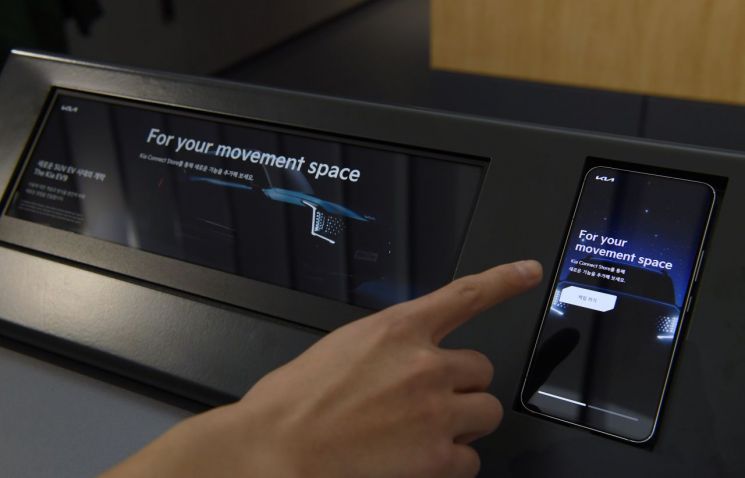 In SDV, the 'FoD (Features on Demand)' service allows customers to selectively purchase software features according to their needs. It was first applied to the Kia EV9, which was released last year.
 [Photo by Hyundai Motor Group]
Choi Jong-chan, National Standard Coordinator at the National Institute of Technology and Standards, said, "The most important topic currently is vehicle software," adding, "Since 2020, China's automotive industry has undergone innovative changes, and with autonomous driving demonstrations and electric vehicles leading the way, SDV has become a representative leading industry in China." He pointed out that as new industries emerged that did not exist before, standards have taken on an important role, and there is fierce competition for leadership surrounding SDV standards.
In the past, automobiles required individual electronic control units (ECUs) for each part such as the engine, transmission, and brakes. An ECU is a type of computer, analogous to the brain in humans. Automotive companies introduced a structure where ECUs integrate control by grouping parts with similar functions. ECUs control grouped parts such as electronic convenience and body, connectivity, powertrain, and electrification.
Recently, the zonal centralized approach has gained attention. Instead of parts, the vehicle body is divided into several zones for control. Just as hardware parts consist of tens of thousands of components, software also has numerous multi-layered structures. To integrate and control these various software components, a vehicle software platform is necessary. It functions similarly to a computer operating system (OS), controlling so that the in-vehicle communication system and functions operate organically.
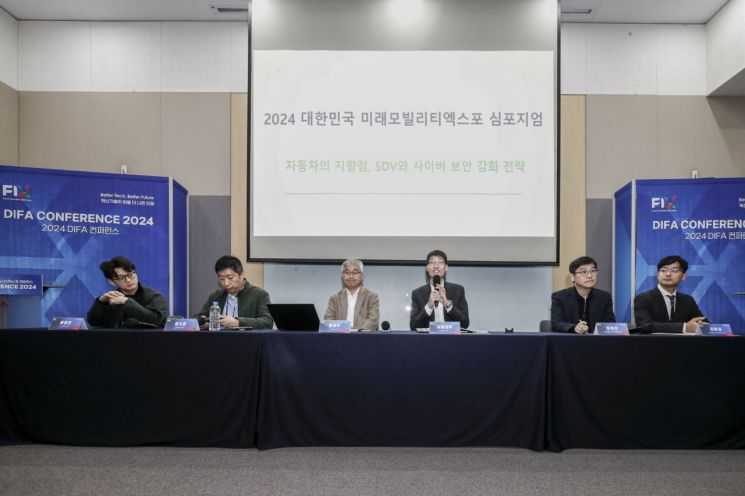 Participants are discussing at the symposium held on the 23rd at Daegu EXCO.
 [Photo by Korea Automobile Journalists Association]
Jung Ji-hoon, Head of Vehicle Electronics Software Center at Hyundai AutoEver, said, "The core of (SDV applications) is security, secure memory, communication diagnostics ODA," adding, "If linked with cloud and artificial intelligence (AI), it is expected to continue evolving." Hyundai AutoEver independently developed the Hyundai Motor Group’s standard vehicle software platform ‘Mobilize Classic.’ It is installed in all mass-produced vehicles of Hyundai, Kia, and Genesis. Only a few companies such as Toyota, Volkswagen Group, General Motors (GM), and Tesla have independently developed vehicle software platforms.
Kim Bong-seop, Head of Research and Development at the Intelligent Automotive Parts Promotion Institute, said, "The automotive industry has significant forward and backward linkage effects with machinery, batteries, steel, semiconductors, software, as well as robotics, defense, and shipbuilding, and the scalability of mobility is also very large," adding, "It is urgent to establish an ecosystem for supply chain independence and security assurance of SDV-oriented mobility parts and software."
Following the presentations, a discussion session was held. Professor Hong Sung-soo of Seoul National University said, "With the emergence of SDV, software is recognized as a very core automotive part in the automotive industry parts supply chain," adding, "Security vulnerabilities can occur throughout the entire process where such software parts are produced, verified, distributed, and used." Given that an attack on a single software component can affect millions of SDVs, Director Jung emphasized the need for strategies to effectively respond to security threats in the software supply chain.
© The Asia Business Daily(www.asiae.co.kr). All rights reserved.
![Clutching a Stolen Dior Bag, Saying "I Hate Being Poor but Real"... The Grotesque Con of a "Human Knockoff" [Slate]](https://cwcontent.asiae.co.kr/asiaresize/183/2026021902243444107_1771435474.jpg)
















