Altman-founded TFH 'Human Verification' Using Iris Data
Utilizing Personal Information to Distinguish AI from Humans
"Companies Must Set Boundaries on Biometric Data Collection"
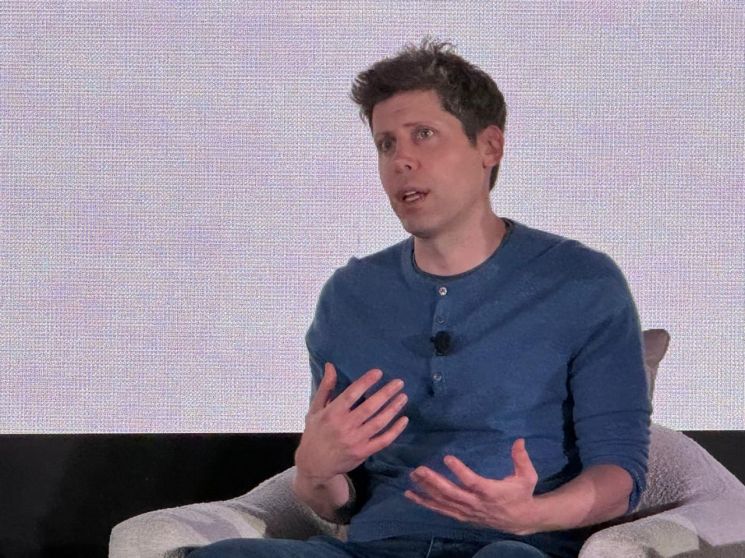 Sam Altman, co-founder of the virtual asset world developer 'Tools for Humanity (TFH),' is speaking at 'A New World' held in San Francisco, USA, on the 17th (local time).
 [Photo by Yonhap News]
“Tools for Humanity (TFH), co-founded by Sam Altman, the father of ChatGPT, is renaming its virtual asset Worldcoin to World, expanding its authentication methods, and focusing heavily on personal data collection. They aim to build an identity verification network using this information to distinguish between AI and humans. Altman’s vision for accelerating the era of AGI (Artificial General Intelligence) includes the need to advance technologies that can prove human identity. However, experts warn of potential misuse and urge caution regarding personal data collection. The capability to collect personal data could become a variable in realizing Altman’s ideals.
According to industry sources and foreign media on the 24th, Alex Blania, TFH co-founder, recently announced via social media the renewal of the project and his intention to develop private methods for individuals to prove their identity online. He also stated that they will continue to pursue decentralized projects to ensure everyone can benefit from AI.
Blania’s stance is similar to what was presented at TFH’s first official event, “A New World,” held on the 17th (local time). At this event, Blania revealed TFH’s rebranding and expansion strategy, focusing on expanding personal data collection and enhancing infrastructure for authentication. As stated during the “A New World” event and on social media, they have emphasized providing infrastructure that uses personal data such as iris scans to verify human identity.
To achieve this goal, TFH has been collecting iris data through a device called “Orb.” They collect personal data like iris information, blockchain it to manage without tampering or forgery, and propose a method to prove that humans are truly human in the AI era. TFH collects iris data, links it to the blockchain, creates a World ID, and rewards users with the virtual asset World. Through this renewal, they announced plans to also authenticate identity using passports with Near Field Communication (NFC) functionality and to launch a service next year where users can order an Orb via smartphone and have it delivered.
TFH designed the Orb to be equipped with NVIDIA’s Jetson, a robotics chip with AI performance approximately five times better than before, enabling much faster and more efficient process scaling. Unlike before, when they used other blockchain networks like Ethereum, they plan to directly manage digital identities by launching their own blockchain platform called World Chain.
This move is interpreted as groundwork to more firmly realize the AI world Altman envisions. The U.S. IT media TechCrunch stated, “The World project is based on the premise that within advanced AI systems, it will become impossible to distinguish whether an online conversation partner is a human.” They added, “This solution is a blockchain-based human verification service designed to ensure that everyone can enjoy the benefits of AI.” Given the serious problems that could arise from the difficulty in distinguishing humans from AI due to forgery, tampering, and deepfakes, being able to definitively prove humanity could also help accelerate the AI era.
Sam Altman, CEO of OpenAI, is deeply involved in TFH’s management. It is claimed that TFH holds personal data, uses it to increase users of World, and is pushing for integration with OpenAI and expansion of market share.
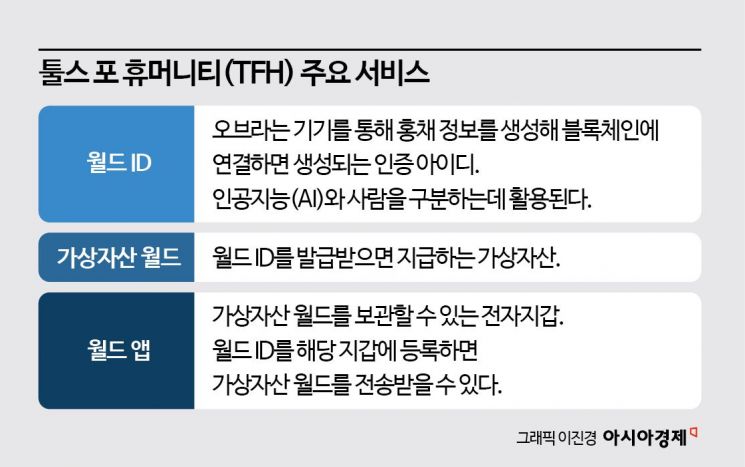
Blania told TechCrunch, “I talk with Altman about twice a week,” adding, “He participates in all decisions.” Altman indirectly revealed his involvement with TFH while expressing expectations. At the “A New World” event, he said, “I often joke that when in doubt, scale up,” and added, “Since 99.9% of the world’s population has not yet joined World, I want to see what happens when we build infrastructure for everyone and scale globally.” TechCrunch reported that Blania did not deny the possibility of integration between World and ChatGPT.
However, concerns have been raised about a specific company holding sensitive information such as iris data. Previously, the Personal Information Protection Commission imposed a fine of about 1.1 billion KRW on TFH, making worries about personal data leaks a reality. TFH collected iris data from about 30,000 domestic customers without properly notifying the purpose of collection and use, or the retention and usage period. It was also found that they transferred personal data overseas to countries like Germany without informing related notices.
Professor Kim Myung-joo of the Department of Information Security at Seoul Women’s University explained, “Biometric information such as iris data cannot be changed once collected until it is completely destroyed, so a more cautious approach is necessary,” and added, “We should be wary of companies collecting and managing biometric information.”
Glossary
© The Asia Business Daily(www.asiae.co.kr). All rights reserved.


















