An intelligent fire detection technology that can reduce false fire alarms (malfunctioning fire alarms) has been developed and is nearing commercialization. Researchers expect that applying this technology in the field will also reduce the social costs associated with false fire alarms.
The Electronics and Telecommunications Research Institute (ETRI) announced on the 23rd that it has developed an artificial intelligence sensor (hereinafter referred to as intelligent fire detection technology) that can prevent false fire alarms by measuring particle scattering degrees that vary according to the wavelength of light to distinguish between smoke and non-fire aerosols.
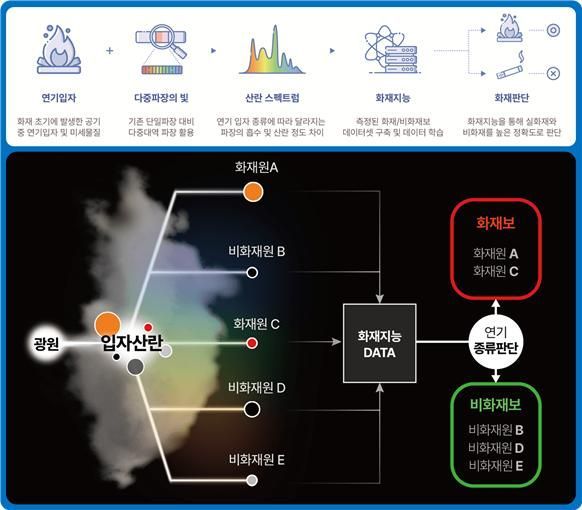 Conceptual diagram of intelligent fire detection technology. Provided by Electronics and Telecommunications Research Institute (ETRI)
Existing photoelectric fire detectors operate by arranging an infrared light source and a photodiode that detects light in a misaligned manner inside the detector. When particles such as smoke enter the detector, the photodiode captures the scattered light generated when the particles collide with the light source, and when the scattered light exceeds a certain level, an alarm sounds to indicate a fire situation.
However, since particles in aerosol form such as dust and moisture generated in daily life, smoke from cooking processes, and cigarette smoke can all enter the detector, there is a frequent drawback that alarms sound even in non-fire situations (scattered light detection).
According to data from the National Fire Agency, from 2021 to July 2022, there were a total of 258,220 cases where fire alarms sounded and fire trucks were dispatched, of which 96.6% were found to be alarms caused by malfunctions.
On the other hand, the intelligent fire detection technology measures the unique scattering characteristics of aerosol particles using various wavelengths of light and accurately determines whether a fire has occurred based on this, which ETRI explains can drastically reduce cases where frontline firefighters make futile trips due to false alarms caused by malfunctions.
Previously, ETRI projected multiple wavelengths of light onto aerosol particles and measured the scattering degrees of each to build a database (DB).
They then integrated the constructed DB with artificial intelligence technology so that the AI sensor for preventing false alarms detects aerosol particles according to the situation and determines whether a fire has occurred, allowing the alarm to sound only when a fire actually happens.
ETRI plans to first apply the intelligent fire detection technology to air-suction type detectors.
Air-suction type detectors operate on a principle similar to photoelectric detectors but use a fan to suck in air and quickly detect smoke. This method detects faster than photoelectric detectors but has the possibility of malfunction due to dust and moisture, so it is installed and used only in limited places such as semiconductor cleanrooms and server rooms.
Currently, most air-suction type detectors distributed in the market are expensive products imported from overseas. Also, they do not yet have the function to distinguish between fire and non-fire.
Considering this, ETRI expects that if a domestically produced product applying intelligent fire detection technology is released, it will be competitive in the fire detector market.
Lee Kang-bok, head of the Defense Safety Intelligence Research Lab at ETRI, said, “Once the intelligent fire detection technology is commercialized, it will drastically reduce cases where firefighters are dispatched due to false alarms in non-fire situations,” adding, “This will bring about cost savings related to fire dispatches amounting to 20 billion KRW annually and reduce the waste of firefighting resources.”
Meanwhile, this research was conducted as part of the ‘ETRI Research and Development Support Project’ supported by the Ministry of Science and ICT and the Institute for Information & Communications Technology Planning & Evaluation (IITP) (project titled ‘Development of Intelligent Fire Detection Equipment Based on Smoke Particle Spectrum Analysis’).
© The Asia Business Daily(www.asiae.co.kr). All rights reserved.
![Clutching a Stolen Dior Bag, Saying "I Hate Being Poor but Real"... The Grotesque Con of a "Human Knockoff" [Slate]](https://cwcontent.asiae.co.kr/asiaresize/183/2026021902243444107_1771435474.jpg)















