Hankyung Association Hosts International Seminar with Former World Bank Director Hawkman
"Increased Trade Uncertainty After US Election... Calls for CPTPP Membership Discussion" Recommendations
As global trade policies increasingly revolve around "industrial policies disguised as protectionism," an international trade expert advised that it is crucial to thoroughly understand the policy goals of the United States, China, and the European Union (EU). This includes proactively identifying non-economic policy objectives such as environmental policies implemented under carbon neutrality, labor, human rights, and values, in order to reduce costs. It was pointed out that responding reactively after regulatory policies like the EU Carbon Border Adjustment Mechanism (CBAM) are introduced is too late.
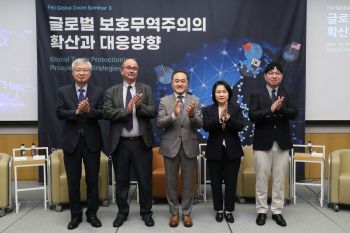 Jeong Cheol, Chief Research Officer of the Korea Economic Research Institute and President of the Korea Economic Research Institute, along with other guests, are taking a commemorative photo at the seminar titled "The Spread of Global Protectionism and Response Directions" held on the 23rd at the FKI Tower Conference Center in Yeouido, Seoul.
 From the left: Lee Tae-ho, Advisor at Law Firm Gwangjang; Bernard Hawkman, Professor at the European University Institute; President Jeong; Yoo Myung-hee, Professor at Seoul National University; Lee Si-wook, President of the Korea Institute for International Economic Policy.
[Photo by Korea Economic Research Institute]
Bernard Hoekman, professor at the European University Institute and former director of the World Bank’s International Trade Department, said at a seminar titled "The Spread of Global Protectionism and Response Directions," hosted by the Korea Economic Association at the FKI Tower in Yeouido, Seoul on the 23rd, "Trade responses should be made after first distinguishing the goals of each government." The seminar was attended by Professor Hoekman, Jung Chul, research chief and president of the Korea Economic Research Institute, Lee Si-wook, president of the Korea Institute for International Economic Policy, Yoo Myung-hee, professor at Seoul National University and former chief trade negotiator, and Lee Tae-ho, advisor at the law firm Kwangjang.
Professor Hoekman reported that advanced countries are leading the spread of protectionism. Among 1,806 global trade policies announced or implemented last year, 1,030 (57.0%) involved subsidies. He explained, "According to the Global Trade Alert (GTA), a trade research institute, about 1,800 trade policies were implemented last year, of which 70.9% were executed by advanced countries, and 47.7% were led by China, the EU, and the United States."
Notably, advanced countries’ trade policies are driven by non-traditional motives such as climate change response (28.1%) and supply chain stability (15.2%). This means that advanced countries are pursuing non-traditional trade policies rather than traditional motives like resolving trade deficits or revitalizing the domestic economy.
Professor Hoekman said, "The protectionism currently pursued by countries is an industrial policy disguised as protectionism," adding, "It is a policy that justifies government intervention to provide credit in financial markets to prevent specific market failures." He continued, "In particular, to respond to non-economic trade policies related to values, human rights, labor, environmental protection, and international standards, governments must first identify which of these they prioritize most and respond efficiently."
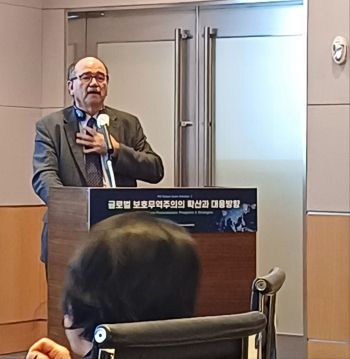 Professor Bernard Hawkman of the European University Institute is giving a presentation forecasting the trends of global protectionism at the seminar "The Spread of Global Protectionism and Response Directions," held on the 23rd at the FKI Tower Conference Center in Yeouido, Seoul.
 [Photo by Moon Chaeseok]
Lee Si-wook predicted that both Donald Trump, the Republican candidate, and Kamala Harris, the Democratic candidate, would strengthen sanctions against China in the U.S. presidential election. He said that if Trump implements tax cuts over ten years, a fiscal deficit of $4.5 trillion to $10 trillion (approximately 6,220 trillion to 13,825 trillion KRW) could occur, and policy focus would be on covering this deficit. Lee noted, "Trump admires William McKinley, the 25th president, who implemented protectionist policies through tariff increases and immigration restrictions," adding, "There is a possibility that Korea could face pressure over the U.S. trade surplus issue."
He added, "If Harris is elected, the U.S. could implement a CBAM-like policy," and "Issues that were previously resolved through inter-state disputes (ISD) in labor could shift to state-to-corporate disputes, so companies need to prepare for this."
There was also a suggestion to discuss joining the Comprehensive and Progressive Agreement for Trans-Pacific Partnership (CPTPP). Lee Tae-ho, advisor at the law firm Kwangjang, said, "The current situation, where protectionism is used as an important policy tool amid the shift from free trade to economic security, is very challenging for Korea," and recommended, "The long-stalled discussions on joining the CPTPP should be actively pursued."
Yoo Myung-hee, professor at Seoul National University and former chief trade negotiator under the Moon Jae-in administration, emphasized the need to establish a multi-layered response system to prepare for uncertainties. Professor Yoo said, "Trade policies linked to values such as environment, labor, and human rights are emerging," and stressed, "We need to reorganize trade policies focusing on supply chains, advanced technologies, and carbon neutrality, and strengthen strategic cooperation with major countries." She added, "We must build a multi-layered response system to uncertain trade environments and enhance expertise to improve risk response capabilities."
The Korea Economic Association also announced plans to release high-quality analytical reports on the ripple effects of carbon neutrality-related policies like the EU CBAM on the international trade environment. Jung Chul, research chief and president of the Korea Economic Research Institute, said in his opening remarks, "The Korea Economic Association plans to proactively identify anticipated issues arising from the rapidly changing external trade environment and support companies’ smooth responses to global protectionism," adding, "We will analyze the domestic economic impact of new trade environments such as the EU’s CBAM and the U.S. Clean Competition Act and propose countermeasures to minimize these effects."
© The Asia Business Daily(www.asiae.co.kr). All rights reserved.
![Clutching a Stolen Dior Bag, Saying "I Hate Being Poor but Real"... The Grotesque Con of a "Human Knockoff" [Slate]](https://cwcontent.asiae.co.kr/asiaresize/183/2026021902243444107_1771435474.jpg)

















