Partnering with Companies in Seocho, Songpa, Gangdong, and Dongjak Districts
Seocho District Achieves Annual Cost Savings of 80 Million KRW
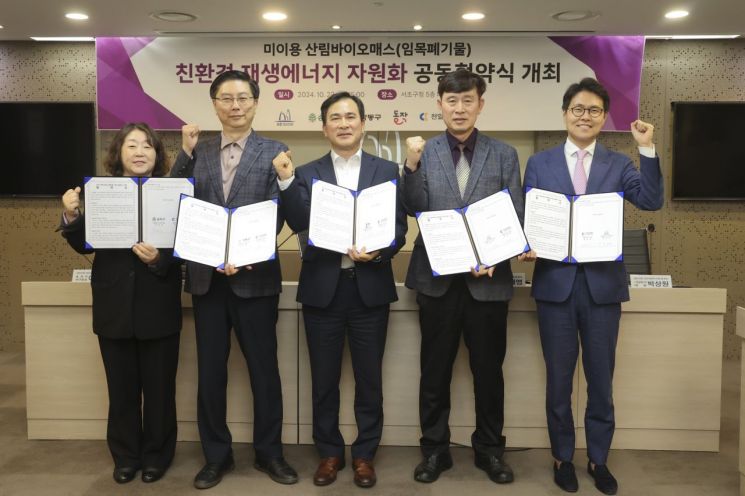 Ceremony scene (from left: Lee Hye-kyung, Deputy Mayor of Songpa-gu; Kim Kyung-tak, Deputy Mayor of Gangdong-gu; Jang Young-min, Deputy Mayor of Dongjak-gu; Kim Tae-myung, Deputy Mayor of Seocho-gu; Park Sang-won, CEO of Cheonil Energy). Provided by Seocho-gu.
Seocho-gu, Seoul (District Mayor Jeon Seong-su) announced on the 23rd that on the 22nd, it signed a joint agreement with three districts?Songpa-gu, Gangdong-gu, and Dongjak-gu?and the eco-friendly energy innovation company Cheonil Energy (CEO Park Sang-won) for the resource recycling of woody waste.
Through this agreement, each district will be able to freely recycle unused forest biomass, a type of woody waste generated from urban forest maintenance, into eco-friendly renewable energy wood chips.
Unused forest biomass refers to forest byproducts generated from forest management activities that do not meet the standards for raw timber or are difficult to collect, making their use challenging. These mainly include byproducts from forest maintenance or tree cutting and pruning for roadside tree creation and management.
With this agreement, each district will recycle all forest resources (urban forests) that were previously treated as woody waste into eco-friendly renewable energy wood chips, completely eliminating the budget previously required for woody waste disposal. The processed wood chips will be used as renewable energy in power plants, which is expected to reduce carbon emissions.
In the case of Seocho-gu, it is expected to save about 80 million KRW in disposal costs for approximately 825 tons of woody waste annually and reduce greenhouse gas emissions by about 590 tons of CO2 equivalent (tonCO2).
District Mayor Jeon Seong-su said, “With this joint agreement, four neighboring autonomous districts have cooperated to recycle unused forest biomass in the region into eco-friendly renewable energy. We expect this to greatly help us move toward an eco-friendly city that responds to the national carbon neutrality policy by practicing environmental protection through budget savings and resource circulation.”
© The Asia Business Daily(www.asiae.co.kr). All rights reserved.
![Clutching a Stolen Dior Bag, Saying "I Hate Being Poor but Real"... The Grotesque Con of a "Human Knockoff" [Slate]](https://cwcontent.asiae.co.kr/asiaresize/183/2026021902243444107_1771435474.jpg)















