KOSPI Falls to 2570 Level
Samsung Electronics Slumps Due to Foreign Selling
Samsung Electronics Hits 52-Week Highs Consecutively
Samsung Electronics Surpasses 16% of KOSPI Market Cap
The KOSPI has fallen below the 2600 level again. The continued foreign selling pressure on the leading stock Samsung Electronics for 30 consecutive days has led to the sluggish performance of Samsung Electronics' stock price. Additionally, uncertainties surrounding the U.S. presidential election and concerns over weak corporate earnings in the third quarter are weighing on the KOSPI. It is expected to fluctuate around the 2600 level for the time being.
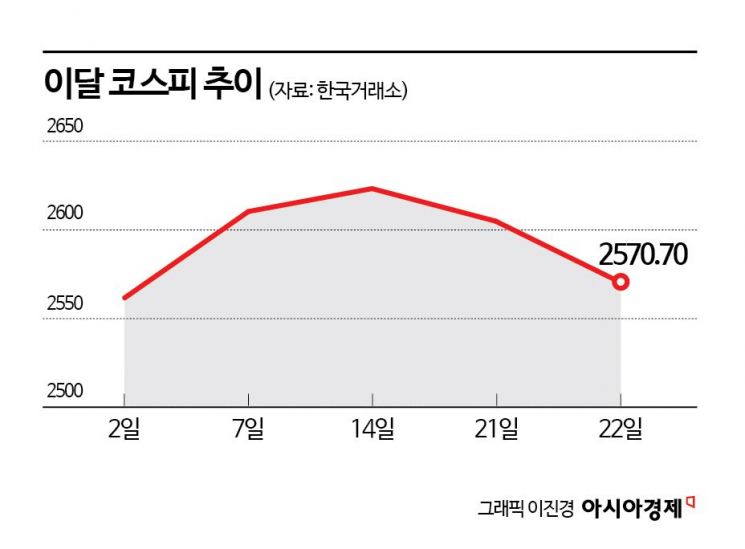
According to the Korea Exchange on the 23rd, the KOSPI closed at 2570.70, down 1.31% from the previous session. The 2600 level was broken again after just one day. Since the beginning of this month, the KOSPI has been attempting to stabilize above 2600, recovering to the 2630 level on the 15th, but the stock price has weakened again, falling back to the 2570 level.
The main reason for the sluggish trend in the KOSPI can be found in the poor performance of the leading stock Samsung Electronics. Samsung Electronics has been hitting new 52-week lows continuously due to ongoing foreign selling pressure. On the previous day, it closed at 57,700 KRW, down 2.20%, breaking below the 58,000 KRW level. Samsung Electronics has fallen 6.18% this month. During the same period, the KOSPI dropped by 0.87%.
Foreign net selling of Samsung Electronics shows no signs of stopping. Until the previous day, foreigners have net sold Samsung Electronics for 30 consecutive trading days. The continuous net selling has been breaking the longest net selling record day by day. During this period, the scale of foreign net selling of Samsung Electronics reached 11.908 trillion KRW. In the same period, foreign net selling of the KOSPI was 10.6472 trillion KRW, reflecting the impact of the selling pressure on Samsung Electronics directly on the KOSPI. Jeong In-ji, a researcher at Yuanta Securities, analyzed, "The peak of cumulative foreign net buying in the KOSPI market since the beginning of the year was on July 11, and since then until the 21st of this month, foreign net selling amounted to 14.8 trillion KRW, of which 14 trillion KRW was net selling of Samsung Electronics. Excluding Samsung Electronics, foreign selling was actually very minimal."
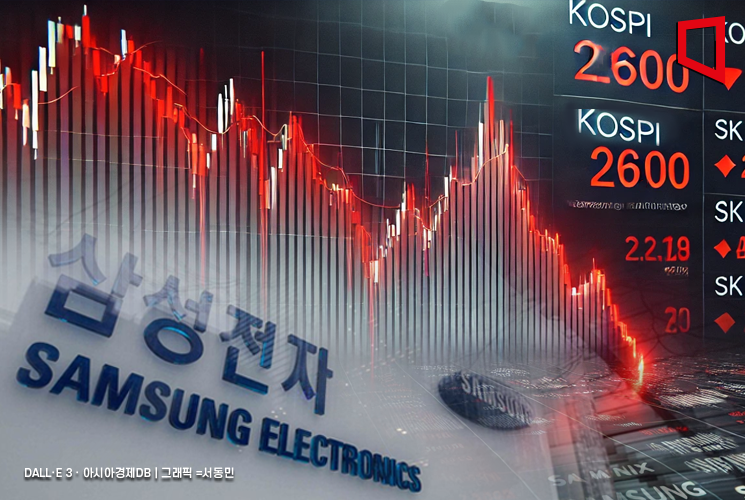
The market capitalization of the KOSPI has decreased by about 19 trillion KRW this month, while Samsung Electronics' market capitalization decreased by 20 trillion KRW during the same period. Samsung Electronics accounts for 16.43% of the KOSPI.
As Samsung Electronics continues its downward trend without finding a bottom, the KOSPI is also expected to face a challenging trend. In addition, uncertainties surrounding the U.S. presidential election and concerns over third-quarter corporate earnings are also cited as factors hindering the KOSPI's rise. Jo Jun-gi, a researcher at SK Securities, said, "For the time being, the domestic stock market is most likely to be influenced by three variables: the third-quarter earnings season, the U.S. presidential election, and China's stimulus measures."
From this week, corporate third-quarter earnings will begin in earnest, but the atmosphere is not optimistic. Byun Jun-ho, a researcher at IBK Investment & Securities, said, "As the earnings season begins in earnest, there is a phase where interest in fundamentals centered on corporate earnings can expand again. Considering recent growth rate slowdown, the sharp drop in the won-dollar exchange rate in the third quarter, and the poor performance of Samsung Electronics, which are major variables related to earnings, the third-quarter earnings season is expected to see earnings announcements that meet or slightly fall short of market expectations rather than surprising results that exceed expectations."
Uncertainty related to the U.S. presidential election is also negatively affecting the stock market. Researcher Byun said, "The market is concerned about risks associated with the possibility of Donald Trump's election, including dollar strength, expanded geopolitical risks such as U.S.-China conflicts, trade contraction due to tariff increases, and the resurgence of inflation. Additionally, historically, global and domestic stock markets tend to face correction pressures before the U.S. presidential election, and in the case of the domestic stock market, this correction pressure has intensified as the election approaches. This shows a strong tendency to avoid uncertainty right before the U.S. presidential election."
© The Asia Business Daily(www.asiae.co.kr). All rights reserved.
![Clutching a Stolen Dior Bag, Saying "I Hate Being Poor but Real"... The Grotesque Con of a "Human Knockoff" [Slate]](https://cwcontent.asiae.co.kr/asiaresize/183/2026021902243444107_1771435474.jpg)
















