'20th Anniversary Innovation Plan for City Bus Semi-Public Operation System' Announced
Strict Management of Private Capital... No Excessive Profits Allowed
Reform of Financial Support Method... Encouraging Voluntary Innovation
Route Curvature Eased and Some Routes to Be Discontinued
"Some private capital is undermining the public nature of the transportation industry... We will thoroughly block 'meoktwi' (asset stripping)."
Seoul Mayor Oh Se-hoon has launched a major overhaul of city bus operations. He plans to improve the previously one-sided financial support structure to encourage management innovation and strictly filter private capital to maximize public interest. Bus routes will also be revised for the first time in 20 years, including the elimination of long-distance and overlapping routes.
On the 22nd, Mayor Oh announced the "20th Anniversary Innovation Plan for the City Bus Semi-Public Operation System" at Seoul City Hall. Introduced by Seoul in July 2004 as the nation's first, the 'city bus semi-public operation system' maintains the form where private transportation companies supply services, but the revenue generated from bus transportation is jointly managed by the companies and local governments. However, if total costs exceed total revenue resulting in a deficit, the local government provides financial support.
However, maintaining the semi-public system for 20 years has increased Seoul City's financial burden. Mayor Oh also pointed out, "The financial support amounting to several hundred billion won annually has increased Seoul City's burden," and "Various problems have arisen, such as concerns over the erosion of public interest due to the entry of private capital and a route system that does not adequately respond to transportation demand." However, switching to a fully public system is not easy. Compared to the current semi-public system, a public system involves higher initial financial burdens such as route rights and vehicle acquisition, and continuous financial expenditures. Moreover, excessive competition among transportation companies leads to a focus solely on profit, lowering service quality and neglecting investment in citizen safety."
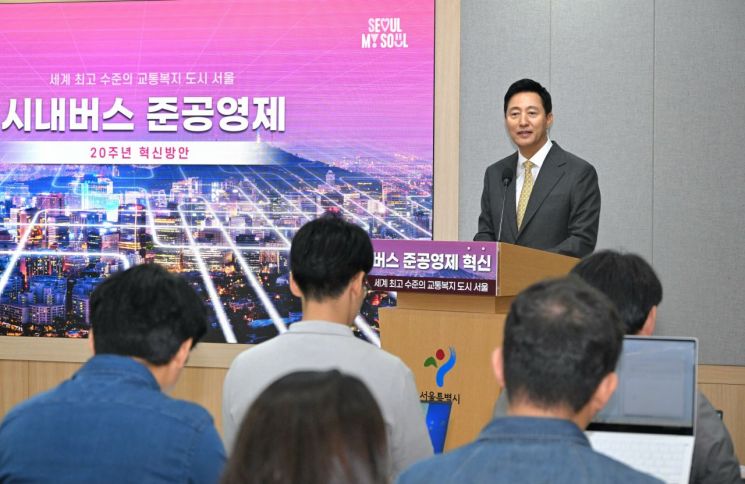 On the 22nd, Seoul Mayor Oh Se-hoon announced the "20th Anniversary Innovation Plan for the Semi-Public Operation System of City Buses," focusing on the reorganization of the city bus operation system at Seoul City Hall.
 [Photo by Seoul City]
Innovation for sound finances and securing public interest... Oh Se-hoon-style private capital 'meoktwi' prevention measures draw attention
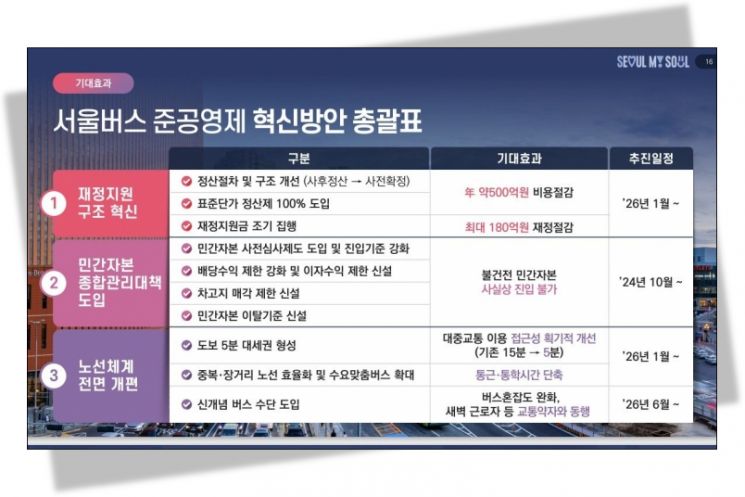
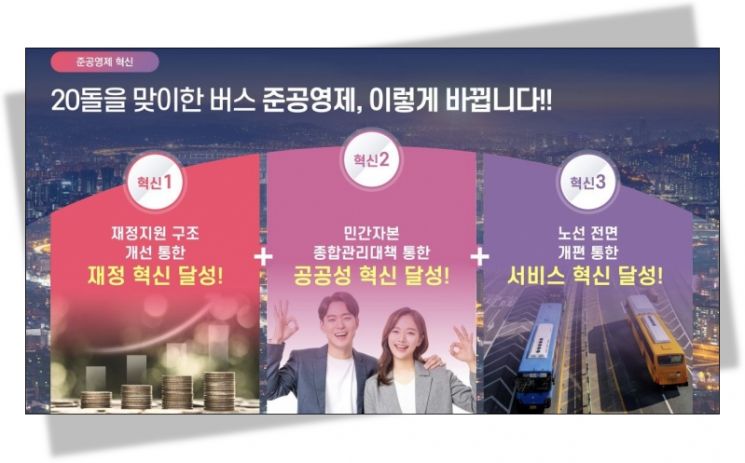
Accordingly, Seoul has chosen to improve the semi-public system by minimizing the disadvantages of both public and private systems and maximizing the advantages of each. The core of this measure is innovation in three major areas: ▲ finance ▲ public interest ▲ service.
The most notable aspect is the comprehensive management plan for private capital. Currently, private capital such as private equity funds, which perceive semi-public transportation companies as stable investment targets, have acquired six Seoul city bus companies. This is to address concerns about potential damage to public interest. Mayor Oh said, "Currently, some private equity funds and other private capital have acquired six bus companies and then resold them in a short period, causing cases that undermine public interest," and promised, "From now on, we will create a structure that prevents the entry of unsound capital and excessive profits." Seoul City is currently discussing systematic management plans by establishing guidelines at each stage, including before and after entry and upon exit.
In particular, a pre-screening system based on strict entry criteria will be introduced to restrict the entry of unsound, foreign capital, and capital seeking excessive profits. Furthermore, foreign capital and asset management companies will be banned from entry, and domestic asset management companies will only be given opportunities if they have been established for more than two years. To ensure the effectiveness of pre-entry management measures, Seoul City plans to revise the ordinance related to the operation of the semi-public system within this year in cooperation with the city council.
Management of private capital that has already entered will also be strengthened. Dividend payout ratios exceeding 100% will be prohibited, and a mandatory holding of one month's worth of cash assets (working capital) will be enforced to limit dividend income. Additionally, prior notification will be required when issuing corporate bonds, and if interest expenses increase due to corporate bonds, this will be reflected in company evaluations to establish a structure that prevents excessive profit-seeking.
The so-called 'meoktwi'?where private capital exploits loopholes in the semi-public system by selling off valuable assets and quickly liquidating and exiting the transportation industry?will also be blocked at the source. If a garage is sold arbitrarily, garage rental fees will not be supported. To induce stable and long-term investment by private capital, if resale occurs within five years after initial entry or to foreign capital, 200 points will be deducted from the company evaluation for five years, creating a structure that fundamentally prevents 'meoktwi.'
The financial operation method will also change through improvements in the financial support structure. The current 'post-settlement system,' which fully compensates for transportation deficits after settlement, will be replaced by a 'pre-determined system' that sets total revenue and total costs in advance for the following year and supports only the difference. The existing full compensation 'post-settlement system' provided no incentive for transportation companies to actively reduce costs, but with the change to the 'pre-determined system,' companies will need to voluntarily increase revenue and reduce costs, driving management innovation. Additionally, switching to the pre-determined system will simplify settlement tasks, reduce settlement personnel, decrease administrative costs, and is expected to save up to 18 billion won annually in loan interest and other expenses.
The compensation method for labor and fuel costs will also be revised. The current reimbursement method, which fully compensates actual expenses regardless of amount, will be changed to a standard unit price reimbursement system (hereafter, standard reimbursement system) that sets upper limits. Currently, actual cost reimbursement applies to two items?driver labor costs and fuel costs?which account for 85% of the standard transportation cost, while other items such as tire costs, maintenance costs, and labor costs for maintenance and management staff are subject to the standard reimbursement system with limits based on the number of vehicles or operating distance.
Increased route curvature slows travel speed... Achieving 'large catchment areas' through route reorganization
Route reorganization will also be promoted. Although service quality greatly improved through the reorganization of main and branch routes and the establishment of central bus-only lanes at the time of the semi-public system introduction, after 20 years, service levels have declined due to increased route curvature causing slower travel speeds and overlaps with other transportation modes.
Accordingly, Seoul plans to realize 'large catchment areas' where any Seoul citizen can access public transportation within a 5-minute walk through a complete overhaul of bus routes. This approach builds a public transportation system centered on cost-effective buses instead of railways, which require long construction periods and massive construction and operating costs.
Double-decker buses will be deployed mainly on main routes with low curvature where passenger congestion is severe. Autonomous buses will be prioritized on routes with many early morning and late-night workers, such as cleaning and security staff, during times when driver supply is difficult. Demand-responsive transportation will be introduced in areas with a high elderly population or near social welfare facilities.
Seoul has been consulting with stakeholders such as the bus association since January. From next year, it plans to promote institutional improvements for the full route reorganization and the implementation of the pre-determined system. Mayor Oh said, "By achieving three innovations in finance, public interest, and service to mark the 20th anniversary of the semi-public system, we will realize reliable transportation welfare that citizens can feel convenient and satisfied with in their daily lives, and through this, establish Seoul city buses as the world's top-level."
© The Asia Business Daily(www.asiae.co.kr). All rights reserved.
![Clutching a Stolen Dior Bag, Saying "I Hate Being Poor but Real"... The Grotesque Con of a "Human Knockoff" [Slate]](https://cwcontent.asiae.co.kr/asiaresize/183/2026021902243444107_1771435474.jpg)

















