Diverse Nationalities Including Nepal, Brazil, and Egypt
Amid growing international concerns over North Korea's deployment of troops to the Ukraine war, reports have emerged that a significant number of foreign soldiers sent to the front lines to fight for the Russian military were deceived into enlisting without knowing they would be deployed in combat.
The British current affairs weekly The Economist reported on the 20th (local time) that the number of foreign soldiers deployed for the Russian military in the Ukraine war is estimated to be in the thousands to tens of thousands. Their nationalities were diverse, including Nepal, Slovakia, Brazil, India, Egypt, Cuba, Sri Lanka, and Serbia.
After interviewing several foreign nationals of the Russian military captured as prisoners by the Ukrainian forces, The Economist found that most claimed they were deceived into being sent to the battlefield.
Prisoner A, from Nepal, said he went to Russia to study abroad but ended up enlisting. A claimed that after being deceived by the agency that arranged his studies and unable to pay university tuition, he desperately signed a contract with the Russian military. He was told he would only help the wounded, but he was actually deployed to the front lines, according to A.
Prisoner B, from Slovakia, admitted volunteering for the military because he needed citizenship, but claimed that although he was promised to only dig trenches and build bunkers, he was sent right into the middle of the battlefield.
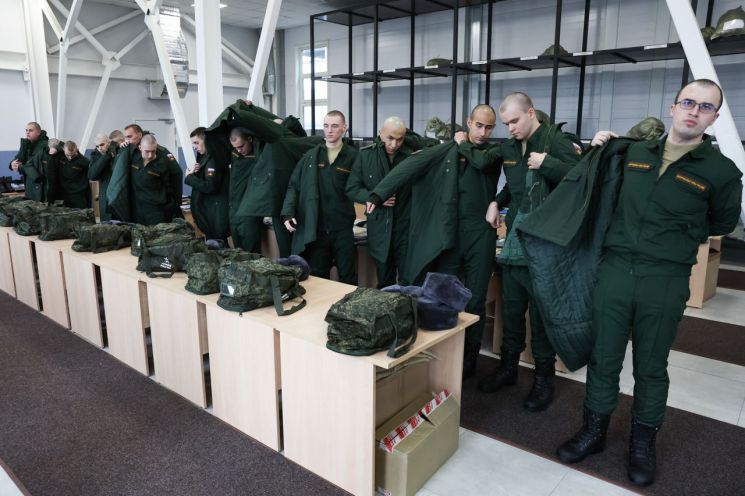 Conscripts receiving uniforms at a Russian conscription office on the 15th. [Image source=TASS Yonhap News]
Prisoner C, a Brazilian national residing in Australia, said he came to Russia after receiving a job offer from an IT company and only later learned that the company worked for the Russian military intelligence. He protested to the company that he did not come to Russia for such work, but was eventually sent to the front lines and was even threatened with arrest or execution if he tried to escape.
Among them, it is presumed that some mercenaries voluntarily enlisted. C claimed to have witnessed Chinese special forces during training and met an Iranian commander who spoke Russian. It is reported that they receive a monthly salary of $2,000 (about 2.7 million KRW) and participate in combat.
It is explained that a significant number of these foreign soldiers were effectively used as "cannon fodder" on the battlefield. A Ukrainian intelligence official told the media, "Because they were deliberately sent ahead of the Russian troops to identify the positions of the Ukrainian forces, many of them have died."
In particular, since fighting for foreign armies is illegal in many countries, these soldiers may face imprisonment upon returning home.
The Economist reported that there were 16 foreign soldiers in a prisoner camp in the Lviv region alone, with even more in other camps. Aside from Russia, the most common nationalities among the prisoners were Sri Lanka and Nepal.
© The Asia Business Daily(www.asiae.co.kr). All rights reserved.
![Clutching a Stolen Dior Bag, Saying "I Hate Being Poor but Real"... The Grotesque Con of a "Human Knockoff" [Slate]](https://cwcontent.asiae.co.kr/asiaresize/183/2026021902243444107_1771435474.jpg)















