Doosan Group Reinitiates Merger to Synergize Energy and Construction Sectors
Doosan 3 CEOs Apologize for Lack of Communication... Will Enhance Shareholder Value
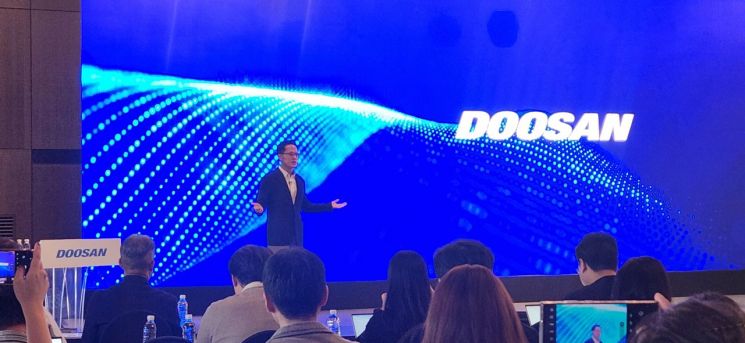 Park Sang-hyun, CEO of Doosan Enerbility, is explaining the purpose of business structure reorganization and synergy at the Doosan press conference held on the afternoon of the 21st at The Plaza Hotel in Seoul. Photo by Jeong Dong-hoon
Doosan Group is resuming its business restructuring plan to merge Doosan Bobcat and Doosan Robotics.
The CEOs of Doosan Enerbility, Doosan Bobcat, and Doosan Robotics held a press conference on the 21st at The Plaza Hotel in Jung-gu, Seoul, where they apologized for the confusion caused by insufficient communication with shareholders and the market during the business restructuring process. They stated, "The purpose of the business restructuring is to increase investment capacity through efficient asset reallocation and to maximize synergy effects by grouping related business areas." They emphasized, "Through this, we will rapidly grow the company's value and enhance shareholder value."
Merger ratio increased by 30% to 1 to 0.043 compared to the previous plan
Park Sang-hyun, President and CEO of Doosan Enerbility; Scott Park, Vice Chairman and CEO of Doosan Bobcat; and Ryu Jeong-hoon, Vice President and CEO of Doosan Robotics, personally conducted the presentation. The three CEOs disclosed the split-merger ratio and explained the purpose and synergy effects of this business restructuring.
In July this year, Doosan announced and pursued a business restructuring plan to separate Doosan Enerbility into a newly established corporation holding Doosan Bobcat shares and then merge it with Doosan Robotics. The previous plan, which adopted a comprehensive stock exchange method, was withdrawn at the end of August due to shareholder opposition and pressure from financial authorities.
On this day, Doosan reassessed the value of the newly established corporation from the split of Doosan Enerbility holding Doosan Bobcat and changed the merger ratio so that Doosan Enerbility shareholders could receive more Doosan Robotics shares than before. The intrinsic value of the newly established split-merger corporation rose nearly threefold from 10,221 KRW per share to 29,965 KRW. Accordingly, the common stock merger ratio between Doosan Robotics and the split newly established division of Doosan Enerbility increased by nearly 30%, from 1 to 0.031 to 1 to 0.043.
In other words, shareholders holding 100 shares of Doosan Enerbility will receive 88.5 shares (previously 75.3 shares) of Doosan Enerbility and 4.33 shares (previously 3.15 shares) of Doosan Robotics through the split-merger. Compared to before the ratio change, shareholders will receive more shares. When simply converted based on the closing price on July 11 (board meeting), the value of the shares held increases by approximately 390,000 KRW compared to the previous plan.
Park Sang-hyun, President of Doosan Enerbility, said, "We changed the split-merger ratio to provide shareholders with as many shares as possible," adding, "We expect the growth of both Doosan Enerbility and Doosan Robotics to accelerate further through this business restructuring." He emphasized, "Doosan Enerbility shareholders will simultaneously hold shares of both companies, whose values will increase, allowing them to expect additional future profits."
Park Sang-hyun, President of Doosan Enerbility: "1 trillion KRW capacity, immediate investment in nuclear power and SMR"
Park said, "By disposing of non-operating assets and securing over 1 trillion KRW in investment capacity, we will promptly invest in large nuclear power plants, small modular reactors (SMR), gas and hydrogen turbines, where demand is increasing, to seize the market in a timely manner."
Regarding large nuclear power plants, the industry expects the possibility of orders for a total of 10 units: 2 units in the Czech Republic (with potential for 2 more), 2 to 4 units in the United Arab Emirates (UAE), 2 units in Poland or Saudi Arabia, and 2 units in Northern European countries such as Sweden or the Netherlands. Additionally, Doosan Enerbility aims to secure about 62 SMR orders over the next five years and plans to expand SMR production facilities capable of manufacturing about 20 units annually through active facility investment.
Park stated, "Last week, Amazon's $500 million (approximately 689 billion KRW) investment in X-Energy was announced, and Newscale Power is also reportedly negotiating power supply with other big tech companies. With such U.S. big tech investments in SMR expanding significantly, there is a high possibility of exceeding the initially set order targets."
He added, "The expected return on investment when making additional investments with the funds secured through this restructuring is anticipated to be over 15%, which is higher than the existing dividend income from Doosan Bobcat. We expect to achieve an additional operating profit of 200 billion KRW by 2028."
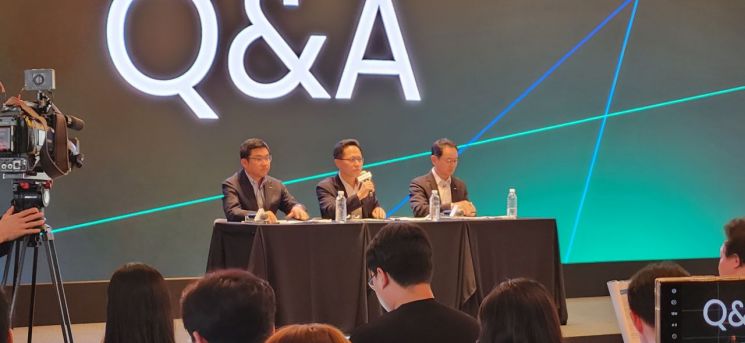 Park Sang-hyun, CEO of Doosan Enerbility (center), Ryu Jeong-hoon, CEO of Doosan Robotics (left), and Scott Park, CEO of Doosan Bobcat (right), are explaining the purpose of business structure reorganization and synergy at the Doosan press conference held on the afternoon of the 21st at The Plaza Hotel in Seoul. Photo by Jeong Dong-hoon
Robotics and Bobcat Targeting 120 Trillion KRW 'Professional Services' Market in Agriculture and Construction by 2030 through Merger Synergies
CEO Ryu said, "The professional services market in agriculture and construction is estimated to grow to about 120 trillion KRW by 2030, but there is no overwhelming leader in this field yet. Doosan Robotics, ranked 4th globally in collaborative robots with the most diverse lineup, and Doosan Bobcat, a global top-tier company in construction, agriculture, and logistics, can dominate the professional services market through synergy."
He continued, "By incorporating Doosan Bobcat, which has 17 production bases worldwide and 1,500 sales networks, as a subsidiary, Doosan Robotics' presence will be further strengthened in advanced markets such as North America and Europe, which currently account for 70% of its sales. We will target the professional services market through continuous technological cooperation and sales network expansion, including immediately realizable synergies such as the 'Forklift-Palletizer Solution' combining Doosan Bobcat's forklifts and Doosan Robotics' collaborative robots."
Vice Chairman Park, who spoke next, said, "While we have achieved rapid growth over the past five years by expanding our core business of small construction equipment into adjacent areas such as agricultural machinery and forklifts, we realized that product diversification alone has limitations for further growth. Therefore, we have been continuously considering development and innovation of future technologies and products centered on unmanned and automated systems."
Doosan Bobcat is particularly interested in the industrial autonomous work equipment market, which includes construction equipment, agricultural equipment, and logistics equipment. As of the end of last year, the autonomous work equipment market size was about 30 trillion KRW (23.3 billion USD). Park said, "With the global decline in the working-age population and rising labor costs, automation will accelerate, and this market is expected to grow annually by 12.8%, reaching 80 trillion KRW (61.2 billion USD) by 2031."
Park also noted, "To capture this high-growth market, it is essential to quickly acquire technologies such as software development, precision control, vision recognition, and artificial intelligence (AI). Doosan Bobcat's major competitors have already started securing these technologies." For example, global construction equipment company Caterpillar acquired Marble Robotics to develop automation and unmanned driving technologies, and agricultural equipment company John Deere acquired Bear Flag Robotics. Both acquisitions aimed to accelerate automation and autonomous driving technologies.
Park added, "We plan to combine Doosan Bobcat's hardware manufacturing capabilities with Doosan Robotics' motion automation software and solution development capabilities to lead the unmanned and automated market. For this, it is preferable to restructure so that Doosan Robotics becomes the parent company and Doosan Bobcat its subsidiary, rather than having Doosan Bobcat as a subsidiary of Doosan Enerbility, which lacks business synergy," explaining the purpose and expected effects of this business restructuring.
Doosan is currently promoting business restructuring to reorganize the group's business portfolio into three major sectors: 'Clean Energy,' 'Smart Machine,' and 'Semiconductors and Advanced Materials,' aiming to maximize business synergy and enhance shareholder value.
© The Asia Business Daily(www.asiae.co.kr). All rights reserved.
![Clutching a Stolen Dior Bag, Saying "I Hate Being Poor but Real"... The Grotesque Con of a "Human Knockoff" [Slate]](https://cwcontent.asiae.co.kr/asiaresize/183/2026021902243444107_1771435474.jpg)

















