A domestic research team has succeeded in decoding the standard genome of pine trees for the first time in the world.
On the 21st, the National Institute of Forest Science announced that, in collaboration with the research team led by Professor Kim Seung-il of the Department of Environmental Horticulture at the University of Seoul, they completed the standard genome of pine trees by reflecting haplotype information.
Haplotype is a compound word of haploid and genotype, referring to a set of chromosomal genetic information inherited from either the paternal or maternal side.
The pine genome (total 21.7 Gb) is seven times larger than the human genome (3.2 Gb). Additionally, over 70% of the entire genome consists of repetitive sequences, and the base sequences of paired genes differ, making genome decoding challenging.
The joint research team used the latest genome assembly method called phasing to solve these problems. This method assembles chromosomes inherited from each parent separately to complete the standard genome of the haplotype.
During this process, the team identified genes present on one or both paternal or maternal chromosomes but with different expression levels, revealing that these genes are mainly related to environmental stress and resistance to pests and diseases.
In particular, they secured the highest quality precision and accuracy among publicly available gymnosperm genomes, enhancing the reliability of the research.
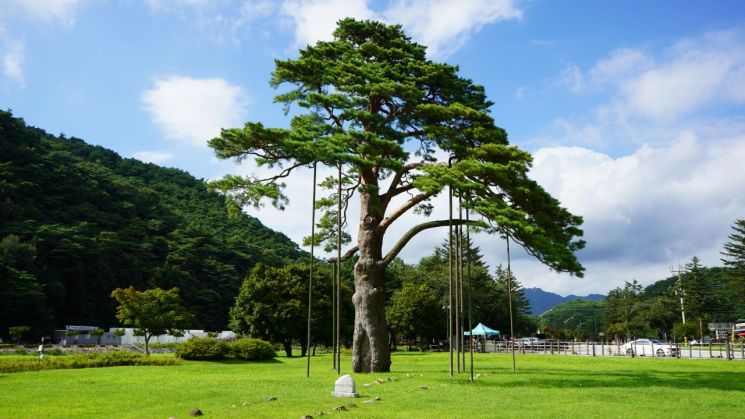 Jeongipumsong (Natural Monument No. 103) used for decoding the standard genome of Korean pine. Provided by the National Institute of Forest Science
The standard genome decoding targeted the Jangipumsong of Sogrisan, a representative pine tree in Korea. Jangipumsong holds great significance not only for its historical and cultural value spanning over 600 years but also for its genetic value in restoring successor trees.
The standard genome contains core information on the number, location, and function of genes related to life phenomena, and is utilized for disease prevention and early diagnosis.
The research results were recognized for their academic value and published online on the 20th in the genetics journal Nature Genetics (Impact Factor IF=31.7).
The published genome information is expected to be used for ▲ selecting breeding materials and developing technologies resistant to environmental stresses such as drought and heatwaves ▲ developing early diagnosis technologies for tree diseases and pests including pine wilt disease ▲ studying pine tree health recovery using environmental adaptability markers.
It will also be utilized for research on interactions between matsutake mushrooms and pine trees, and for constructing a “pine pan-genome map” that can secure genetic variations related to climate change and disease traits.
Park Eung-jun, head of the Forest Microbial Utilization Research Division at the National Institute of Forest Science, said, “The standard genome information of pine trees will be a new opportunity to establish management plans for domestic pine forests facing crises due to climate change and forest disasters.”
© The Asia Business Daily(www.asiae.co.kr). All rights reserved.
![Clutching a Stolen Dior Bag, Saying "I Hate Being Poor but Real"... The Grotesque Con of a "Human Knockoff" [Slate]](https://cwcontent.asiae.co.kr/asiaresize/183/2026021902243444107_1771435474.jpg)















