Hong Jun-pyo, Mayor of Daegu, and Lee Cheol-woo, Governor of Gyeongbuk, Sign
After Integration, Daegu City Hall and Gyeongbuk Andong and Pohang Offices to be Utilized
Daegu and Gyeongbuk have taken a step closer to unification as the 'Daegu-Gyeongbuk Special City,' a status equivalent to that of the capital Seoul. With the signing of an agreement by the city and provincial governments and the Ministry of the Interior and Safety, which includes the name of the integrated local government and plans for the use of government buildings, the administrative integration of Daegu and Gyeongbuk (TK) is now set to proceed with gathering opinions from the councils and proposing related legislation.
On the 21st at 2 p.m., Minister of the Interior and Safety Lee Sang-min, Chairman of the Local Era Committee Woo Dong-gi, Mayor of Daegu Hong Joon-pyo, and Governor of Gyeongbuk Lee Cheol-woo met at the Government Seoul Office and signed the 'Joint Agreement for the Integration of Daegu and Gyeongbuk.'
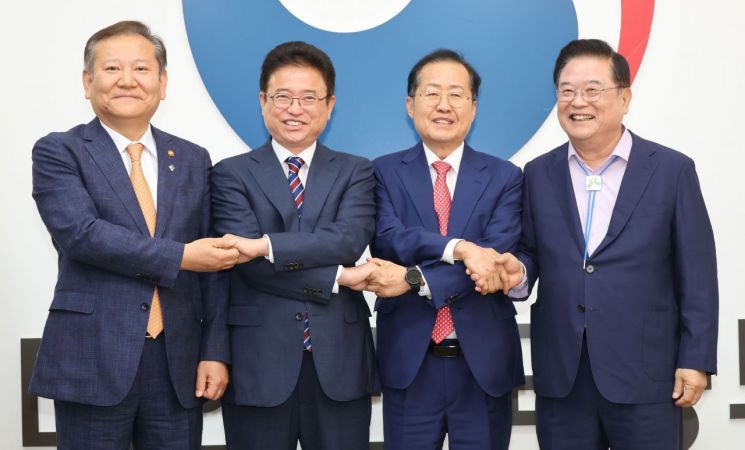
Previously, these four institutions had agreed on June 4 to officially promote TK integration, but conflicts arose over the location of government buildings and the authority of cities and counties. The Ministry of the Interior and Safety proposed a mediation plan this month, which accelerated the negotiations.
The joint agreement announced that day outlined the roles of the four institutions in promoting TK integration and included seven agreed-upon points between Daegu and Gyeongbuk. First, the name of the integrated local government was set as 'Daegu-Gyeongbuk Special City,' with a status equivalent to that of the capital Seoul Special City.
Regarding the controversial location of government buildings, it was agreed to utilize the current Daegu City Hall and the Gyeongbuk Andong and Pohang government buildings. However, functions will be distributed considering the regional characteristics of each building’s location, and no jurisdictional boundaries will be set based on the location of the government buildings. Initially, Daegu had proposed setting jurisdictional boundaries for each government building in the Special Act on Administrative Integration, but Gyeongbuk opposed this, arguing it was inconsistent with the basic direction of administrative integration to 'strengthen city and county autonomy.'
Next, even after integration into the Daegu-Gyeongbuk Special City, cities, counties, and autonomous districts will continue to perform their previous duties. To achieve the practical effects of integration, it was also specified that the Daegu-Gyeongbuk Special City must be granted comprehensive functions such as establishing comprehensive plans for economic and industrial development, balanced development, and metropolitan administration.
Additionally, the agreement included the Ministry of the Interior and Safety’s mediation proposals such as ▲the rank and number of vice mayors and fire chiefs with a status equivalent to that of the capital, ▲deciding the location of the council through a joint general meeting of both councils, and ▲principles for hearing opinions from city and provincial councils and efforts to gather residents’ opinions.
Based on the joint agreement announced that day, Daegu and Gyeongbuk plan to promptly prepare integration measures and submit them to the government. Subsequently, the government will form an inter-ministerial consultative body involving related ministries to prepare support measures for the Daegu-Gyeongbuk integration. The integrated Daegu-Gyeongbuk local government aims to launch in July 2026 following the enactment of a special law.
© The Asia Business Daily(www.asiae.co.kr). All rights reserved.

















