At Statistics Korea's Audit: "Failure to Create Growth Engines"
"Low Public Inflation Perception" Criticism
Commissioner Lee Hyung-il Responds: "Reflects Consumption Patterns"
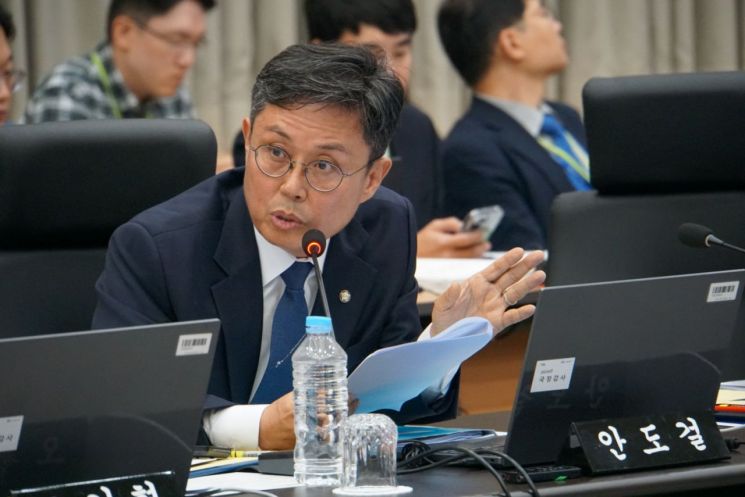 Democratic Party of Korea lawmaker Ando-geol is questioning Statistics Korea Commissioner Lee Hyung-il during the National Assembly inspection of Statistics Korea held at the Daejeon Government Complex on the morning of the 18th.
 [Photo by Ando-geol's office]
Concerns have been raised that South Korea's economy, after a surprise growth in the first quarter of this year, experienced a contraction in the second quarter, indicating a re-entry into an economic downturn phase.
On the 18th, Ahn Do-gul, a member of the Democratic Party of Korea representing Gwangju Dongnam-eul, stated at the National Assembly audit of Statistics Korea held at the Daejeon Government Complex, “Following a brief growth spurt due to export recovery and base effects in the first quarter, the economy re-entered a stagnation phase from the second quarter onward,” diagnosing that “this is due to exports failing to translate into domestic demand stimulation, resulting in a failure to create additional growth engines.”
Statistics Korea’s Business Cycle Clock for August this year points to an economic downturn phase, similar to the periods during the 2009 financial crisis and the 2020 COVID-19 crisis. Among the 10 components that make up the Business Cycle Clock, six indicators?retail sales, service industry production, construction performance, employment numbers, business conditions, and consumer expectations?showed a downward trend, while three indicators?export volume, manufacturing production index, and facility investment index?showed an upward trend. Imports were analyzed to have entered a recovery phase.
The National Assembly Budget Office also analyzed, based on the coincident index, that the sluggish domestic demand is spreading throughout the economy, causing a rapid economic downturn. The coincident index has been declining since the fourth quarter of last year and has plummeted for six consecutive months since March this year.
During the audit, the issue of the public’s perception of statistical indicators was also raised. Inflation is a key measure directly related to citizens’ daily lives and an important factor in macroeconomic policy decisions. However, concerns were raised about the reliability of inflation indicators because ‘owner-occupied housing costs,’ which have a significant impact on perception, are not included among the current 457 items.
When Representative Ahn pointed out through questioning that “the owner-occupied housing cost index should be reflected as a major indicator,” Lee Hyung-il, Commissioner of Statistics Korea, avoided a direct answer, saying, “We will consider it.”
Additionally, it was pointed out that recently relevant products and services such as delivery fees and electric kickboards are not being reflected in a timely manner. Although the delivery fee index recently showed a downward trend, there was a large gap between this and consumers’ actual perceptions. Furthermore, there were calls for revising indicators to reflect new consumption patterns, including coffee, laundry subscription services, and VR/AR devices.
Representative Ahn emphasized, “The revision cycle for inflation index items should be shortened from the current five years to two or three years to respond swiftly to changing consumption patterns.”
In response, Commissioner Lee Hyung-il of Statistics Korea replied, “We will revise the inflation index items every five years and adjust the inflation index weights every two to three years to reflect changes.”
© The Asia Business Daily(www.asiae.co.kr). All rights reserved.
![Clutching a Stolen Dior Bag, Saying "I Hate Being Poor but Real"... The Grotesque Con of a "Human Knockoff" [Slate]](https://cwcontent.asiae.co.kr/asiaresize/183/2026021902243444107_1771435474.jpg)















