"Hotels Concentrated in Myeongdong, Foreign Foot Traffic Surges"
Garosugil's Bustle Drops Sharply... Dispersed to Hannam and Seongsu Areas
The fortunes of major street commercial districts in Seoul are diverging. Since the COVID-19 endemic phase (transition of an infectious disease to an endemic), the number of foreign tourists visiting Korea has increased again, causing the vacancy rate in Myeongdong's commercial district to fall below 10%, while the Garosugil district's vacancy rate approached 40% as foot traffic dispersed to surrounding areas.
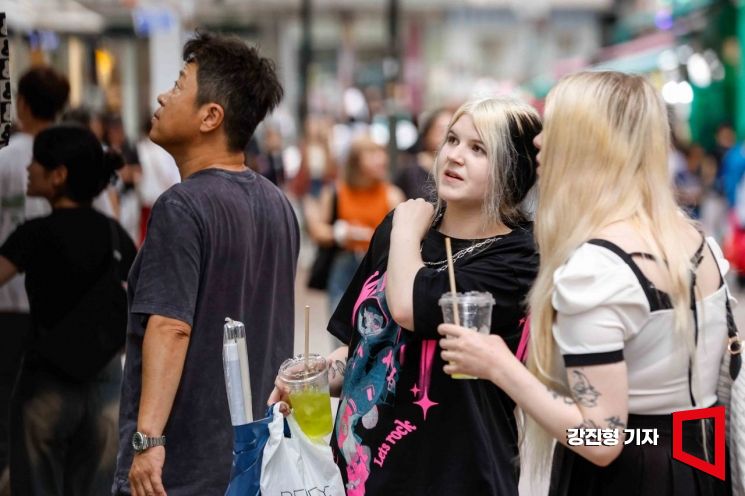
According to Cushman & Wakefield on the 18th, the average vacancy rate for the six major street commercial districts in Seoul in the second quarter of this year was 18.3%, down 0.4 percentage points from the same period last year. Among them, Myeongdong, the area most visited by foreign tourists, saw its vacancy rate drop from 14.5% to 6.8% within a year.
According to the Korea Tourism Organization, the number of foreign tourists visiting Korea last year was 11.03 million, an increase of 245% compared to the previous year. The number of foreigners visiting Myeongdong was about twice that of Hongdae and about ten times more than other commercial districts.
Accordingly, the number of newly opened stores was also highest in Myeongdong. Cushman & Wakefield stated, "Small vacant spaces that were recently empty, including those occupied by Lululemon and Musinsa Standard, have been filled with cosmetics and accessory stores, confirming the highest number of new stores." They added, "Interest in K-beauty seems to have driven this growth."
The vacancy rate in Myeongdong's commercial district is also low compared to major overseas commercial districts. In New York, USA, the vacancy rate was 14.0% as of the second quarter of this year, and in Hong Kong, it remained at 10.5%. Shanghai, China showed 9.3%, Singapore 6.7%, while Tokyo, Japan was significantly lower at 1.0%.
However, the situation was different in the Gangnam area. The vacancy rate in Garosugil increased from 36.5% to 39.4% during the same period. The Cheongdam district's vacancy rate also rose by 1.1 percentage points from 16.3% to 17.4% year-on-year. Cushman & Wakefield analyzed that the overall vitality of the commercial districts declined somewhat as foot traffic spread to Hannam, Seongsu, and Dosan Park. However, Cheongdam is expected to gradually recover as a preferred area for luxury brands.
A Cushman & Wakefield official said, "Unlike Gangnam, Myeongdong naturally attracts foreign foot traffic because major hotels are concentrated nearby," adding, "Foreign tourists were found to frequently visit flagship stores or pop-up stores of domestic fashion and beauty brands, as well as popular F&B outlets."
Additionally, the Gangnam commercial district showed a vacancy rate of 20.0% in the second quarter, and Hannam and Itaewon showed 11.5%. These represent increases of 0.8 percentage points and 1.7 percentage points respectively compared to the same period last year. The official said, "All six major commercial districts have recovered sales to pre-pandemic levels," but added, "As the trend shifts from group tourism to individual tourism, efforts to meet this demand will become increasingly important."
© The Asia Business Daily(www.asiae.co.kr). All rights reserved.
![Clutching a Stolen Dior Bag, Saying "I Hate Being Poor but Real"... The Grotesque Con of a "Human Knockoff" [Slate]](https://cwcontent.asiae.co.kr/asiaresize/183/2026021902243444107_1771435474.jpg)
















