US Defense Secretary "Destroyed Weapons Attacked Civilian Ships and Warships"
Interpreted as a Warning to Iran Ahead of Israeli Retaliation
The analysis suggests that the large-scale airstrike targeting Yemen's Iran-aligned Houthi rebels, involving the deployment of the U.S. military's strategic asset B-2 Spirit stealth strategic bomber (hereafter B-2 bomber), serves as a strong warning message to Iran.
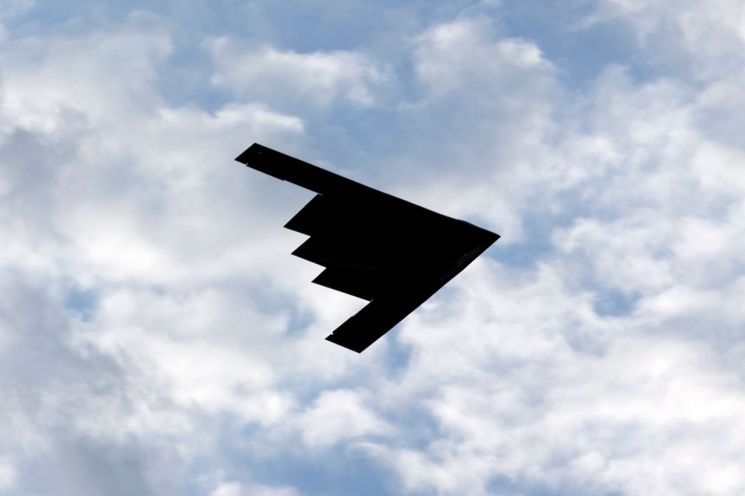 On July 4, 2020, at the Independence Day celebration held in Washington DC, a B-2 Stealth Bomber flew over the Washington Monument. The U.S. military and the Department of Defense announced that the United States carried out multiple attacks with B-2 bombers on weapons storage facilities in Yemen controlled by the Houthi rebels supported by Iran on October 16. [Image source=AFP Yonhap News]
On the 16th (local time), the U.S. Department of Defense issued a statement signed by Secretary of Defense Lloyd Austin, announcing that U.S. forces had precisely struck five underground weapons depots located in areas controlled by the Houthi rebels in Yemen.
Notably, multiple B-2 strategic bombers were used in this attack. Following Iran's airstrikes earlier this month, Israel had warned of retaliation. Through this operation, the U.S. aims to demonstrate overwhelming military power to deter Iran's counter-retaliation and break the "cycle of revenge," according to observers.
In the statement, Secretary Austin said, "I approved this strike under the direction of President Biden to further degrade the Houthis' ability to continue destabilizing behavior and to protect U.S. forces and personnel in one of the world's most important waterways."
The B-2 bomber is a representative strategic asset of the U.S. military. It is considered the only aircraft capable of carrying the ultra-powerful bunker buster GBU-57, with a maximum speed of Mach 0.95 and a weapons payload capacity of 18 tons. The GBU-57 is an aerial bunker-buster bomb capable of destroying facilities up to 60 meters underground, and it is evaluated to have the power to target nuclear facilities that Iran has constructed deep underground.
According to the Israeli daily Times of Israel, while the U.S. military has responded to Houthi provocations in the Red Sea following the Gaza Strip war, there has been no reported precedent of deploying B-2 bombers.
Experts interpret the deployment of B-2 bombers capable of dropping the GBU-57 in this operation as an intention aimed at Iran.
Although the U.S. Department of Defense did not directly mention Iran, it openly issued strong statements that could intimidate Iran if heard.
Secretary Austin stated in the release, "No matter how deeply buried and fortified as a fortress, the U.S. has uniquely demonstrated the capability to strike facilities that adversaries try to shield from attack."
He emphasized, "The deployment of the U.S. Air Force's B-2 Spirit long-range stealth bomber proves America's global strike capability to take action anytime, anywhere against such targets when necessary."
The U.S. New York Times (NYT) reported, "The U.S. Air Force possesses 19 B-2 bombers, all stationed at Whiteman Air Force Base in Missouri, and they are dispatched to other regions for training."
Therefore, the bombers used in the Yemen strike likely flew from Missouri, refueled mid-air, and returned, or took off from bases much closer to the target.
The U.S. deployed the THAAD (Terminal High Altitude Area Defense) missile defense system along with about 100 U.S. troops to strengthen Israel's defense system against Iranian airstrikes.
This is interpreted as a warning that the U.S. could directly intervene in the conflict at any time if U.S. forces suffer casualties due to Iranian retaliation.
In this context, the strategic bomber airstrike against the Houthi rebels is analyzed as another U.S. deterrence measure to prevent Iran's counterattack level from exceeding the "threshold" in the event of Israeli retaliation.
The NYT noted, "Although Secretary Austin did not mention Iran, the use of the B-2 bomber?the only aircraft capable of attacking nuclear facilities buried deep in Iran?against the Houthis is notable amid the tense situation between Israel and Iran, which risks escalating into full-scale war."
The Times of Israel also interpreted this attack as "an indirect warning from the U.S. to Iran, the main backer of the Houthis."
© The Asia Business Daily(www.asiae.co.kr). All rights reserved.

















