Increase in Population Due to Rising Average Temperatures
Unexpected Mosquitoes Disrupt Sleep at Night
Likely to Continue Until the End of October
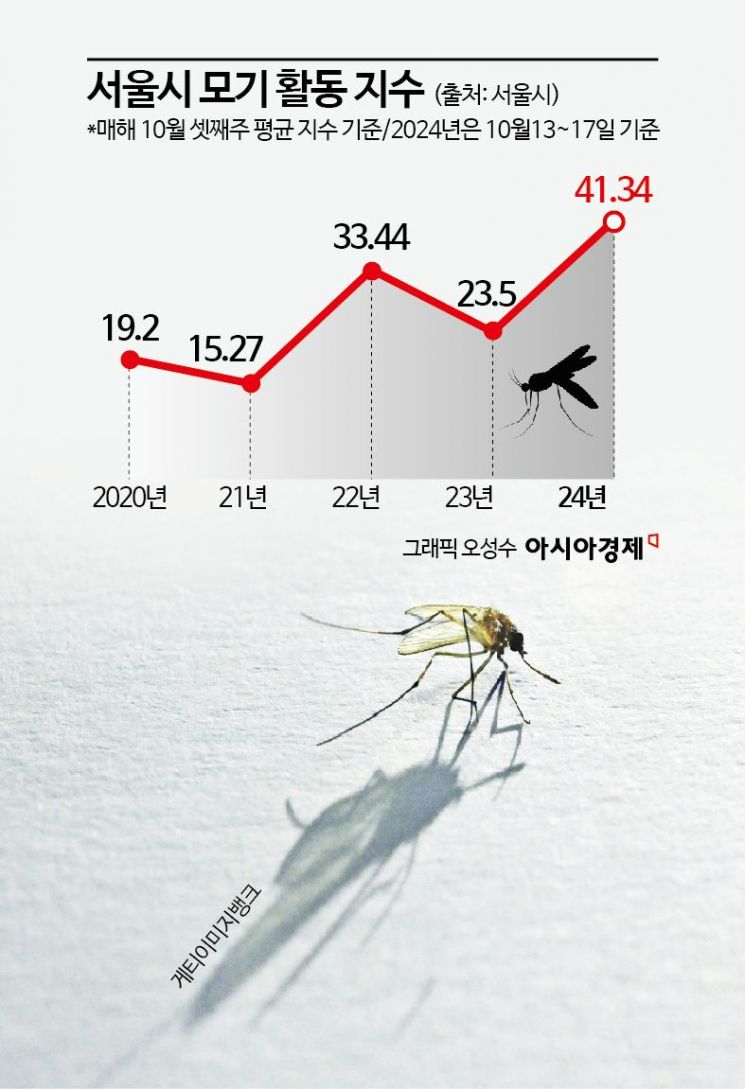
Recently, autumn mosquitoes have been rampant, and the mosquito activity index has been found to be more than twice as high as it was five years ago. It is analyzed that the number of mosquitoes has increased due to abnormal climate, with heatwaves in summer and rising average temperatures in early autumn.

According to the Seoul mosquito forecast on the 18th, the average mosquito activity index for the third week of October was recorded as 19.2 in 2020, 15.27 in 2021, 33.44 in 2022, 23.5 in 2023, and 41.34 in 2024, based on data from October 13 to 17. This year’s mosquito activity index has more than doubled compared to 2020. The mosquito forecast is divided into four stages: Level 1 ‘Comfortable (below 25)’, Level 2 ‘Attention (below 50)’, Level 3 ‘Caution (below 75)’, and Level 4 ‘Unpleasant (75 and above)’.
Mosquitoes are cold-blooded animals whose body temperature changes according to the external temperature, so their activity sharply decreases when the temperature drops below 13 degrees Celsius. However, this year’s heatwave continued until September, and the minimum temperature in October also exceeded 13 degrees, allowing mosquito activity to persist. Cities have a ‘heat island effect’ due to many buildings, resulting in higher temperatures than rural areas, which is more favorable for mosquito activity.
Citizens are losing sleep at night due to unexpected mosquitoes. Lee (28), a resident of Eunpyeong-gu, Seoul, said, “I have woken up more than once recently,” and complained, “After enduring it, I turned on the light and caught mosquitoes, and there were three in my room.” Kim Seoyeon (27), a resident of Guro-gu, Seoul, also said, “I think I have been bitten more recently at home than in summer,” adding, “I suffer every night and am eagerly waiting for the weather to get colder.”
Local governments are actively working to control mosquitoes. Gwangjin-gu, Seoul, installed three digital mosquito sensors (DMS) at the beginning of this year using full district funds. Jung-gu, Seoul, conducted a ‘visiting mosquito larva control project.’
An official from the Korea Disease Control and Prevention Agency explained, “Mosquito occurrence is greatly influenced by weather factors, so when temperatures remain high, the period of mosquito appearance is extended,” and added, “Mosquito activity is expected to decrease around the end of October.”
© The Asia Business Daily(www.asiae.co.kr). All rights reserved.


















