Proposal for Establishment and Amendment of Institutions Related to Changwon Area National Assembly Members
Ministry of Economy and Finance Expresses Reluctance Due to Overlapping Functions with Other Agencies
As the government is consolidating national institutions related to the defense industry, there appears to be a mismatch with local governments attempting to establish additional related institutions.
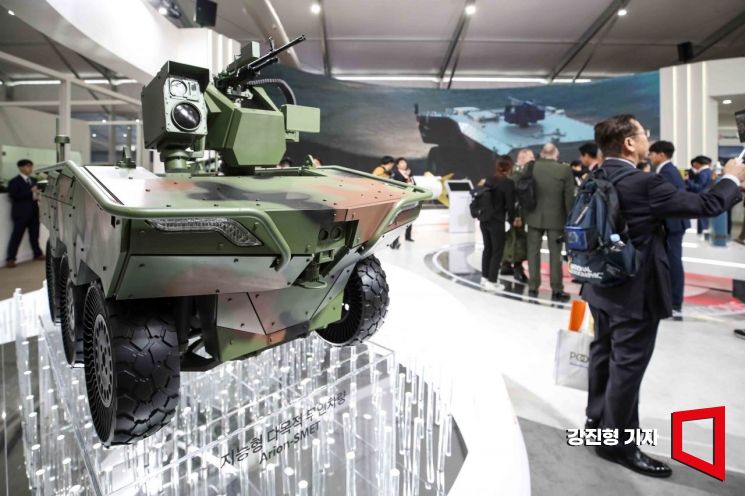 On the 2nd, a model of an unmanned vehicle by Hanwha Aerospace was exhibited at the 'Korea International Defense Industry Exhibition' held at Gyeryongdae, Chungnam. Photo by Jinhyung Kang aymsdream@
According to the National Assembly on the 17th, lawmakers representing Changwon City in Gyeongsangnam-do, where defense companies are concentrated, have consecutively proposed legislative amendments to establish defense-related institutions. There are about 100 defense companies in Gyeongnam, including system integrators, primary contractors, and general companies. Among the 27 nationally designated defense companies in the province, 59.2% (16 companies) are concentrated in Changwon.
Heo Seong-mu, a member of the National Assembly's Industry, Trade, Small and Medium Enterprises Committee from the Democratic Party of Korea, proposed an individual bill last month to enact the Defense Industry Promotion Agency Act. This is to establish the Defense Industry Promotion Agency (hereinafter referred to as the Promotion Agency). According to the bill, the Promotion Agency is to conduct research on defense industry policies and systems. The Defense Acquisition Program Administration (DAPA) is in a difficult position because these functions are already performed by the Defense Technology Promotion Research Institute under the Defense Technology Quality Institute. The Defense Technology Promotion Research Institute, consisting of about 190 personnel, has a Defense Industry Promotion Division responsible for fostering the defense industry and supporting exports.
The ruling party has also taken action. Kim Jong-yang, a member of the People Power Party representing Uichang District in Changwon City, proposed an amendment to the Defense Industry Development Act in June to establish the Defense Parts Research Institute. This amendment is identical to the one proposed by former lawmaker Kim Young-sun during the 21st National Assembly. At that time, the Ministry of Economy and Finance opposed it, citing inefficiency in financial management, and it did not pass the National Defense Committee. The Defense Parts Research Institute is expected to perform functions such as developing advanced parts independently and conducting policy research. The Ministry of Economy and Finance is again concerned about overlapping functions with the Defense Technology Promotion Research Institute and the Agency for Defense Development (ADD), making the passage of the amendment uncertain.
Industry insiders argue that institutions with overlapping defense-related functions should be significantly reduced. Recently, the Ministry of National Defense has also been promoting the consolidation of institutions with duplicated functions. This is because there are many institutions involved in developing or operationalizing weapons. The targets include the Defense Technology Promotion Research Institute under the Defense Technology Quality Institute, the Defense Rapid Acquisition Technology Research Institute under DAPA, and the Civil-Military Cooperation Promotion Institute under the ADD. These three institutions will be merged to establish the Defense Technology Innovation Institute.
DAPA also plans to establish regional offices, but the feasibility is low. DAPA intends to reorganize the one-stop support centers for defense companies located in Daejeon, Gumi, and Changwon into regional offices such as the Gyeongnam Regional Office. This would be similar to the formats of the Military Manpower Administration (11 offices), Ministry of Employment and Labor (6 offices), and Ministry of SMEs and Startups (13 offices). However, this year’s government organization management guidelines stipulate ‘minimizing the establishment of new regional offices through work system efficiency,’ making approval from the Ministry of the Interior and Safety and other ministries difficult.
© The Asia Business Daily(www.asiae.co.kr). All rights reserved.

















