Night Shift Changed to Two Shifts
Additional Production Cuts at Hyundai Steel Due to Scheduled Maintenance
"Production Cuts Will Continue"
The domestic rebar market is struggling to emerge from the recession tunnel. As the construction industry continues to slump, Hyundai Steel and Dongkuk Steel, the top two producers of rebar in the country, have decided to further reduce production to defend prices.
According to industry sources on the 18th, Dongkuk Steel plans to completely halt factory operations for two days this month. Since June, the company has been producing only at night, when electricity costs are cheaper, instead of during the day, in an effort to cut costs, but it has judged that even this is insufficient for cost reduction.
Recently, the work system was changed from three shifts to two shifts, eliminating one daytime shift, and if the two-day shutdown is implemented, production will drop to 53% relative to scale. A company official said, "The specific shutdown dates have not been decided yet," and added, "We will decide on additional production cuts next month as well."
Hyundai Steel is in a similar situation. Since February, Hyundai Steel has been conducting special maintenance for six months on the electric furnace at its Incheon plant, and the Dangjin steelworks will also undergo regular maintenance for three months from September to mid-December. Considering that regular maintenance usually lasts two to three weeks, this maintenance is interpreted as a production cut measure to control output.
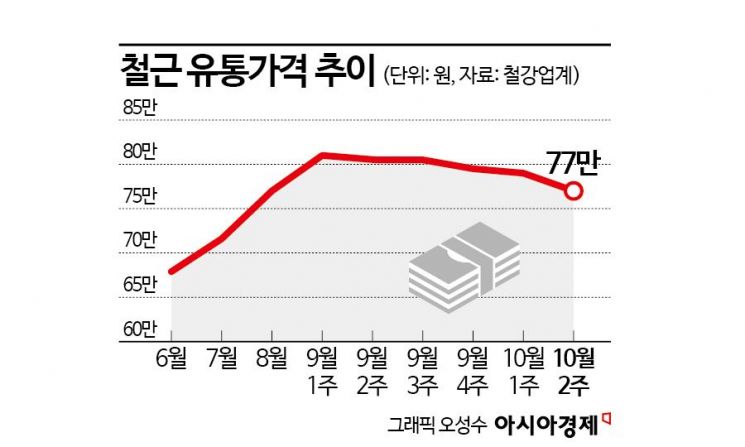
The reason for further reducing production is that rebar prices show little sign of rebounding. Typically, the third quarter is the peak season for construction, and rebar demand should increase significantly, but this year the slump continues. Due to production cuts in June, rebar prices rose from 679,000 KRW per ton in September to 810,000 KRW, but in October prices started to decline again, falling to 770,000 KRW per ton in the second week (11th). This is far below the profitability threshold of 900,000 KRW. To raise prices, production must be reduced.
Steel industry insiders expect these production cuts to continue for some time. An industry official said, "Steel-producing advanced countries like Japan have already been regularly reducing production by operating at night," adding, "Effectively controlling supply is the key to corporate competitiveness."
© The Asia Business Daily(www.asiae.co.kr). All rights reserved.
![Clutching a Stolen Dior Bag, Saying "I Hate Being Poor but Real"... The Grotesque Con of a "Human Knockoff" [Slate]](https://cwcontent.asiae.co.kr/asiaresize/183/2026021902243444107_1771435474.jpg)















