"Includes Factors Hindering Normal Operation"
"Will Lower the Quality of Medical Education"
The Korea Institute of Medical Education and Evaluation (KIMEE), which assesses and certifies the quality of medical education, has urged the withdrawal of the Ministry of Education's proposed amendment to the "Regulations on the Evaluation and Certification of Higher Education Institutions," stating that it will degrade the quality of medical education.
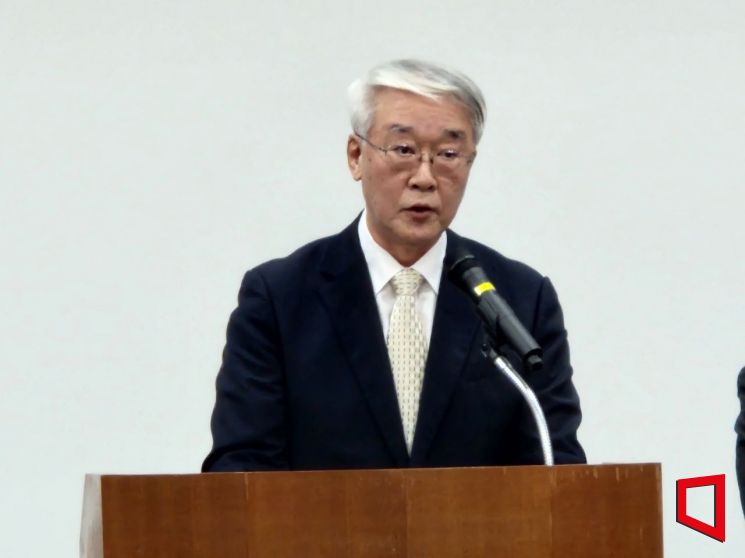 Anduk Seon, President of the Korea Institute of Medical Education and Evaluation, is speaking at a press conference announcing the institute's position on the "Amendment to the Regulations on Evaluation and Accreditation of Higher Education Institutions" held on the 16th at the Cancer Research Institute of Seoul National University Hospital in Jongno-gu, Seoul. Photo by Taewon Choi peaceful1@
On the 16th, KIMEE held a press conference at the Cancer Research Institute of Seoul National University Hospital in Jongno-gu, Seoul, to announce its position on the proposed amendment to the "Regulations on the Evaluation and Certification of Higher Education Institutions." Andukseon, President of KIMEE, said, "The recently proposed amendment by the Ministry of Education contains many elements that hinder the normal operation of the medical school evaluation and certification project, which has been recognized as a core mechanism for ensuring the quality of medical education in Korea." He added, "This will deepen confusion in the medical education field and negatively affect the improvement of medical education standards and the quality assurance of the medical workforce produced."
He continued, "For any attempt to gain legitimacy, there must be no problems in training and producing doctors that society desires when actually implemented," and added, "KIMEE urges the Ministry of Education to establish and implement policies that respect the value of medical education and the importance of training doctors."
He also emphasized that the independence and autonomy of the evaluation agency must be preserved. He said, "To conduct proper evaluations, evaluation criteria and procedures must be autonomously established, and evaluations must be conducted independently, free from interference by stakeholders. Only the evaluation results obtained through this process can gain public trust." He added, "This is a core value required and emphasized not only in Korea but also internationally for the existence of evaluation agencies."
He further stated, "Any attempts by some to steer evaluation results favorably are wrong efforts that go against the 'healthiness' our society has achieved," and emphasized, "KIMEE clearly states that any measures that undermine the independence and autonomy of the evaluation agency must be immediately stopped."
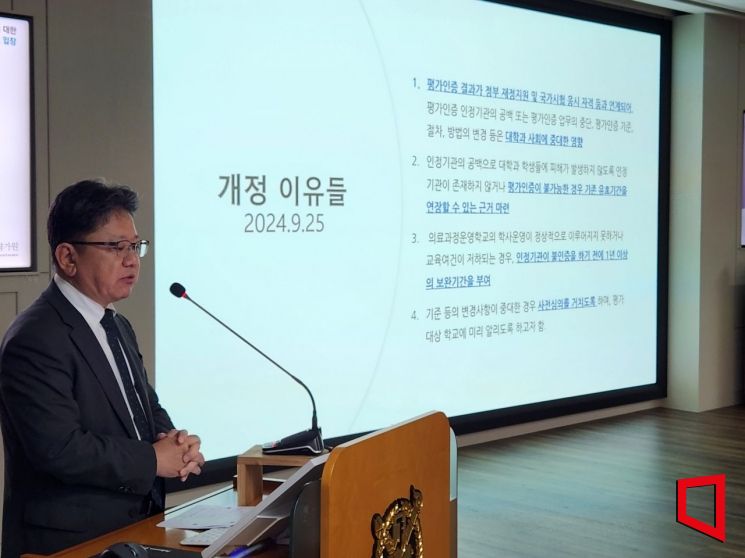 Yang Eun-bae, Vice President of the Korea Institute of Medical Education and Evaluation, is speaking at a press conference announcing the institute's position on the "Amendment to the Regulations on Evaluation and Accreditation of Higher Education Institutions" held on the 16th at the Cancer Research Institute of Seoul National University Hospital in Jongno-gu, Seoul.
 Photo by Choi Tae-won peaceful1@
The problems of the proposed amendment to the "Regulations on the Evaluation and Certification of Higher Education Institutions" were also pointed out. Eungbae Yang, Senior Vice President of KIMEE, first identified four issues with the government's amendment: ▲ establishing grounds for extending the validity period of existing evaluations and certifications in case of a gap in recognition agencies ▲ introducing special provisions for the evaluation and certification of schools operating medical programs ▲ clarifying grounds for prior notification and prior review regarding changes in evaluation and certification criteria and gaps in evaluation and certification work ▲ and introducing mandatory prior notice regulations when changing evaluation and certification criteria, procedures, and methods.
Regarding the first issue, he explained, "The validity period of certification can be effectively extended indefinitely, which cannot guarantee the quality of medical school education. This is an evasion of the government's responsibility and undermines the evaluation and certification system that verifies the quality of education."
On the second issue, which grants a one-year remediation period instead of non-certification in disaster situations, he criticized, "Certification, non-certification, and granting remediation periods should be independently and autonomously decided through strict evaluation and judgment by the evaluation agency, considering the special characteristics of the evaluation target field. Forcibly granting remediation periods does not comply with the spirit of the Constitution and legal provisions."
Regarding the third issue, which requires prior review by the Ministry of Education when changing evaluation and certification criteria, procedures, and methods, he argued, "Existing laws stipulate that changes in evaluation and certification criteria must be reported afterward. This is because the Constitution and laws establish the responsibility to guarantee the autonomy and professionalism of education and the autonomy of universities."
On the fourth issue, which mandates prior notice, he said, "I agree with prior notice itself, but it should not be stipulated by law." He added, "This amendment, which forces a one-year prior notice when changing evaluation criteria or procedures, risks nullifying the major ongoing evaluations of expanded medical schools."
© The Asia Business Daily(www.asiae.co.kr). All rights reserved.
![Clutching a Stolen Dior Bag, Saying "I Hate Being Poor but Real"... The Grotesque Con of a "Human Knockoff" [Slate]](https://cwcontent.asiae.co.kr/asiaresize/183/2026021902243444107_1771435474.jpg)
















