Estimated Sales Next Year Below Expectations at About 44 to 52 Trillion
Significant Impact from US Pressure Blocking Exports to China
Despite Pledge to "Continue Services in China," Decline in Just 6 Months
Companies with High China Exposure Likely to Adjust Status
Foundries Using EUV Equipment Also Affected
Dutch semiconductor equipment company ASML is expected to face a 'performance shock' this year due to U.S. sanctions against China, drawing attention to how this will affect the global semiconductor market, including Korean companies.
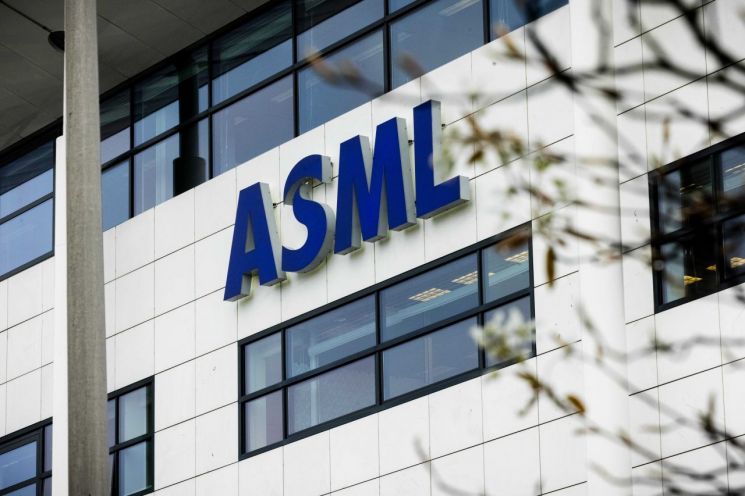
According to global securities markets and industry sources on the 16th, ASML estimated its sales for next year to be between 30 billion and 35 billion euros (approximately 44 trillion to 52 trillion KRW), significantly below the market expectation of 36.1 billion euros (about 53 trillion KRW). Its third-quarter booked sales also stood at 2.6 billion euros (about 3.8655 trillion KRW), far below the market forecast of 5.6 billion euros (about 8.3245 trillion KRW) compiled by market research firm LSEG. Due to the unexpectedly poor performance outlook, ASML's stock price fell by 16.26% that day.
On the same day, ASML experienced an incident where its third-quarter results were prematurely published on its official website before the earnings announcement. However, because the results were much weaker than expected, the incident did not attract much attention. The shock felt by the industry appears significant. Semiconductor-related stocks also fell in tandem, reflecting the widespread concern in the semiconductor market caused by ASML's poor performance. Nvidia dropped 4.69%, TSMC fell 2.64%, Broadcom declined 3.47%, and AMD also dropped 5.22%.
Experts analyze that ASML's poor performance outlook is largely due to U.S. influence aiming to control ASML equipment exports to China through the Dutch government. The U.S. is imposing sanctions within its domestic market and pressuring global companies to reduce China's influence in the semiconductor supply chain and prevent China from developing semiconductors. ASML has been required not to sell equipment or provide maintenance services to China. China is reported to be a key customer, accounting for 49% of ASML's semiconductor equipment sales, using more ASML equipment than South Korea, which accounts for 19%. Regarding this, during the Q1 earnings conference call last April, ASML CEO Peter Wennink stated, "There is no reason not to provide maintenance services for sold equipment," indicating a refusal to comply with U.S. pressure. However, six months later, ASML's performance has plummeted, creating an uneasy atmosphere around the company. ASML CFO Roger Dassen also acknowledged the difficult situation, stating that "(future) sales to China will sharply drop to the 20% range."
With ASML's poor performance potentially changing the global semiconductor market dynamics, attention is focused on how this will impact Korean companies. Semiconductor companies with significant export shares to China are likely to take ASML as a cautionary example, reviewing their product situations and actively working to reduce their China-related shares. ASML's extreme ultraviolet (EUV) lithography equipment is also in the spotlight. This equipment uses extreme ultraviolet light to etch circuits onto wafers, and ASML is the only company in the world capable of manufacturing it. Since this equipment is essential for foundry processes below 7 nanometers (nm), it is analyzed that it will affect TSMC (Taiwan) and Samsung Electronics, which compete in the foundry market, in some way. If exports to China are blocked, there is also a strong possibility that ASML will negotiate to increase transaction volumes with companies like Samsung Electronics.
© The Asia Business Daily(www.asiae.co.kr). All rights reserved.
![Clutching a Stolen Dior Bag, Saying "I Hate Being Poor but Real"... The Grotesque Con of a "Human Knockoff" [Slate]](https://cwcontent.asiae.co.kr/asiaresize/183/2026021902243444107_1771435474.jpg)















