Foreign Media: "Multiple Breaches in Israeli Airspace During Iran's One-Day Airstrikes"
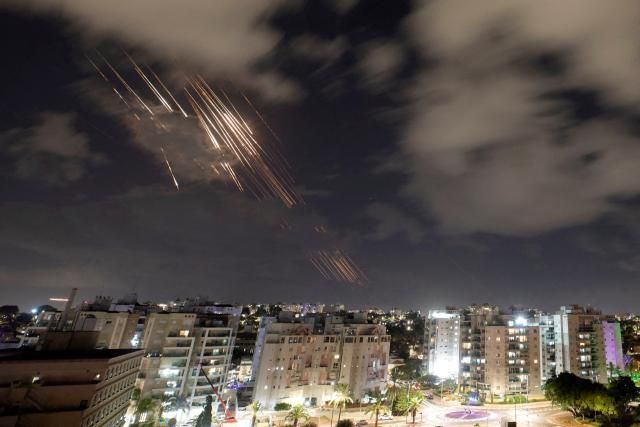
As Israel engages in multifaceted conflicts with Iran and its proxy forces known as the "Axis of Resistance," it is reported that its air defense interceptor missiles are running low. Israel relies partly on the United States for interceptor missiles, but there are concerns that the U.S. stockpile will eventually reach its limit. If interceptor missiles become scarce, analysts suggest that the Israeli military situation in the Middle East, which had been dominant since the Palestinian militant group Hamas's airstrike last October, could change.
According to foreign media reports on the 15th (local time), when Iran launched more than 180 ballistic missiles at Israel on the 1st, gaps were visible across Israeli airspace. The reports explained, "(During Iran's second retaliatory airstrike) about 30 Iranian missiles struck the Nevatim Airbase in Israel, and one missile fell just 700 meters from the headquarters of Mossad, Israel's intelligence agency." Compared to Israel's claim of achieving a 99% interception rate during Iran's first airstrike in April, the defense against this second Iranian airstrike is considered to have been less successful.
Meanwhile, on the 14th, the Lebanese militant group Hezbollah attacked an Israeli military base with drones, resulting in the deaths of four Israeli soldiers. Foreign media reported, "Despite Hezbollah having been attacked for weeks on its weapon depots by Israel, it demonstrated that it can still strike at least 60 km inside Israeli territory."
Israel's air defense network, composed of three overlapping layers?Iron Dome, Arrow, and David's Sling?has been regarded as the world's strongest defense system. Iron Dome serves as a low-altitude air defense system used to intercept rockets and drones heading toward the country. The Arrow, jointly developed with the United States, is designed to intercept stratospheric ballistic missiles, while David's Sling is known as a medium-to-long-range air defense system for intercepting bombers. However, recent Iranian and Hezbollah airstrikes have breached Israeli airspace, revealing vulnerabilities in the air defense network.
The problem is that Iran and Hezbollah still possess a significant number of missiles. Dana Stroul, a former U.S. Department of Defense official, stated, "If Iran responds to Israeli attacks and Hezbollah joins in, Israel's air defense capabilities will be insufficient." Asaf Orion, a former Israeli brigadier general, said, "We have not yet seen Hezbollah's full capabilities," adding, "They are currently using only about one-tenth of the rocket-launching capacity estimated before the war."
Israel sources some of its air defense systems domestically, but inventory remains insufficient. Boaz Levy, CEO of Israel Aerospace Industries (IAI), the state-owned company supplying interceptor missiles, said, "We are operating three shifts to maintain the production line, with some lines running 24/7," adding, "It is no secret that we need to replenish our stock."
The United States, Israel's staunch military ally, announced on the 13th that it would deploy the THAAD (Terminal High Altitude Area Defense) missile defense system to Israel and send 100 U.S. troops. Regarding this, former U.S. Department of Defense official Stroul expressed concern, saying, "Considering that the U.S. missile stockpile is not infinite and that it is also supporting Ukraine, which is at war with Russia, there could come a point when limits are reached."
Ehud Eilam, a former researcher at the Israeli Ministry of Defense, pointed out, "The depletion of Israeli interceptor missiles is a matter of time," and emphasized, "We need to reconsider deployment methods and priorities."
© The Asia Business Daily(www.asiae.co.kr). All rights reserved.
![Clutching a Stolen Dior Bag, Saying "I Hate Being Poor but Real"... The Grotesque Con of a "Human Knockoff" [Slate]](https://cwcontent.asiae.co.kr/asiaresize/183/2026021902243444107_1771435474.jpg)















