The U.S. administration under Joe Biden has notified the Israeli government that if the humanitarian situation in the Gaza Strip does not improve within the next 30 days, U.S. weapons support could be suspended. This is considered the strongest warning issued by the U.S. since the outbreak of the Gaza Strip war in October last year.
According to the U.S. State Department on the 15th (local time), Secretary of State Antony Blinken and Secretary of Defense Lloyd Austin, in a joint letter, informed Israel that if the current humanitarian crisis in the Palestinian Gaza Strip continues, it could potentially violate U.S. laws regulating overseas military assistance. The four-page letter, dated the 13th, was delivered to Israeli Defense Minister Yoav Gallant and Strategic Affairs Minister Ron Dermer.
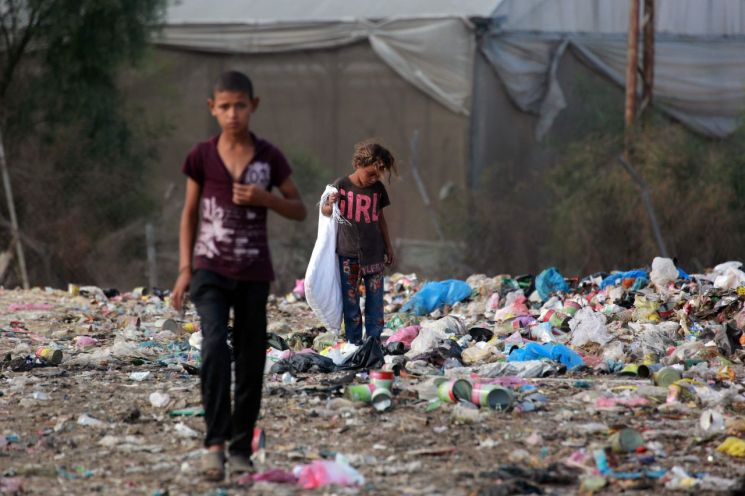
The letter expressed concern over the sharp decline in international humanitarian aid reaching the Gaza Strip due to Israel's blockade operations, resulting in hunger and widespread suffering. Blinken and Austin referenced Israel's March promise not to block humanitarian aid to Gaza and emphasized that the U.S. must "continuously assess" whether this commitment is being upheld under U.S. law and National Security Memorandum 20 (NSM-20). They warned that based on this assessment, concrete measures such as suspending weapons support to Israel could follow.
State Department spokesperson Matthew Miller confirmed at a press briefing that "what we have observed over the past few months is that humanitarian aid has not been sustained," adding, "The Israeli government has an obligation to provide (humanitarian) aid." According to the State Department, aid shipments such as relief supplies to Gaza have decreased by more than 50% since the first half of this year. In September, aid reached its lowest level since the outbreak of the Gaza war in October last year.
In the letter, Blinken and Austin stated, "We are particularly concerned that recent Israeli government actions are contributing to the rapid deterioration of the situation in Gaza," urging, "Israel must take a series of concrete steps within 30 days as promised to us." Specifically, they mentioned allowing at least 350 relief trucks into Gaza, opening additional humanitarian corridors, and canceling evacuation orders in areas where operations are unnecessary.
Notably, the letter was made public amid the Biden administration's efforts to persuade Israeli Prime Minister Benjamin Netanyahu to restrain excessive military provocations in the Middle East ahead of the U.S. presidential election in November. Axios, which released a copy of the letter before the State Department briefing, noted, "Israel, fighting on multiple fronts, heavily depends on U.S. military support," and described the letter as "the most comprehensive list of demands the U.S. has made to Israel since the outbreak of the Gaza war." The Wall Street Journal (WSJ) also reported, "The letter implicitly acknowledges that Israel's actions in Gaza violate U.S. law," calling the mention of reducing arms sales "the strongest threat from the U.S. since the Gaza war began last year."
However, spokesperson Miller added that the letter is a private diplomatic communication and not a decision made out of concern for its impact on the November U.S. election. John Kirby, National Security Council (NSC) Coordinator for Strategic Communications at the White House, also explained that the letter was not written as a "threat" but "simply to repeatedly convey the urgency and seriousness we feel, emphasizing the need to dramatically increase humanitarian aid."
Currently, in the U.S., there is growing resentment toward the Biden administration's support for Israel, especially among Arab and Muslim Americans who tend to lean Democratic. The Arab American Political Action Committee (AAPAC), which supported Biden in the 2020 election, has announced it will not endorse any candidate in this election.
As Israel expands its frontlines to Hamas in Gaza and Hezbollah in Lebanon, concerns about a full-scale war in the Middle East persist. Israeli Prime Minister Netanyahu, who has promised strong retaliation for recent missile attacks by Iran, reportedly conveyed during a call with President Biden on the 9th that Israel would not strike Iran's nuclear or oil facilities. According to a Washington Post (WP) report the previous day, U.S. officials explained that Israel's retaliation would be calibrated to avoid perceptions of political interference in the U.S. election. NBC News also cited three Biden administration officials saying Israel's retaliation would be limited to military targets.
The New York Times (NYT) noted, "These concessions could reduce the immediate possibility of full-scale war between the two adversaries (Israel and Iran)," but added, "Even if Israel does not attack Iran's nuclear or oil facilities, the possibility of strikes on military installations remains. If Israel's retaliation escalates, it could lead to a vicious cycle of retaliatory attacks by Iran." Netanyahu's office stated in a press release that day, "We listen to the opinions of the U.S., but the final decision will be made based on our national interests."
© The Asia Business Daily(www.asiae.co.kr). All rights reserved.
![Clutching a Stolen Dior Bag, Saying "I Hate Being Poor but Real"... The Grotesque Con of a "Human Knockoff" [Slate]](https://cwcontent.asiae.co.kr/asiaresize/183/2026021902243444107_1771435474.jpg)















