Tumor on the Crown of the Head of a Breakdancer with 20 Years of Experience
A journal has reported that a tumor can develop on the crown of the head due to a breakdancing (breaking) move called the so-called 'headspin,' where the dancer spins while balancing on their head on the floor.
On the 15th, Yonhap News cited The Washington Post (WP) and reported on the research results of Danish neurosurgeons Mikkel Bundgaard Skotting and Christian Bastrup Sønderg?rd.
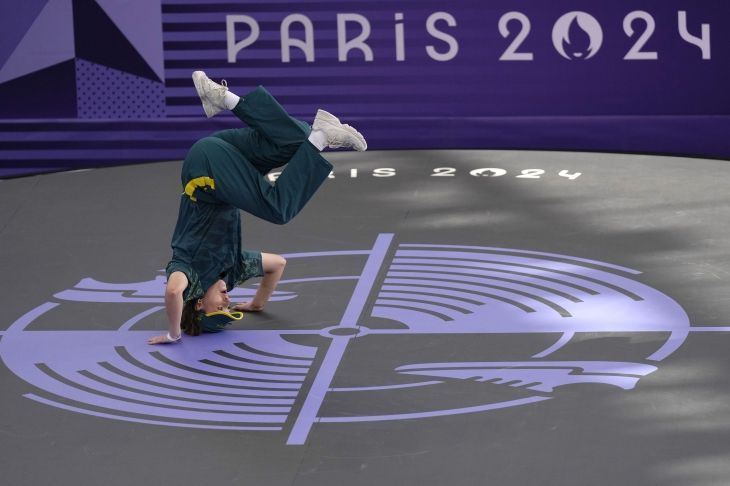 Reagan, the Australian breaking dance representative, is performing at the preliminary round of a competition held on August 9th (local time) at Place de la Concorde in Paris, France. (This is not directly related to the article.)
 [Photo by Yonhap News]
They recently published a case of a male patient in his 30s who developed a tumor on his head due to the breakdancing move called the 'head spin' in the medical journal BMJ. The head spin is a move where the dancer balances on their head on the floor and spins their body.
The patient mentioned in the study had been performing head spins for about 20 years. The doctors revealed that a tumor measuring 1 inch (2.54 cm) thick had developed on the top of his head due to this move. Previously,
about five years ago, he experienced hair loss on his scalp and noticed the scalp becoming soft along with a small lump. However, he continued breakdancing and only recently sought medical attention when the lump grew larger and the scalp became even softer.
A lump was palpable between the scalp and the skull, and MRI examination revealed a tumor on the scalp. The tumor was surgically removed, and as a result, the patient developed a cone-shaped lump on the top of his head.
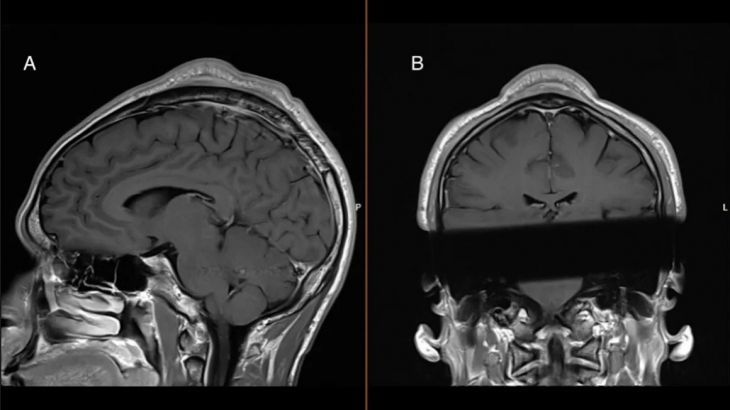 A lump on the crown of the head of a dancer who has been practicing breakdancing (breaking) for about 20 years.
 [Photo by Medical Journal BMJ/Yonhap News]
The dancer, who had not been able to go out without wearing a hat to cover the lump, said, "I am really happy to be able to go out without a hat," and added, "Many people do not notice the lump, and they say my head looks completely normal."
The research team emphasized, "This case highlights the importance of recognizing the chronic scalp condition of breakdancers and suggests that surgical intervention can be an effective treatment."
At the same time, they stated, "This study does not oppose the headspin move," and reiterated, "It emphasizes the importance of understanding the chronic scalp condition of breakdancers and suggests that surgical intervention can be an effective treatment."
According to a study published in 2009, among 106 breakdancers surveyed, 60.4% reported scalp injuries caused by headspins, and 23.6% reported painless lumps on their heads.
Meanwhile, breakdancing originated in the early 1970s in New York, USA, as a type of hip-hop dance. It was introduced as an Olympic event for the first time at this year's Paris Olympics. At the Olympics, breaking is conducted as a 1:1 individual competition on an 8m x 8m square floor, where dancers compete by taking turns performing moves for 60 seconds to music randomly played by a DJ. Nine judges score the dancers in five categories: technique, expression, originality, execution, and musicality.
© The Asia Business Daily(www.asiae.co.kr). All rights reserved.
![Clutching a Stolen Dior Bag, Saying "I Hate Being Poor but Real"... The Grotesque Con of a "Human Knockoff" [Slate]](https://cwcontent.asiae.co.kr/asiaresize/183/2026021902243444107_1771435474.jpg)
















