'Starship' Test Launch a Great Success... Positive Signal for US Moon Exploration Plan
Overwhelming Recycling Technology Reduces Economic Burden
NASA Also Likely to Expand Usage
Gap Widens Between US and Allies vs. China and Russia
South Korea Expected to Expand Cooperation with US Artemis Plan While Pursuing Independent Moon Exploration
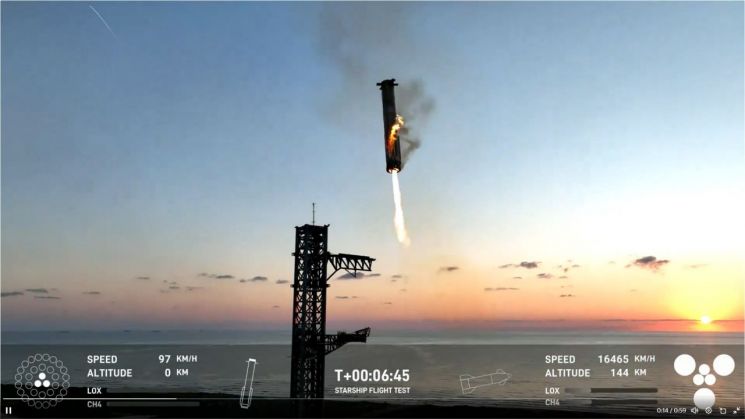 The first-stage booster of SpaceX's Starship rocket, 'Super Heavy,' is returning to the launch site and performing a retropropulsion landing. Super Heavy was successfully caught mid-air by the large chopstick-shaped 'Mechazilla' and safely recovered.
 [Image source=EPA Yonhap News]
A gigantic rocket the size of a multi-story building that was falling from the sky returned to the launch pad like a gentle lamb. This is the story of SpaceX's 'Super Heavy' rocket, a space company operated by Tesla's CEO.
Through the success of Super Heavy, Elon Musk's long-held dream of relocating humanity to Mars has taken a step closer to reality. Musk, who challenged what was once considered impossible with electric cars and autonomous taxis, has now crushed the hopes of his pursuers with overwhelming technology in space as well.
Musk's success is not limited to a single company's achievement. The frustration of countries competing with the U.S., such as China and Russia, has grown, while the cooperative will of allied countries like South Korea, which collaborates with the U.S., has been stimulated.
On the 13th (local time), SpaceX successfully completed the 5th test launch of the most powerful rocket ever built by humans, the 'Starship.' The Starship, as tall as a multi-story building, launched in the early morning, separated in the sky, with the first-stage booster 'Super Heavy' returning to the launch site, and the Starship completing its planned flight, entering Earth's orbit normally, and landing at the Indian Ocean landing site.
Just a few days ago, when Tesla's robot taxi unveiling fell short of expectations, raising doubts about whether Musk's magic was ending, the situation took a dramatic turn.
Facing criticism from Wall Street investors, Musk was delighted. After the successful launch, Musk stated on X (formerly Twitter), "Starship landed exactly at the target point. This success achieved both goals."
This achievement is meaningful as the realization of a dream through technology. Musk has been running toward the dream of relocating to Mars. He founded SpaceX in 2002. After selling PayPal to eBay, Musk embarked on a new startup to conquer Mars.
The highlight of this test launch was the landing of Super Heavy. As Super Heavy descended at a speed of 1 km/s, it slowed down through retro-thrust and was caught by the launch pad's claw called 'Mechazilla.' SpaceX employees cheered, and viewers were amazed.
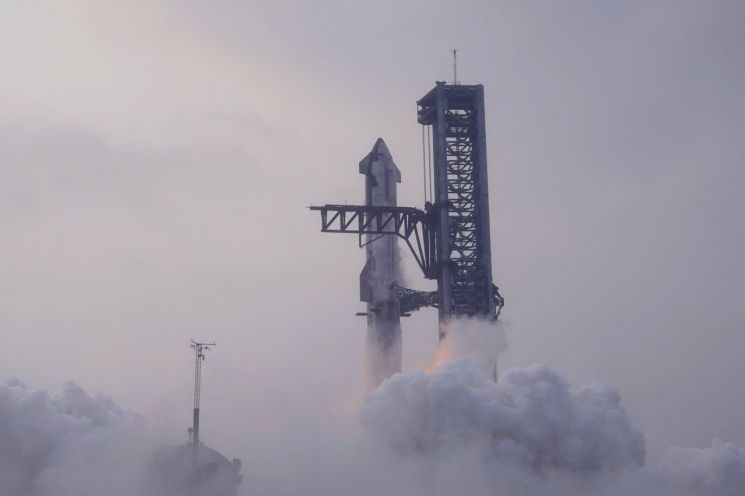 SpaceX's 'Starship' is preparing for its 5th test launch on the 13th in Boca Chica, Texas, USA. [Image source=AP Yonhap News]
SpaceX succeeded in reusing Super Heavy on the first attempt. The 71-meter-tall Super Heavy launched and, about seven minutes later, returned precisely to the launch pad and was secured in midair by a mechanical arm called 'Mechazilla.' The sight of a structure larger than the Statue of Liberty returning to the launch pad and naturally finding its place on the first try was enough to be called a new advancement in space technology.
In terms of scale, Super Heavy is on a different level from the existing Falcon 9 rocket. Super Heavy uses 33 Raptor engines. Even a single Raptor engine boasts superior performance compared to the Merlin engines used in Falcon 9. The fact that it has become reusable forms the foundation for dramatically reducing the cost of venturing beyond Earth to the Moon or Mars.
Musk stated on X, "Great progress has been made in enabling life to live on multiple planets." He reiterated that his goal is the relocation to Mars.
 After the successful return of Super Heavy, Elon Musk stated on his X that "significant progress has been made in enabling life to live on multiple planets," referring back to an interview from several years ago.
Professor An Jaemyung of KAIST said, "Although many processes remain to be overcome to reach Mars, what has been done so far is a groundbreaking milestone in the space field." He added, "As a member of the space community, it is astonishing that such a tremendous event has occurred."
This success is not only Musk's personal achievement but also a national-level accomplishment for the United States. The likelihood of success for the Artemis program, the U.S.'s international lunar exploration plan, has also increased. Starship is scheduled to be used as the lunar lander for the Artemis 3 mission, a manned lunar exploration planned by NASA in September 2026.
The U.S. plans to use NASA's SLS launch vehicle for the Artemis program and Starship for lunar landing. Industry experts predict that, given the soaring costs of the SLS launch vehicle, the U.S. government may strategically utilize Starship for the entire Artemis program. Since reusable launch vehicles from private companies have lower launch costs, there is no reason to use expensive disposable launch vehicles.
A NASA official also mentioned, "SpaceX's technological advancements will be a key to achieving our goals in lunar exploration."
Donald Trump's potential election as U.S. president is also a variable. Trump may actively support Musk's rockets, as Musk has expressed support for Trump and made unusual appearances at his rallies. If the rockets are also cost-effective, there is no problem with the U.S. choosing Musk's Starship. An industry insider predicted, "Since the U.S. has developed technology through competition, there is a good chance they will change their stance."
Internationally, the success of this launch is expected to leave a significant aftershock. In a situation where international competition for lunar exploration, especially with China, is highlighted, the U.S. and its allies have established a foothold to advance further. The competition between countries that can travel to the Moon and Mars with reusable launch vehicles and those that cannot starts from different starting points.
Park Jaesung, head of the Space Transportation Division at the Korea Aerospace Research Institute, said, "Cooperation with the U.S. Artemis program will become even more important in the future," and predicted active discussions on cooperative projects. This signals that South Korea will actively pursue cooperative projects with the U.S. separately from its independent lunar exploration plans.
Yoon Youngbin, director of the Korea Aerospace Research Institute, currently attending the International Astronautical Congress (IAC) in Milan, Italy, is known to be engaging in active negotiations for cooperation with the U.S. on the Artemis project.
© The Asia Business Daily(www.asiae.co.kr). All rights reserved.
![Clutching a Stolen Dior Bag, Saying "I Hate Being Poor but Real"... The Grotesque Con of a "Human Knockoff" [Slate]](https://cwcontent.asiae.co.kr/asiaresize/183/2026021902243444107_1771435474.jpg)

















