On Parents' Day and Birthdays, Give Handwritten Letters and Books as Gifts
Recommend 'I Do Not Say Goodbye' as an Introductory Read
Novelist Han Kang (54) became the first Asian woman to receive the Nobel Prize in Literature, drawing attention to the books she recommended to her father, writer Han Seung-won (85).
According to Yonhap News on the 12th, Han Seung-won opened his studio, Haesantogul, located in Jangheung, Jeollanam-do, and revealed the books and handwritten letters his daughter Han Kang has sent every year. Han Seung-won stated that Han Kang gifts him books along with handwritten letters asking about his well-being on Parents' Day, birthdays, and holidays each year.
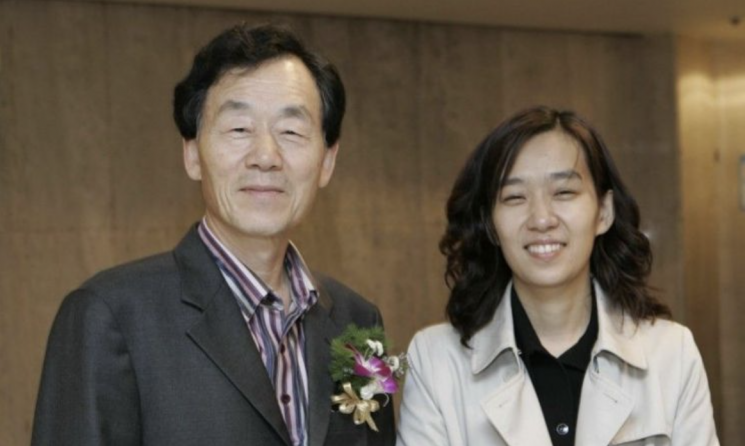 At the Yi Sang Literary Award ceremony held in November 2005 at the Seoul Press Center, organized by Munhak Sasangsa, award-winning author Han Kang stands together with her father, author Han Seung-won. [Image source=Yonhap News]
Looking at Han Kang's handwritten letters revealed by Han Seung-won, there were brief messages such as "Dear Father, happy birthday. Please stay healthy. I picked two books that you might enjoy reading," and "Father, are you keeping well in mind and body? I'm sending you two books I recently read and really liked." Along with these, Han Kang sent books to Han Seung-won.
Among the books recommended by Han Kang, Han Seung-won said the most enjoyable one he read was Robin Wall Kimmerer's Gathering Moss. Gathering Moss is a work by the author, an Indigenous descendant and female ecologist, and is a nature essay that delicately portrays the life of moss with poetic sensitivity. Han Seung-won said, "It was interesting to read because it literarily captures the story of moss and grass well," adding, "Perhaps because she resembles me, her father, my daughter also has a special affection for nature."
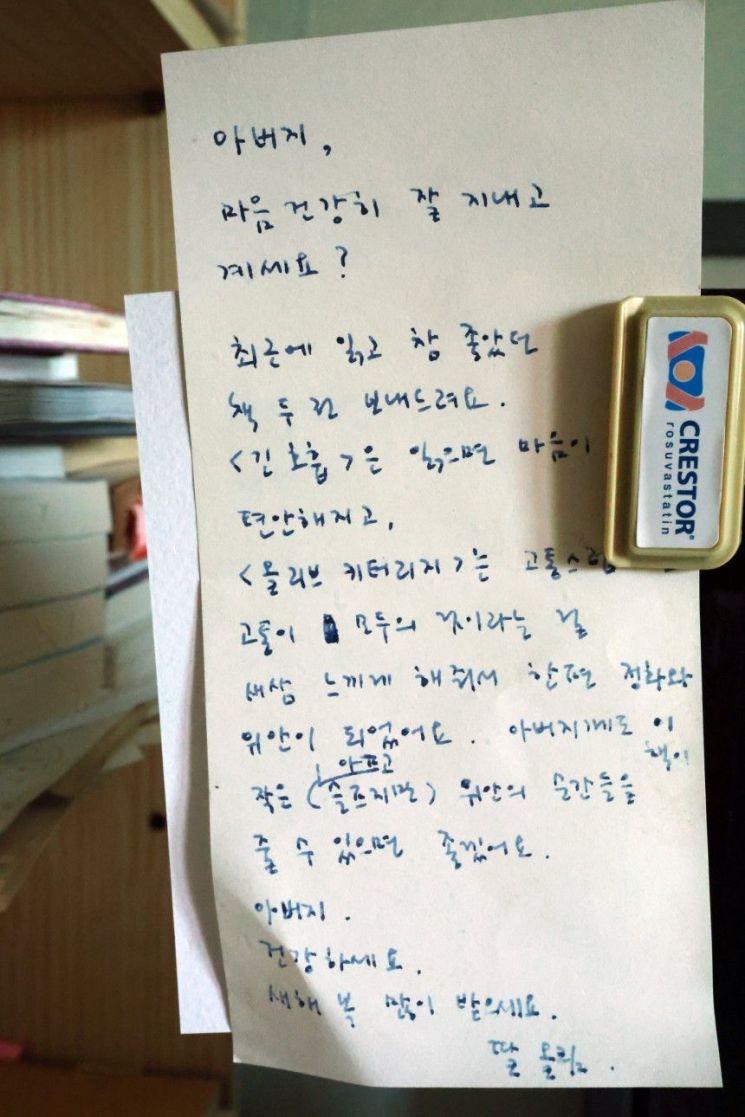 On the morning of the 11th, a handwritten letter from Nobel laureate novelist Han Kang to her father, writer Han Seung-won, was placed in the studio of Haesan Cave (Han Seung-won Literature Museum) in Anyang-myeon, Jangheung-gun, Jeollanam-do.
 [Image source=Yonhap News]
Earlier this year, Han Kang sent her father Mary Oliver's Long Life, which finely describes the beauty of nature, along with a letter saying, "Reading this book brings peace to the heart." She also enclosed Elizabeth Strout's Olive Kitteridge, writing, "It made me realize anew that pain is universal, which was both cleansing and comforting," and added, "I hope this book can give you small moments of (painful and sad but) consolation as well."
Han Seung-won said, "It feels like just a few years ago my young daughter was following me in reading books, but now I am deeply immersed in the joy of reading books she has chosen," proudly adding, "It seems to be the greatest love that a novelist father and daughter can share."
Han Seung-won debuted in 1968 and has published novels such as Aje Aje Bara Aje, Choui, Mom of the Evening Primrose, short story collections like Saeteomal People, and poetry collections including Diary of Passion and The House That Draws the Moon. He has received awards such as the Yi Sang Literary Award, the Hyundai Literary Award, and the Kim Dong-ri Literary Award. The father and daughter are also notable for being the first to win the Yi Sang Literary Award across two generations.
Meanwhile, Han Kang, who became the first Korean writer to win the Nobel Prize in Literature on the 10th, was asked, "If you were to suggest a book to someone who just learned about you, which book would you recommend first?" She answered, "I think every writer likes their most recent work. Therefore, I hope my most recent work, Human Acts, can be the starting point. This book is directly connected to some human actions."
Human Acts is a book that unfolds the tragedy of the Jeju 4.3 Incident through the perspectives of three women. After the publication of Human Acts in 2021, Han Kang also appeared on the official YouTube channel of the publisher Munhakdongne and revealed that she cried while listening to the song "How Can I Love the Heartbreak, You're the One I Love" by the Korean sibling duo AKMU.
© The Asia Business Daily(www.asiae.co.kr). All rights reserved.
![Clutching a Stolen Dior Bag, Saying "I Hate Being Poor but Real"... The Grotesque Con of a "Human Knockoff" [Slate]](https://cwcontent.asiae.co.kr/asiaresize/183/2026021902243444107_1771435474.jpg)

















