The Brightest Comet Appearing This Year
The brightest comet appearing this year, ‘C/2023 A3 (Tuzinshan-Atlas comet)’, will pass its perihelion, the closest point to Earth, around midnight on the 12th. Yonhap News reported on the 11th, citing the Korea Astronomy and Space Science Institute, that this comet can be observed in the western sky after sunset from the 12th through October.
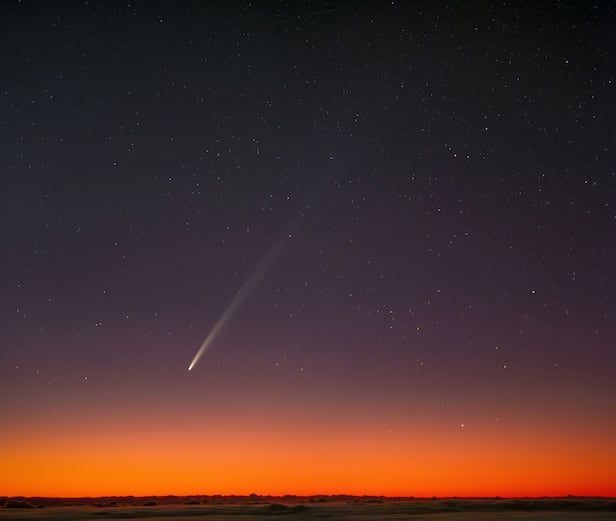 Captured on the 4th at the Gemini Observatory in Hawaii. [Photo by Yeongbeom Jeon, Principal Researcher / Yonhap News]
Tuzinshan-Atlas was first discovered in January last year at the Tuzinshan Observatory in China and was subsequently confirmed and named by the Asteroid Terrestrial-impact Last Alert System (ATLAS) at the Sutherland Observatory in South Africa. Tuzinshan-Atlas is predicted to have an orbital period of 80,000 years. It approached as close as 58 million km from the Sun on the 27th of last month, then changed direction to pass near Earth this month.
On the 12th, when it is expected to be the brightest, the comet’s altitude will be about 5 degrees near the horizon at 6:30 PM. As October progresses, the comet’s altitude will gradually increase, but its brightness will diminish.
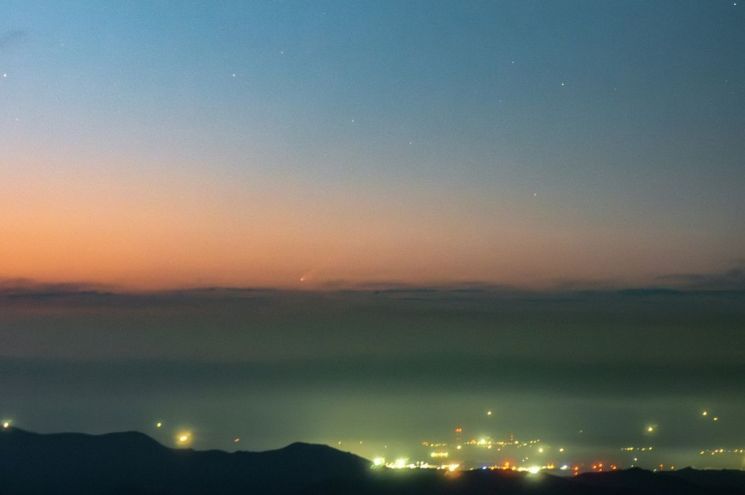 The image of Comet C/2023 A3 (Tsuchinshan-ATLAS) taken at Bohyunsan Optical Astronomy Observatory on the 26th of last month, before it reached perihelion. [Photo by Youngbeom Jeon, Principal Researcher]
The Korea Astronomy and Space Science Institute released photos of the Tuzinshan-Atlas comet taken by OWL-Net (Optical Wide-field patroL Network), a space object electronic optical surveillance system. The images show the comet’s characteristic bright coma and tail.
The institute also stated that around October 12, when Tuzinshan-Atlas is closest to Earth, the distance will be approximately 70 million km, indicating a safe trajectory relative to Earth. Youngbeom Jeon, chief researcher at Bohyunsan Optical Astronomy Observatory of the Korea Astronomy and Space Science Institute, told Yonhap News, "After perihelion, the comet can be observed for about 1 to 2 hours after sunset in the western sky. Although the International Astronomical Union’s Minor Planet Center predicts its brightness to be dimmer than magnitude 2, it is brightening as it orbits the Sun, so it should be visible to the naked eye."
© The Asia Business Daily(www.asiae.co.kr). All rights reserved.
![Clutching a Stolen Dior Bag, Saying "I Hate Being Poor but Real"... The Grotesque Con of a "Human Knockoff" [Slate]](https://cwcontent.asiae.co.kr/asiaresize/183/2026021902243444107_1771435474.jpg)
















