Self-Taught Due to Lack of Korean Literary Translators in the UK
Retaining Original Korean Terms in Translation Draws Attention
Han Kang Also Expresses Trust in Smith’s Translations
"It is difficult to win international literary awards because the Korean language and Hangul are hard to translate."
This was a common refrain whenever a Korean novelist failed to win the Nobel Prize in Literature or the Man Booker Prize. Sometimes, this sentiment was also used to criticize Korean literature or novelists. However, Han Kang’s selection as the winner of the International Booker Prize in the UK in 2016 for her novel The Vegetarian disproved this notion. Following the critical acclaim, not only Han Kang and her book The Vegetarian but also Deborah Smith, a young British translator in her twenties, began to attract significant attention in the literary world.
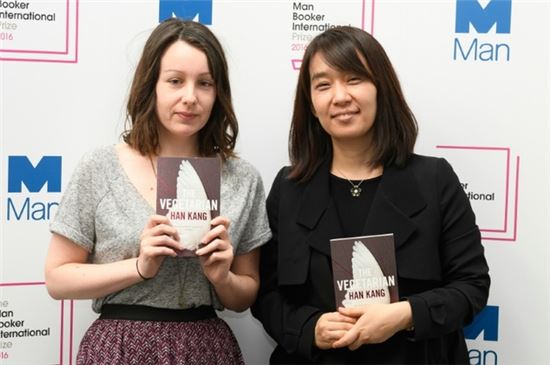 Deborah Smith (left), who translated the novel The Vegetarian, and author Han Kang (right).
 [Photo by Asia Economy DB]
On October 10, 2024, foreign media outlets such as the BBC revisited Deborah Smith while reporting on Han Kang’s Nobel Prize in Literature win. Deborah Smith, originally from the small town of Doncaster in central England, graduated from the University of Cambridge with a degree in English literature in 2009. After deciding to become a translator, she discovered that there were no professional translators specializing in Korean in the UK, so she began teaching herself Korean.
Once she made the decision to become a full-time Korean translator, Smith completed a PhD program in Korean literature at SOAS, University of London. In 2014, she was a young translator of just 26 years old. Deborah Smith initially began translating Korean works without any prior knowledge of Korea or Korean literature. Her reasoning was, "Among the countries whose books I have never read, Korea seemed to be a relatively affluent, developed country, so I assumed its literary scene would be active."
Deborah Smith said it was only in her second year of the PhD program that she was able to read Korean novels, albeit with difficulty. Her career as a professional translator took off at the 2014 London Book Fair. Korea was designated as the guest of honor at the event, and organizers urgently searched for Korean literature translators active in the UK. Coincidentally, she had previously sent a sample translation of The Vegetarian to a local publisher, which led to its publication.
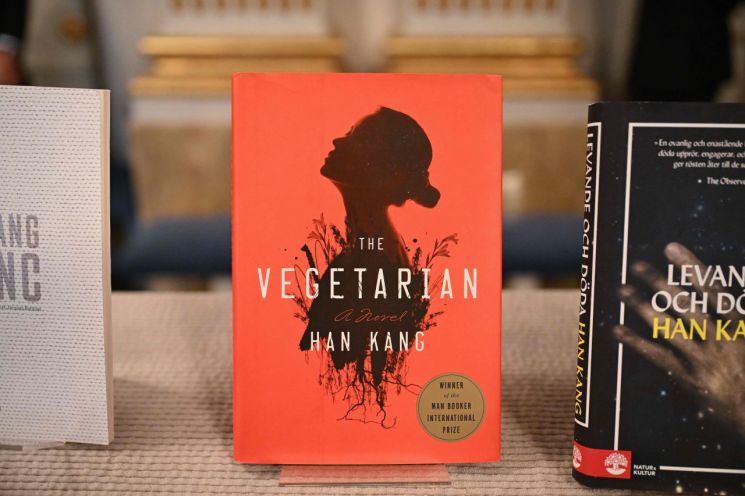 The Vegetarian, translated into English, ultimately won the Man Booker Prize. At the time, The New York Times introduced the English version of The Vegetarian and wrote, "It is a story about an ordinary housewife who becomes a vegetarian after having a nightmare, with the housewife's self-sacrifice becoming increasingly harsh and unrealistic." It also praised the translation, stating, "The elegant translation transformed the sharp and vivid Korean original into English, preserving Han Kang's keen exploration of whether true innocence is possible in a cruel world."
 [Photo by AFP · Yonhap News]
The Vegetarian, translated into English, ultimately won the Man Booker Prize. At the time, The New York Times introduced the English version of The Vegetarian, writing, "It is a story about an ordinary-looking housewife who becomes a vegetarian after having a nightmare, with the housewife's self-sacrifice becoming increasingly harsh and unrealistic." The review also praised the translation, stating, "The refined translation transformed the sharp and vivid Korean original into English, preserving Han Kang's keen exploration of whether true innocence is possible in a cruel world."
Han Kang also expressed her trust in Smith’s translation. At a press conference in Korea held shortly after winning the Man Booker Prize in 2016, Han Kang was asked about the translation and replied, "I believe it is important to capture the tone and voice in a novel," adding, "Deborah’s translation is one that places the highest value on tone." She continued, "I felt that she translated the feeling of the italicized nightmare monologues just as I intended, capturing my emotions and the tone exactly. I truly felt a sense of connection and developed great trust in her."
Smith also drew attention for her approach of retaining uniquely Korean words in her translations, rather than paraphrasing them. She opposes using terms like "Korean vodka" for soju or "Korean manga" for manhwa, which frame them as derivatives of other cultures. This approach is evident throughout her translations. In her translation of Han Kang’s Human Acts, she kept words like "hyeong" and "eonni" in their original form.
Currently, in addition to The Vegetarian, Smith has translated other works by Han Kang such as The White Book, as well as Bae Suah’s A Greater Music and North Station, and Hwang Jungeun’s One Hundred Shadows. She has also founded the nonprofit publishing house Tilted Axis Press, which promotes not only Korean literature but also Asian literature to readers around the world.
© The Asia Business Daily(www.asiae.co.kr). All rights reserved.
![Clutching a Stolen Dior Bag, Saying "I Hate Being Poor but Real"... The Grotesque Con of a "Human Knockoff" [Slate]](https://cwcontent.asiae.co.kr/asiaresize/183/2026021902243444107_1771435474.jpg)















