Novelist Han Kang, First Korean Nobel Literature Laureate
"Upset Betting Site Predictions," "Achievement for K-Literature"
Japanese Media Also Spotlight "First Asian Woman"
This year, Korean writer Han Kang was selected as the Nobel Prize in Literature laureate, prompting various reactions from foreign media. In particular, European press described the result as "an unexpected outcome" while praising the literary quality of Han Kang's novels. The French daily Le Figaro reported the news as the main headline on its homepage on the afternoon of the 10th (local time) after the Swedish Academy announced the winner, stating that "it overturned the predictions of online betting sites."
 On the afternoon of the 10th, citizens at the Seoul Station waiting room watched news related to novelist Han Kang becoming the first Korean writer to win the Nobel Prize in Literature.
 [Image source=Yonhap News]
Le Figaro expressed surprise, saying, "Han Kang's name was nowhere to be seen among the leading candidates such as Australian writers Gerald Murnane and Alexis Wright, Romanian Mircea C?rt?rescu, Kenyan Ng?g? wa Thiong'o, American Thomas Pynchon, and French Michel Houellebecq." The daily Lib?ration shared that a literary editor from a Swedish daily predicted, "This year's laureate selection will surprise cultural elites," and reported, "While others bet on Chinese writer Chan Ho-kei and Japanese author Haruki Murakami, the winner was Korea's Han Kang."
Le Figaro noted that Han Kang gained international literary recognition with her Man Booker Prize-winning novel The Vegetarian, and last year received the M?dicis Foreign Literature Prize for the French edition of Human Acts. At that time, Le Figaro's culture section highlighted the work, stating, "One thing is certain: this book is unforgettable once read." Le Monde evaluated, "Han Kang has devoted herself not only to writing but also to art and music, which is reflected throughout her literary works."
The British daily The Guardian also gave significant coverage to Han Kang's award, introducing her as someone who "has explored themes such as patriarchy, violence, sorrow, and humanity through novels and essays." It particularly mentioned The Vegetarian's receipt of the UK's most prestigious Booker Prize, noting, "Although the translation was criticized at the time, it helped secure readers worldwide." Additionally, it reported that Han Kang's work Human Acts will be published in English next year under the title We Do Not Part.
Russian literary critic Nataliya Romikina told Forbes Russia, "The characteristic of Han Kang's prose is that she writes about very horrific events metaphorically and very poetically," and added, "It is interesting that the Nobel Committee awarded the Nobel Prize in Literature to a Korean writer for the first time, choosing first a woman and second a poet, thereby emphasizing a new literary trend of poetic prose." Han Kang's The Vegetarian has previously been published in Russian by the publisher AST.
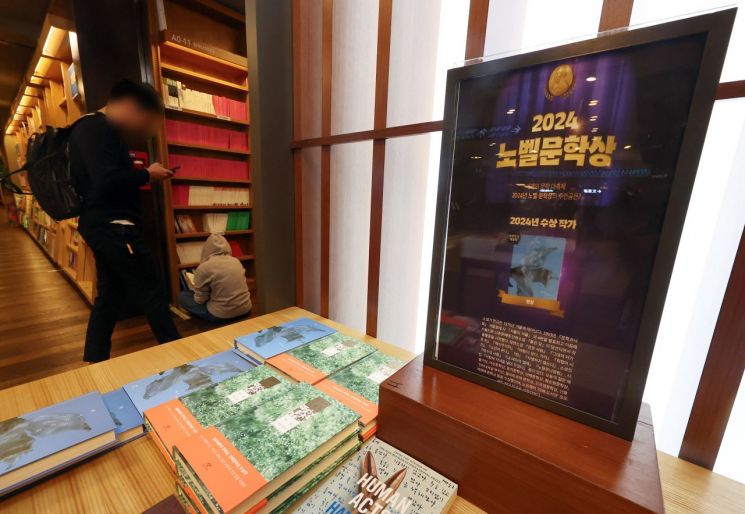 On the afternoon of the 10th, when novelist Han Kang became the first Korean writer to win the Nobel Prize in Literature, Han Kang's books were displayed at Kyobo Bookstore Gwanghwamun Branch in Jongno-gu, Seoul.
 [Image source=Yonhap News]
American media also focused on the fact that the laureate was a Korean writer. The New York Times (NYT) reported, "This year, prominent candidates included Chinese writer Chan Ho-kei," and described Han Kang's win as "a surprising event."
The Associated Press (AP) listed previous Korean cultural achievements such as director Bong Joon-ho winning the Academy Award for Best Picture with the film Parasite, the success of the Netflix drama Squid Game, and the global fame of K-pop groups BTS and Blackpink, analyzing that "Han Kang's Nobel Prize in Literature reflects the growing global influence of Korean culture."
Japan also gave considerable attention to this award. The Asahi Shimbun used the term "extra edition" at the moment the winner was announced, stating, "This is the first time a Korean has received the Nobel Prize in Literature, and also the first for an Asian woman." Kyodo News evaluated, "Since the 2010s, Korean literature with social awareness has been highly regarded worldwide and gained popularity in Japan as 'K Literature.' Among them, Han Kang led in universality and literary quality."
The Swedish Academy announced Han Kang as the laureate on the day, stating, "Han Kang's works confront historical trauma and expose the fragility of human life through powerful poetic prose." It added, "Han Kang challenges historical trauma and invisible rules in her works, revealing the vulnerability of human life in each piece. She possesses a unique perception of the connection between body and soul, the living and the dead, and has become an innovator of contemporary prose with her poetic and experimental style."
© The Asia Business Daily(www.asiae.co.kr). All rights reserved.
![Clutching a Stolen Dior Bag, Saying "I Hate Being Poor but Real"... The Grotesque Con of a "Human Knockoff" [Slate]](https://cwcontent.asiae.co.kr/asiaresize/183/2026021902243444107_1771435474.jpg)
















